Flying South With A Broad-Winged Hawk
Imagine a migrating Broad-Winged Hawk, crossing Pennsylvania from northeast to southwest. Along the way, steep climbs, dramatic drops, and ridgelines with spinning wind turbines mark its route.
Born in a large, unbroken tract of mixed forest, high in a nest of sticks, the bird emerged from one of four eggs incubated for a month, mostly by its mother. Its parents were together for several seasons; for broad-wings, fidelity is a choice.
The hawk’s father, smaller than his mate, spent much of his time hunting to feed her, flying from perch to perch in the forest until he would dive down, dispatch his prey, and take it back to the nest.
For almost six weeks, the parents fed the hawk chick, called an eyas, and its initially helpless siblings, defending them from diurnal raiders such as crows and bigger hunters, including owls and even bears. When small, they would have made a tasty meal for a hungry predator. Everyone is someone else’s dinner, after all.
Broad-wings’ tastes run from frogs, toads, and rodents to reptiles, juvenile birds, and invertebrates such as crickets and beetles.
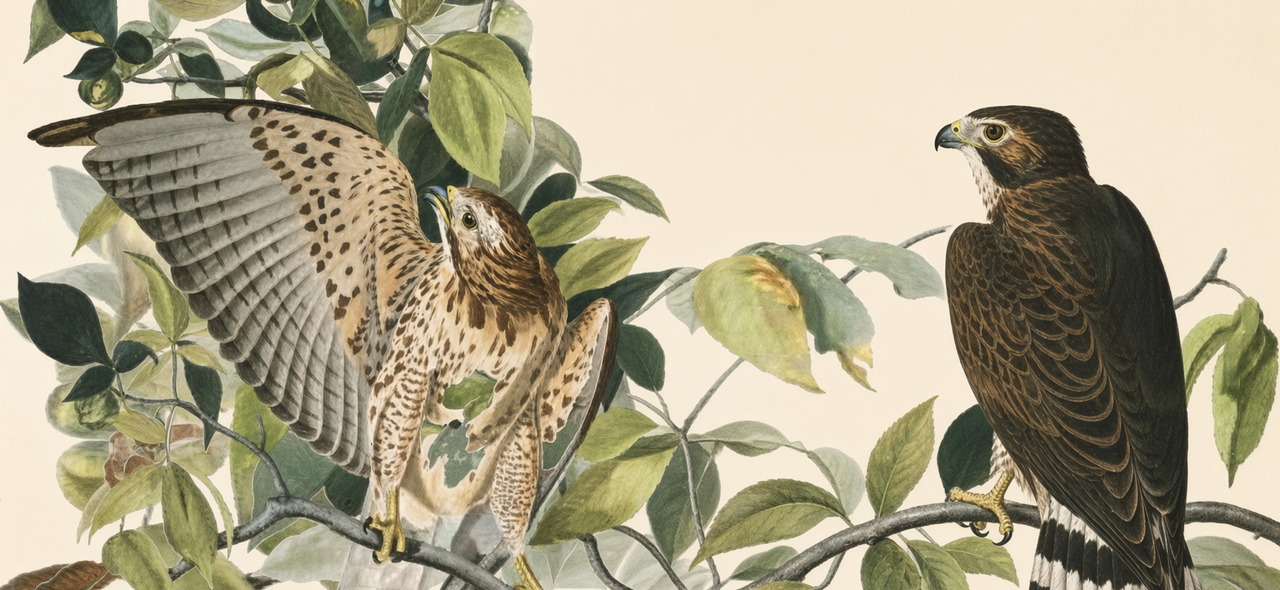
Brown from above, feathers quickly fill in along the hawk’s wings and body. Its white breast and belly are splotched with brown. Rectrices, its tail feathers, are faintly marked in juveniles but molt into what is diagnostic in adults: a tail of bold bands, alternating light and dark.
The bird’s onyx beak is sharp, decurved, and built for tearing. Scaly, yellow legs end in sharp talons evolved to pierce flesh. They’re anisodactyl: one toe points back, three forward. Patient hunters, broad-wings pierce, pin, grip, and tear to survive.
Migrating on early fall mornings, broad-winged hawks flap their wings and rise into the sky. Beyond their natal woodlands, great curvatures of cliff lead southward.
The hawks sense rising columns of warm air, thermals that lift them and let them soar on outstretched wings, almost three feet across. They gather in aerial flocks called kettles that can include dozens or hundreds of broad-wings and other raptors.
Thermals lift the kettles. When the birds spiral as high as the thermals allow, they peel off and glide away in lines. They cover distance this way, descending, then finding the next thermal, climbing, covering more ground as they descend once more, then rising again.
They will rise and glide their way south into Mexico, perhaps even as far south as Brazil.
Every fall, thousands of broad-winged hawks fly past the Allegheny Front Hawk Watch, east of Somerset. Dr. Brian Wargo and eager volunteers of the Hawk Migration Association (HMA), an international nonprofit, tally them.
The data gathered are invaluable in understanding hawk population dynamics and identifying conservation priorities. Decades of HMA work can be reviewed at www.hawkmigration.org. You’ll also find information about other hawk watch sites, ways to protect raptors, and citizen scientists keen to share their passion for these birds.

David Liebmann is an educator who has birded throughout the country.