Jean Jacques’ Audubon and the Eastern Phoebe
Jean Jacques Audubon was born in 1785 to a naval officer and a maid in what became Haiti. Raised in his father’s native France, he came of age interested in fencing, music, dance, riding, and, importantly, drawing. His father had invested in property near Philadelphia in the young United States, and at age 18, Audubon anglicized his name to John James and sailed for America.
Audubon consistently stumbled forward, first failing as family estate manager. Sick with various illnesses, he was nursed back to health by Lucy Bakewell, the girl next door. Audubon was devoted to her for the next four decades. After more business failures, he began to singularly pursue what he had come to love: drawing and painting birds. He wanted to make his mark, and combining birds and art would allow him to do so.
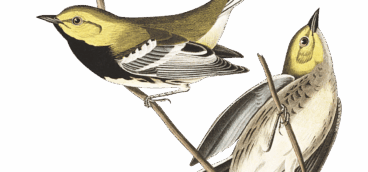
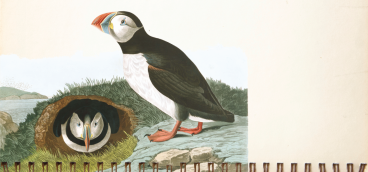
Consciously shaping a new American identity, Audubon molded himself into a woodsman, painter, and naturalist. As his reputation grew, he was seen as both a keen scientist and a fabulist. Audubon was also a slave owner, dead set against abolitionism at home and abroad. Audubon’s legacy deserves careful scrutiny, but he’s a fixture. Pitt’s Hillman Library owns a set of his original large prints, displaying them in rotation in its Oakland lobby. A complete folio last fetched $13 million at auction.
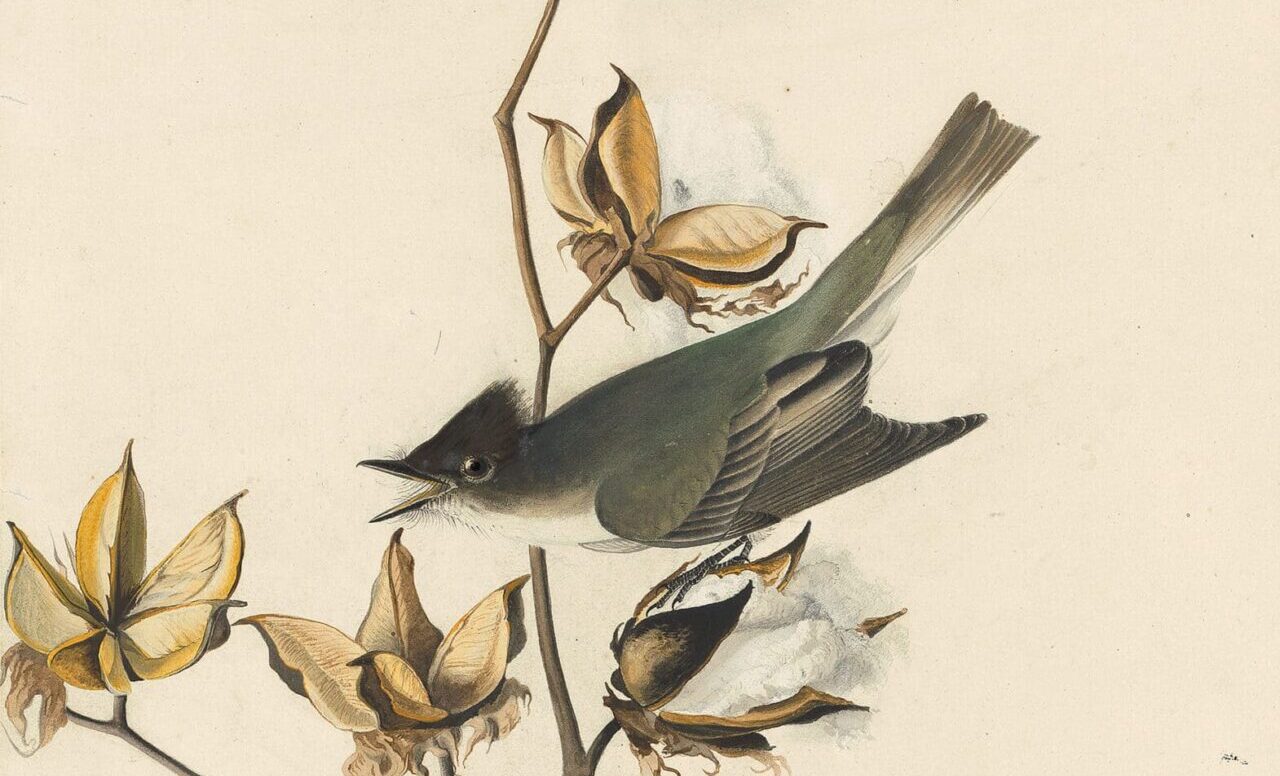
Self-fashioned like a modern “influencer,” Audubon also was our first bander of birds. While living at Mill Grove, that Pennsylvania farm, he skipped work to observe an Eastern phoebe. Would the bird return in future years? To test his hypothesis, Audubon tied a silver thread around the bird’s leg. The songbird left at the end of summer. Audubon waited. When the following spring a phoebe revealed silver ringing its tarsus, the science of bird migration leapt forward.
Eastern phoebes are visually unremarkable birds, returning to our area in mid-March to share their raspy, quick calls on still-frosty mornings. They migrate short to medium distances and can occasionally be found in Allegheny County in winter, too. Phoebes perch, saying their names as they bob their tails. Looking for insects to snap up, they are categorized as flycatchers, preferring their meals on the wing. Short-billed, they are brownish-grey from head to tail on the dorsal side, whitish on chest, belly, and vent. Nondescript. But that call: “Phee-bee. Phee-bee.” Over and over, all spring long.
As with Audubon’s family, female phoebes build the nest and do much of the work of raising young. They like tucking a nest up under a roof or overhang. Males watch the females do the heavy lifting of mud, moss, and sticks, observing for a week or so. The females lay two to six eggs, incubating them for a fortnight, then fill hungry mouths for another two to three weeks. Meanwhile, the seemingly distracted males are itching to wander, a challenge in some humans and birds.
Eastern phoebes have been increasing over the last 50 years, a notable avian exception, while many spring migrants are in significant decline. Thanks to phoebes and the work of scientists at places like the Powdermill Avian Research Center and the National Aviary, Audubon’s banding experiment has grown into a massive body of work, helping us better understand the natural world.

David Liebmann is an educator who has birded throughout the country.