Can Love Conquer All In Pittsburgh Opera’s “Orpheus & Eurydice”?
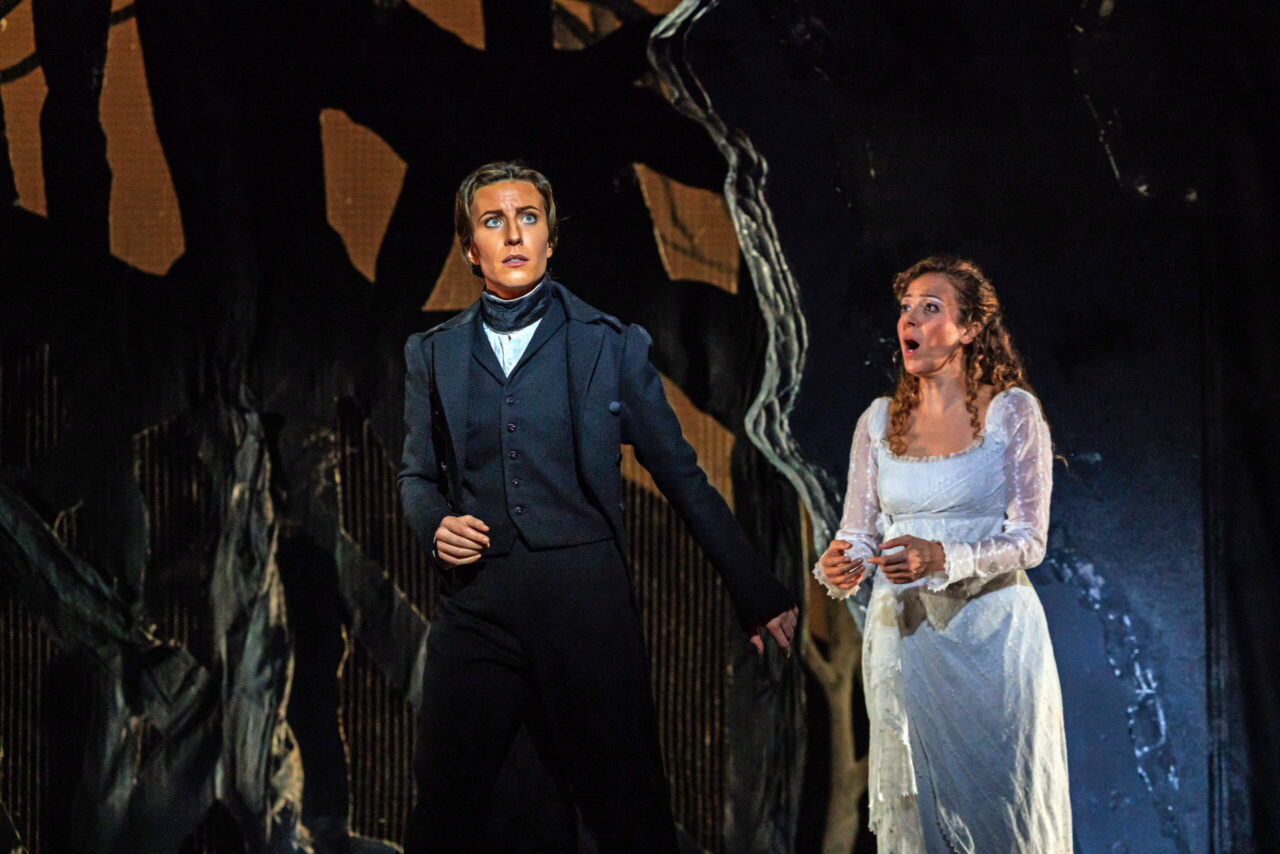
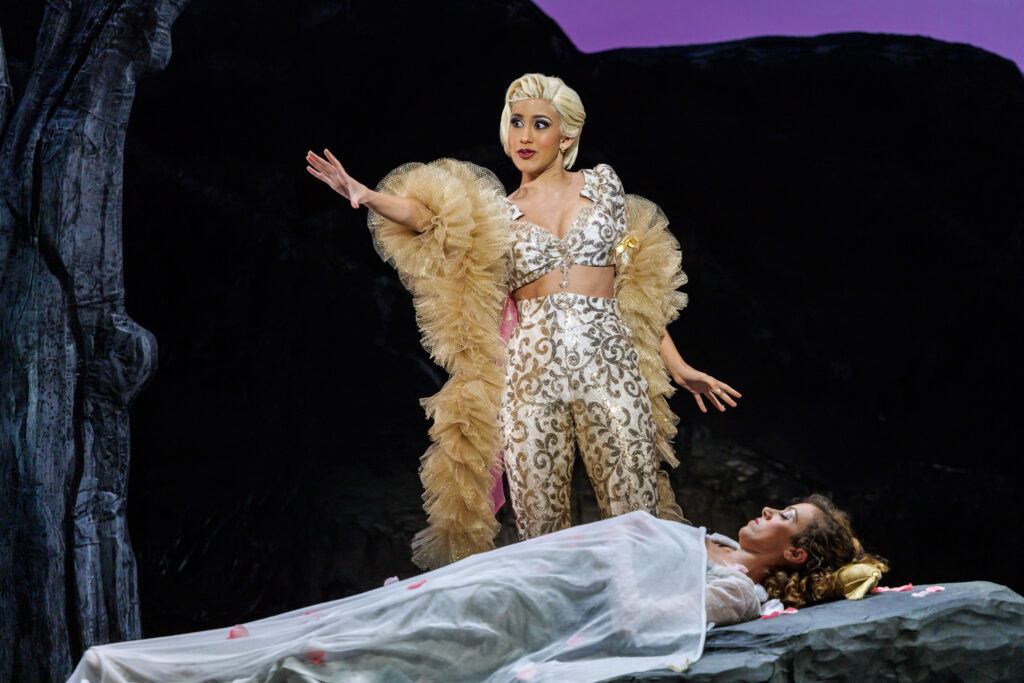
While in most operas and plays the heroine dies at the end – a classic example being “La Bohème” — in the case of Pittsburgh Opera’s “Orpheus & Eurydice” (1762), the love object of the hero is dead even before you take your seat. As if to drive the starkness of this conceit even deeper into our consciousness, Eurydice (who has died on the very day of her wedding to Orpheus) spends much of the first act of this performance lying onstage, lifeless, under a shroud. Talk about burying the lead.
However, I’m not giving anything away here: this is true to the story of the classical myth and is announced in the first lines of the libretto. What I won’t divulge is the ending which, if you know the original, is actually quite different, as well as refreshing and compelling. The present work has the feel of a modern opera — which the 18th century composer Christoph Willibald Gluck intended – dropping many of the tired, heavy, classical motifs in favor of a more passionate, dramatic, and lighter style. In fact, if you’ve never been to an opera, or have only seen them depicted in films, this would make a welcoming introduction for you. With only three main characters, a simple plot, and comprehensible staging, you won’t get lost in the swirling mysteries of what many neophytes find challenging in this art form. And the subject matter – not letting death interfere with love — ranks as one of the most powerful themes in Western art.
Although the performance is sung in French with English supertitles projected over the stage, what transpires is so intrinsic to the human experience that you may find yourself not even looking at the translations. The libretto, by Pierre-Louis Moline, flows with the sincerity of an early Beatles ballad; for example, “Even before the dawn, I ask day to give you back. And after day has fled, my voice calls you all night.”
Playing the part of Orpheus, mezzo-soprano Stephanie Doche’s vocalizations are laced with grief – like a bird that wants to soar but knows it must undertake a chthonic journey and hence finds little joy in contemplating flight. Orpheus the mythic character was a rock star to the ancient Greeks, capable of charming not only any human or animal, but even inanimate objects with the power of his music. Upon the death of his beloved Eurydice, who was tragically bitten by a poisonous snake, he resolves to travel to the underworld to rescue his love, using his mellifluous voice and lyre to charm any furies, ghosts, or gods who might stand in his way.
And yes, they do. Entering hell, marked by a contrapposto crack deep in the earth,
he is undeterred and moves them to capitulation with his enchanting lyre. There he meets Eurydice, played by soprano Lauren Snouffer, still wearing her white wedding dress and flowered garland, whose ethereal voice fills the stage with hope. Their duet is especially powerful.
Making all this possible is the third major character, Amour, sung by soprano Léa Nayak, who looks like the love child of Charo and Gwen Stefani, with a vivacious splash of Liberace thrown in, except that she enters on a golden bicycle, not a Rolls Royce. Wearing a white-and-gold sequined crop top with flared pants and a campy boa, her exuberant voice is as enthralling as her costume, which contrasts with the funeral garb of Orpheus, who looks like a dour 18th century school proctor. (I will leave the rationale for this to costume designer Robert Perdziola).
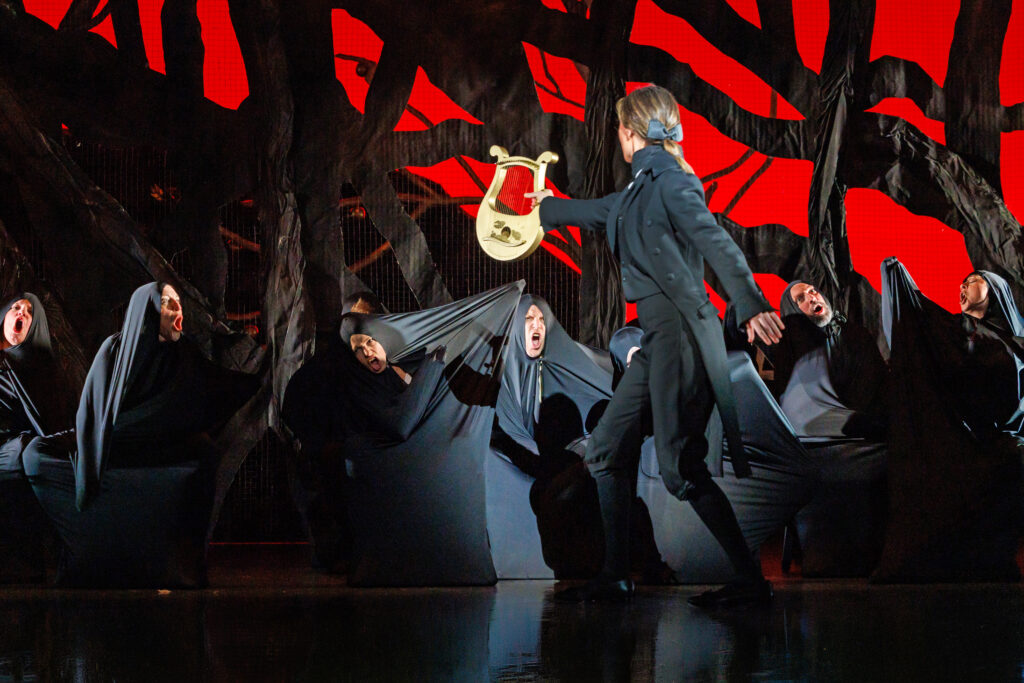
One of the most thrilling moments in the show occurs when Orpheus confronts the gyrating Furies, who are dressed in black shroud-like garments, similar in style to Martha Graham’s famous “Lamentation” piece. The dancers, who are from the iconoclastic Attack Theatre, add a physicality to the performance which manifests in movement what the characters are expressing in song.
From the first galloping notes of the overture the Pittsburgh Opera Orchestra conducted by Anthony Walker fills the auditorium with sonorous drama. Special recognition should go to harpist Nuiko Wadden, who brings the Orphic lyre to life. Steven Kemp’s scenic designs are fantastical, especially the opening set comprising two trees shooting out of the earth like dying hands trying to clasp each other before they expire: one white and one black, exemplifying the distraught lovers. And this coalesces magically with Mary Ellen Stebbins’ lighting designs, which manage to be luminous and crepuscular at the same time, as one would expect in such a world of fantasy.
As somber as this story is, it never becomes overwhelmed with sentimentality and, as I mentioned, the ending may surprise you. I won’t say anything else other than, sometimes, love does conquer all. Especially at the opera.
ORPHEUS AND EURYDICE continues on November 20th and 22nd, Byham Theater, Downtown. www.pittsburghopera.org, or 412-281-0912.

Stuart Sheppard is an award-winning critic, essayist, novelist, and poet who writes “The Hamlet Machine” column for Pittsburgh Quarterly. He is a member of the American Association of Theatre Critics and the International Association of Art Critics. Follow him: @HamletsMachine.