An Archeology of Seeing: David Muenzer’s Compelling “Exit Interview” Exhibition
There are two kinds of artists one encounters in contemporary exhibitions: those who exist on the superficial, apparent plane of the obvious, and those who offer something deeper, with meaning to be found on multiple levels. (There is also nonsensical, banal art, but for the sake of argument, let’s concentrate on the former two styles). Depending on your perspective, you may prefer one over the other, but with so much art being produced for commercial purposes, often with political agendas, I was delighted to discover the current exhibition at Concept Gallery (in Regent Square) by Pittsburgh native David Muenzer, who challenges the viewer to look, and keep looking at his works, as they offer a depth of profoundness that feels like opening a progression of Chinese nesting dolls.
Mr. Muenzer’s show, to his credit, is so diverse, that if you didn’t know better you might assume that four or five different artists had produced the works on view. It’s kind of like walking through a mini–Carnegie International, except that you’re not overwhelmed with didactic wall texts, and each style manifests its own native intelligence, without feeling forced into some sort of tendentious ideological justification, as so much “museum” art is these days.
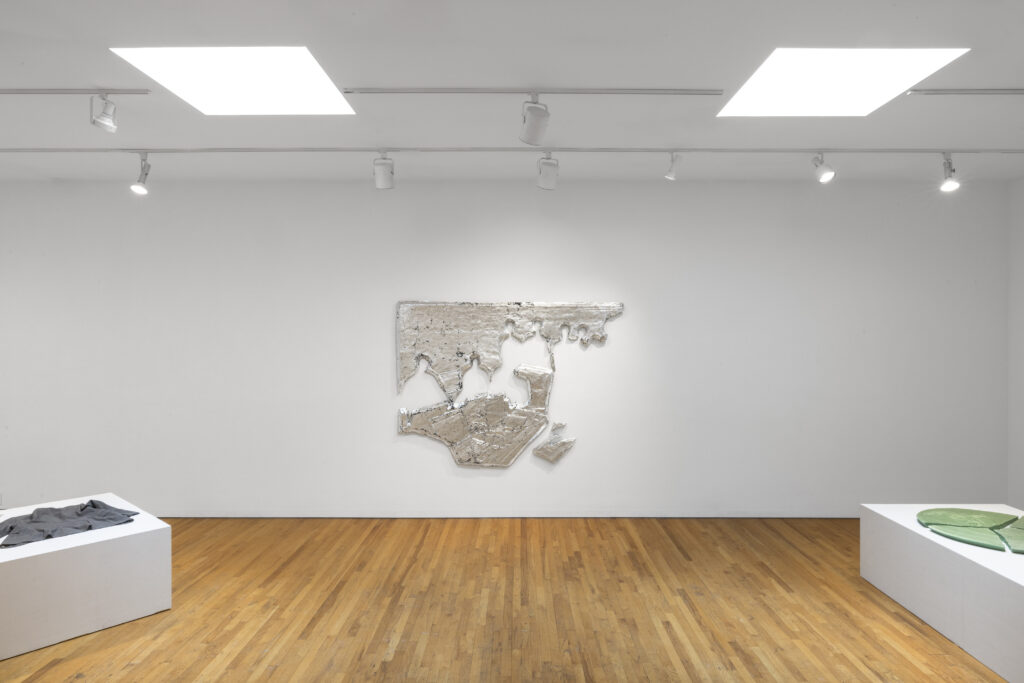
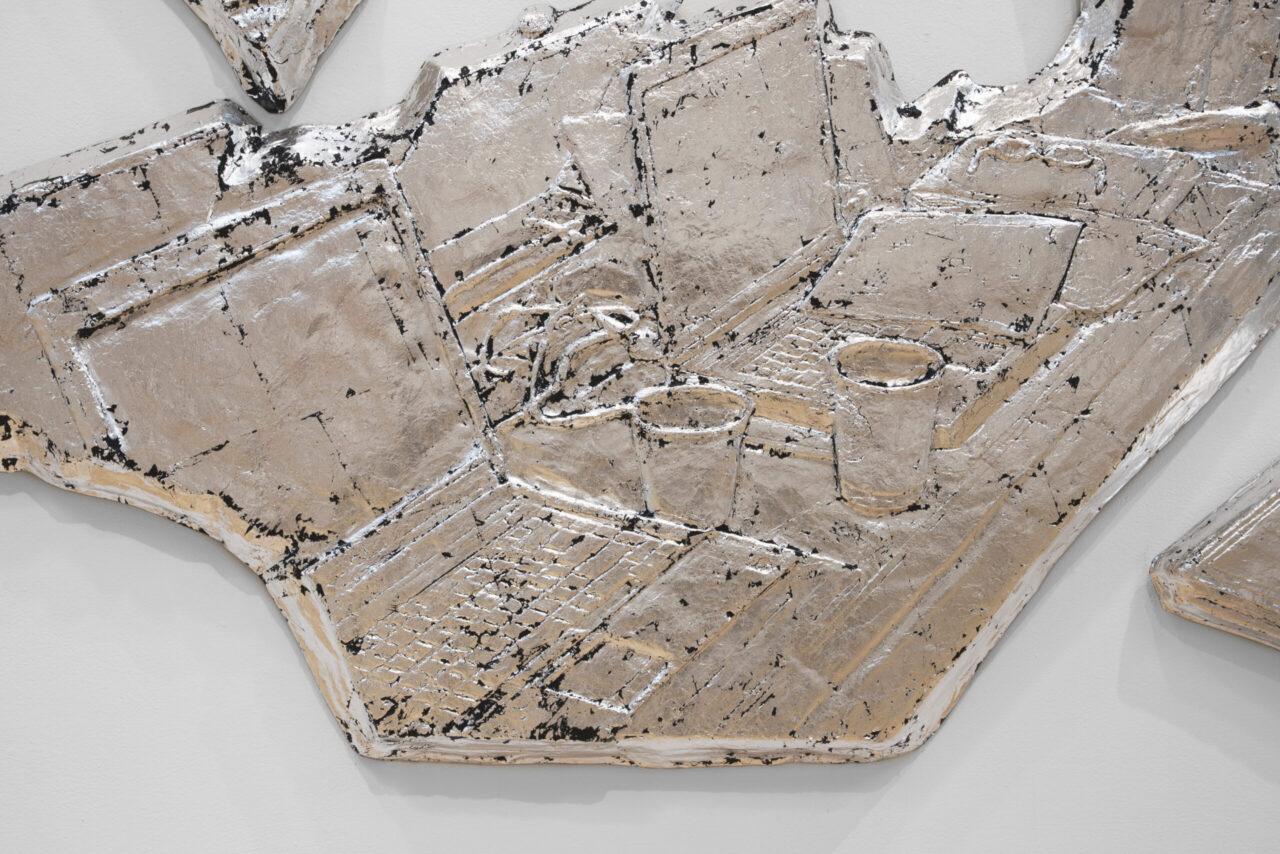
Two works of a series entitled “Goyna” (which means “jewelry” in Bengali) are stunning, in that you are rewarded with layers of meaning the more intently you inspect these pieces. They are, at first glance, luminous, silver shapes hung on the wall, made by a complex process from aluminum-leafed handmade kozo-pulp paper: imagine abstract, bas-relief sculptures that seem to evolve as you look at them from different angles, as well as when the light changes. They appear to be aniconic shapes that have no meaning. But upon closer scrutiny, you’ll notice that actually there are images being represented – which are defined by their negative space — and these vaguely resemble human forms. And then, if you consider the title of the piece, “Situation,” it slowly becomes evident that Muenzer has appropriated the famous photograph of the Situation Room in the White House that depicts the president and his cabinet watching the moment that Osama bin Laden was killed.
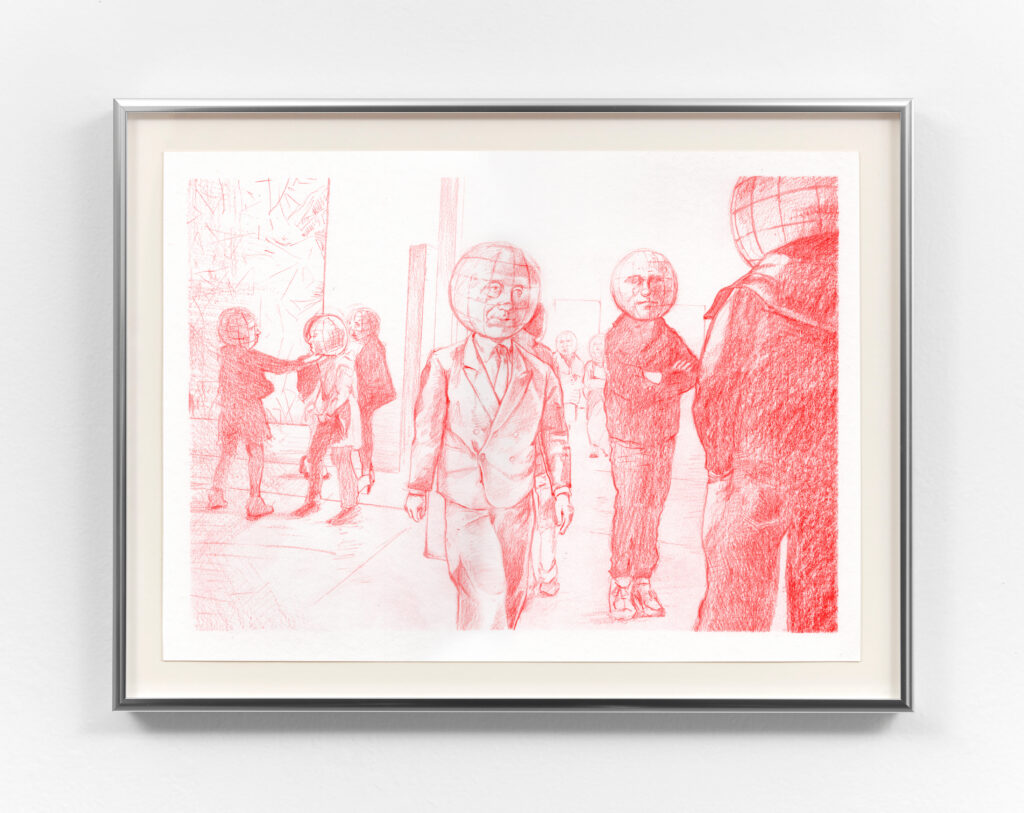
Another delightfully challenging series is based on characters the artist calls “globeheads,” comprising kinetic scenarios of globe-headed people drawn in red pencil. Although they appear as cartoons, there is much happening in each depiction, such as in “Fashion Weak,” which references Rodin’s iconic “The Burghers of Calais,” to make a profound point that may not be obvious on first glance. I will leave further interpretation of these drawings up to the viewer.
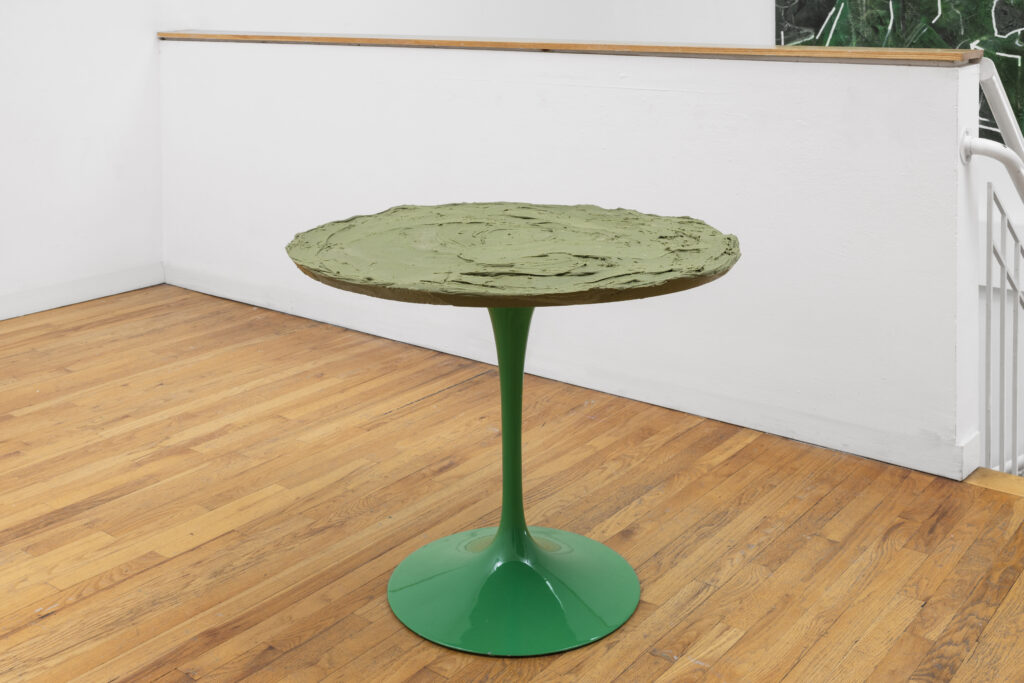
As Monty Python would say, “And now for something completely different.” In an arresting series called “Coffee in the Office,” we find classic Knoll “Tulip” coffee tables that have surfaces made of chocolate – whereby the tables themselves are edible rather than merely supporting items that are edible. In fact, you can see teeth marks on the edges where people have evidently “taken a bite” out of the art. Again, I will leave the potential meaning of this up to the viewer, but it is a stimulating and I dare say delectable trope, rarely encountered in exhibitive spaces.
One other project on display – there are more than I have space to describe in this review — is Muenzer’s “Artist as Interface,” based on a 2010 performative exhibit when Muenzer left his studio and part-time job to become a full-time receptionist at Latham & Watkins LLP, a corporate law firm in midtown Manhattan. Finding the environment of desk cubicles and surrounding office space a kind gallery in itself, Muenzer negotiated for the utilization of two empty floors in the firm’s office building as an exhibition space, making art out of the institutional middens corporations exist in (and often discard). He captures various elements or remnants of this experience — whereby common office objects, such as a vase of dry flowers, are recognized for their inherent aesthetic – vs. decorative – value when taken out of their original context. Much the same way Andy Warhol changed common objects such as Brillo boxes into art by taking them from everyday life and recasting them as exhibitive pieces in themselves.
In an essay written in the early 2000s, shortly before she died, the critic Susan Sontag commented, regarding the latest evolution of contemporary art, that, “Innovation is relaxation now; today’s E-Z Art gives the green light to all.” It is indeed challenging to be innovative, relevant, and profound at the same time. An old boss of mine used to say, “Fast, good, cheap – pick two.” We might pose the same admonition to today’s artists regarding innovation, relevance and profundity – except that we should demand all three. David Muenzer has certainly risen to and fulfilled this challenge. We can only look forward to more of this young artist’s compelling work in the near future.
“Exit Interview” runs through June 13th, Concept Gallery, 1031 S Braddock Ave, Pittsburgh. Admission is free. www.conceptgallery.com

Stuart Sheppard is an award-winning critic, essayist, novelist, and poet who writes “The Hamlet Machine” column for Pittsburgh Quarterly. Follow him: @HamletsMachine.