Quantum’s “Radio Island” is a Testament to the Remarkable Legacy of Karla Boos
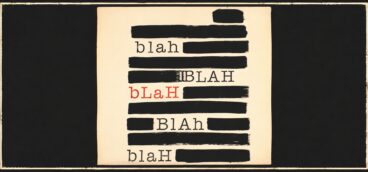
In the spirit of educational guru Stephen Covey, I’m going to begin with the end and state that I don’t know how the play “radio island” concludes. Certainly, I have an idea, or perhaps an interpretation would be the better word, but I’m not really sure, and this is . . . fantastic. In a program note titled, “All Seats Are Obstructed View,” which has some of the poignancy of an Antonin Artaud essay, director Katie Brook states how she was intrigued by the “taste for mystery” inherent in this work, and how it evoked Freud’s theory of the “uncanny.” I would like to point out that this is only possible because of Quantum Theatre’s penchant for risk, and for trusting its audience – propensities all too rare in the arts today. In fact, I can’t think of another theater company in Pittsburgh that could, or would, dare to stage such a production.
We owe this to the vision, artistry, and fortitude of Quantum’s artistic director Karla Boos who, after 35 iconoclastic years, will be retiring from this role at the completion of this show. The encomiums heaped upon Ms. Boos for forging a unique theatrical identity in a town full of dramatic companies are all deserved, and if I may add my own voice to this chorus, let me say that her work has never played it safe, has never failed to challenge expectations, and has never been disappointing, no matter the subject, playwright, or venue. If I had to capture the essence of Quantum with one word, it would be fearlessness, which is, I would argue, one of the rarest artistic qualities in our post-modernist – and now, post-pandemic – age, when risk is often mitigated for commercial survival. That Quantum does not even have a permanent performance space is remarkable, as it relentlessly sails from one non-traditional location to another, a true theater of the floating world.
Even beyond this impressive feat is the fact that Quantum really prefers to perform outdoors, subjecting itself to rain, wind, darkness, and the inevitable cacophonies (automotive, locomotive, and industrial) that permeate Pittsburgh. If the actors aren’t bothered by such inconveniences, why should we be? It’s an astute lesson, and Quantum has been teaching us not only the rules of the theater, but how to break them in the most enlightening ways. In fact, once, during a production of Chekhov’s “The Cherry Orchard,” a train whistle actually blew by chance during a scene in which the characters were debarking for a train station, and it felt like divine justification for all those times such intrusions occurred in less propitious circumstances.
I have stood near Ms. Boos on several occasions when she has had to call off shows upon the threat of an oncoming storm: watching the sky, listening to thunder, and making a decision in seconds that would result in thousands of dollars of ticket sales walking away. Who else does this? Or would have the courage to do this? Theater is stressful enough, but hey, at Quantum, why not gamble on a little act of God to make things even more interesting?
To maintain my objectivity as a critic, I try not to let taste influence my opinions, so I focus on three criteria when evaluating any work: originality, strength, and risk, and Quantum’s efforts, as shaped by Ms. Boos, are consistently endowed with all three. In fact, I can’t think of a single production in the past decade which I’ve covered the company that has been deficient in any one of these areas.
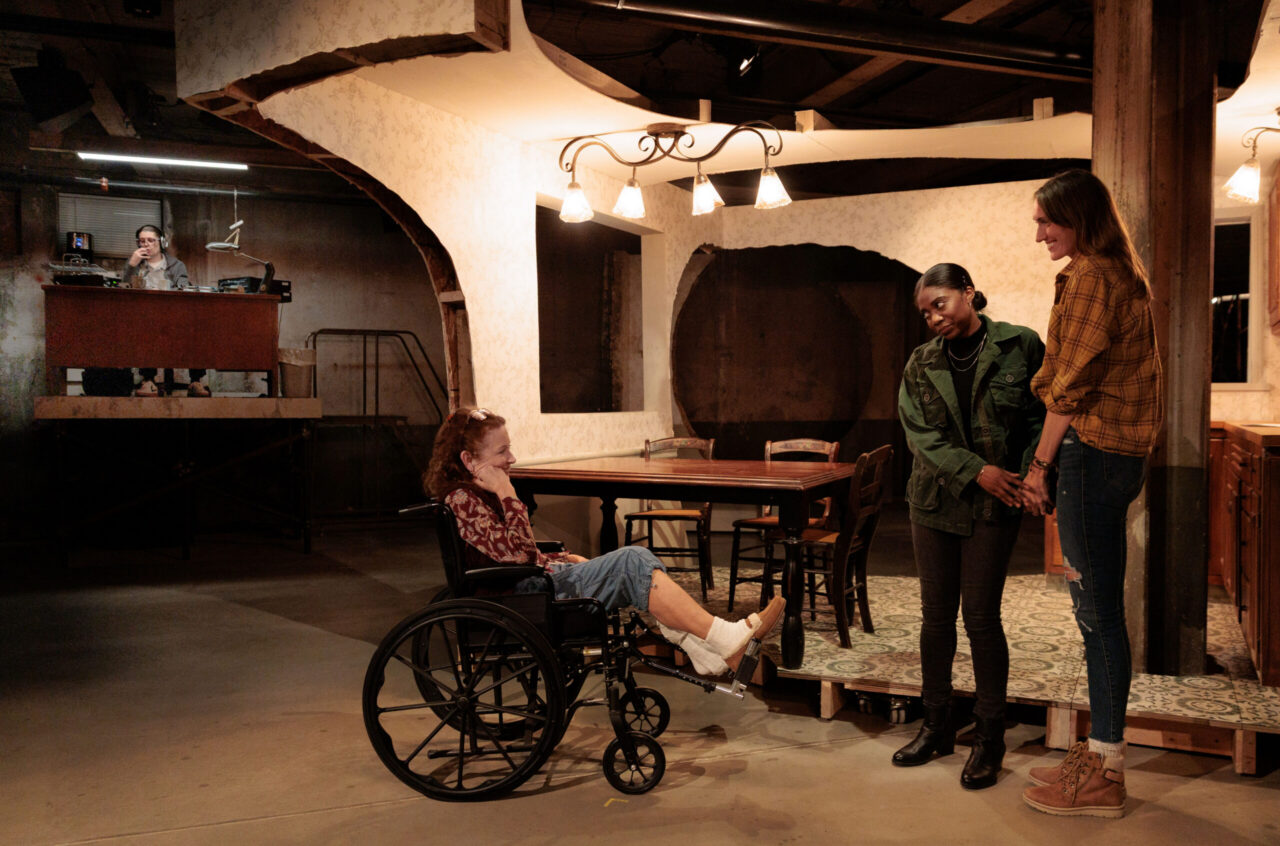
This world premiere play, written by Liza Birkenmeier, embodies these qualities, as it relies on narrative metalepsis, which requires the audience’s active participation, in that the character of Operator (Treasure Treasure) both narrates the action from a platform above the performance space, and also serves as the island’s police dispatcher, switching between roles by plugging into the police switchboard with a grating pop and crackle that becomes louder and louder during the course of the show. (If you’ve ever played in a band with a guitarist who neglects to turn his amp down before plugging in his cord jack, you know how annoying this sound can be). But here’s the catch, what the Operator narrates doesn’t actually happen: the audience must complete the action via its imagination. For example, when the Operator says, “Ellen poured The Sheriff a six-ounce cup of coffee,” Ellen doesn’t pour any coffee. In fact, there isn’t even any coffee on the stage. It’s a completely diegetic act.
This also points to why “radio island” was partially imagined as a radio play – a lost art form in America — which I think would be an equally rewarding way in which to experience it.
The story centers on the character of Ellen (exquisitely depicted by Siovhan Christensen), a hostage negotiator, who returns to her childhood home and becomes embroiled in a hostage negotiation (Somali pirates have commandeered an oil tanker) while navigating a reunion with her eccentric, wheelchair-bound mother Paula (Helena Ruoti). She’s home, but it doesn’t feel like home; it exists in a warped, crepuscular state that makes Ellen increasingly uncomfortable, as she begins to question her assumptions about her childhood relationships with both her peevish mother and her estranged father. Playwright Birkenmeier appropriates this Pinteresque resonance, adds a dash of Wes Anderson’s “Moonrise Kingdom” — with its strange island culture and the fact that communication with the outside world depends largely on a radio operator – and then throws in a mystery to be solved regarding Ellen’s vanished father.
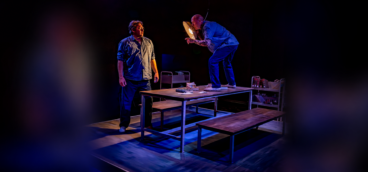
This is a play that wants to be a lot of things simultaneously and fortunately succeeds, largely on the strength of the writing, as well as the pacing and staging by director Brook, and the uniformly accomplished acting. But just when your eyes adjust to C. Todd Brown’s dimly lit set – he must have been watching cinematographer Gordon Willis’ films just before this project – two stagehands appear and move pieces of the walls, floors, and physical property around like a Cubist gallery installation. Are we watching a play or a modernist art exhibit? Scenic designer Chelsea M. Warren keeps us guessing.
You may remember Ms. Christensen from Quantum’s 2016 “The River,” in which her character floated between past and present in a state of shifting perspectives, exuding a kind of temporal stoicism. In this role, we find her in the same “uncanny” confrontation with reality. Her Ellen sees the strangeness unfolding around her – both in her mother’s home, and in the growing limbic resonance she establishers with her pirate negotiator on the phone – but like a character in a Robert Bresson film, she ultimately embraces the enigmatic nature of her circumstances.
Complicating the psychological tension is the arrival of Ellen’s girlfriend Rory (played with a subtle intransigence by Melinda Nanovsky) which disturbs Paula, who demonstrates — in one of the few predictable aspects of this otherwise unpredictable show — a clichéd response, epitomized by her insensitive comment, “When I tell people that my daughter is a lesbian, they always expect you to look a little uglier.”
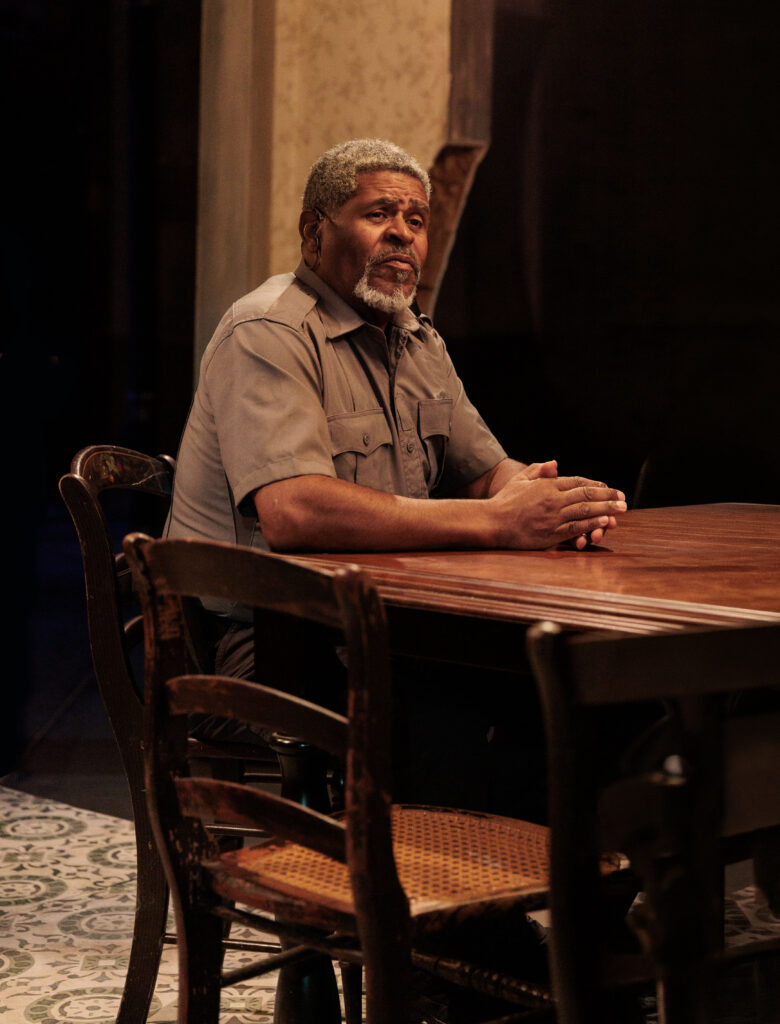
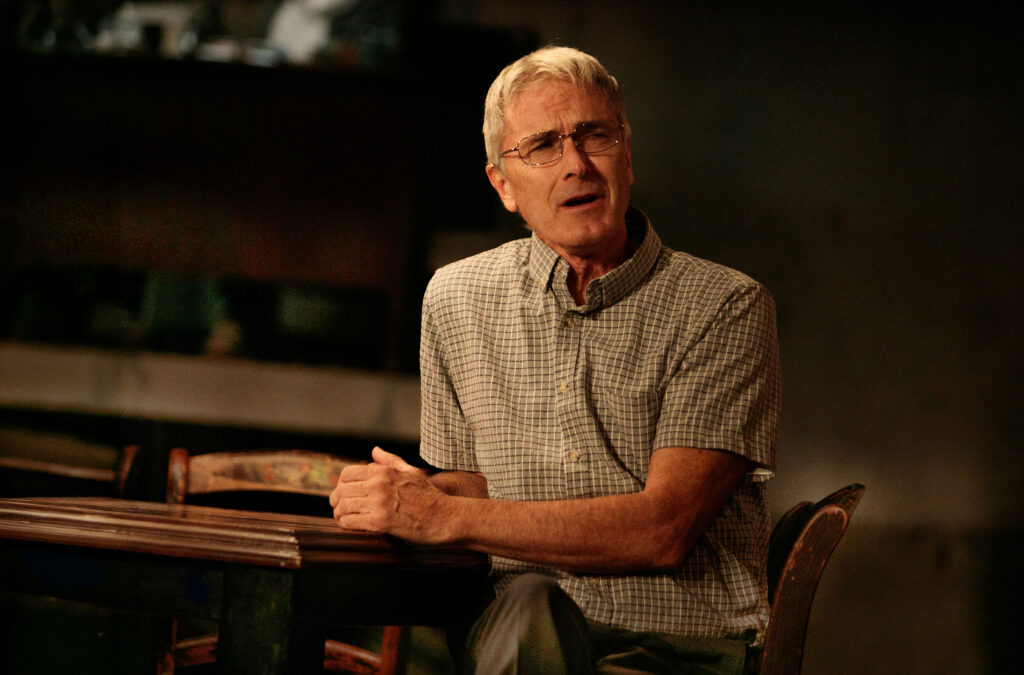
Anchoring these disparate temperaments is the lackadaisical Sheriff (Wali Jamal) who looks into the mystery of Ellen’s missing father, and some bullet holes that have appeared in Paula’s bedroom, which may or may not be connected to him. Mr. Jamal also plays the pirate Contact Man who negotiates with Ellen over the phone from somewhere in the darkness – we’re never really sure where he is — floating like a disembodied voice. And rounding out the cast in two roles is Brett Kennedy, who is one of the oil tanker owners, and the local Reverend, both with distinct and appropriate accents.
To end with the beginning, what makes this production so rewarding is Quantum’s immersive rapport with the audience — which has been growing for three-and-a-half decades — and its confidence that in breaking so many rules of the theater — comprising obstructed views, wheeled sets that are broken apart like Lego pieces, narration of things not happening, and an embrace of the ethereal as normative – that we come to appreciate what transpires even more. This is the great legacy of this company, and we should be thankful to Karla Boos for making this experience in production after production not only possible, but truly sublime.
RADIO ISLAND continues through November 15th at Rockwell Park, 7514 Thomas Blvd, Pittsburgh. 412-362-1713 or www.quantumtheatre.com

Stuart Sheppard is an award-winning critic, essayist, novelist, and poet who writes “The Hamlet Machine” column for Pittsburgh Quarterly. He is a member of the American Association of Theatre Critics and the International Association of Art Critics. Follow him: @HamletsMachine.