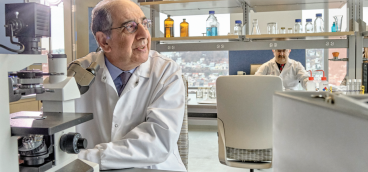
Richard P. Simmons: A Great Man and a Great Friend to Pittsburgh

“The values of the organization are set at the top. The entire organization looks up to see what the CEO is doing—not what he or she is saying. So for those of you who aspire to be a CEO, remember the burden that you carry—not just to make the handful of strategic decisions you will have the opportunity to make, but also the values, the ethics, and the moral compass of the company you lead. That will be how you will be remembered.” – Richard P. Simmons
On April 23, Dick Simmons — one of Pittsburgh’s greatest industrial and philanthropic leaders — passed away in his sleep, ten days before his 95th birthday.
I met Dick more than 30 years ago, as a newspaper reporter and editor. He was a tough, no-nonsense steel CEO. At the time, I asked local leaders for their ideas on turning Pittsburgh around. In contrast to the others, Dick’s response was typically terse: “We must do it ourselves – I, for one, do not believe in the tooth fairy.”
I saw Dick occasionally over the next ten years, largely at Pittsburgh Symphony galas, where he was board chairman and chief benefactor. I didn’t know him well, but we’d had periodic brief conversations, and I knew him to be a serious person. In 2005, purely by chance, I ran into Dick at an event during the six weeks that I was seeking investors to start Pittsburgh Quarterly magazine. I told him what I was doing and asked if he’d like to see a prospectus. He said yes, and when I dropped it off at his house, I had my Airedale, “Smokey,” with me. Dick smiled and said, “I had an Airedale when I was a boy.”
It was good luck, which I needed. I’d met with seven or eight possible investors, with little success. They’d listen to my pitch, nod several times and ask some questions before politely declining. It didn’t help that someone suggested I mention a statistic I’d found – that only one in ten magazines lasted more than six months.
On the appointed day, I arrived at Dick’s office. No small talk. We sat down and I started my pitch. Unlike every other person, Dick sat impassively. No nodding. No smiling. No questions. “This isn’t going well,” I thought, but at the of end my spiel, I figured I might as well make the ask anyway. So I said, “Dick, do you think this is something you might be interested in?” Excusing himself, he left the room. It was worse than I’d thought.
When he returned two minutes later, he said he was prepared to invest an amount that was twice what I was seeking, saying, “All the success I’ve had has come in Pittsburgh, and if I can do something that will help this area, I’m prepared to do it.”
Pittsburgh Quarterly became a reality that day, thanks to Dick Simmons. Dick would later tell friends and public audiences that the magazine was the only investment he ever made that was in the black its first year. Not often, but in key situations over the years, I asked Dick’s advice. It was always incisive, and I always took it.
And once about ten years ago, Dick asked my advice. Could I recommend anyone who might help him write an autobiography for his family and friends? I said I’d be happy to do it. And so we embarked on a year-long process, with interviews in his home office with periodic visits from his two labrador retrievers. And it was then that I learned the details of his remarkable life.
***
Dick was the youngest of three children by six years. His father said few words to him, which Dick attributed to his father not having much interest. His mother loved him but was often sick and incapacitated. So Dick largely raised himself. As he said, “I had to make it on my own.” It made him strong and self-sufficient. At 16, his father had a serious heart attack, and Dick took over his dad’s service station and auto supply store, working there after school.
Seeing his intellectual abilities, particularly in math and science, a high school teacher suggested he go to MIT, which he did, getting off the train alone with a suitcase and a portable typewriter. Surrounded by the nation’s best and brightest, he realized how far behind he was, so he learned to do the two things that would define his career: working hard and thinking. He enjoyed a stint as coxswain on the crew team but kept his eye on his metallurgical engineering studies. A professor suggested he pursue stainless steel because it was more interesting, and Dick ultimately became the nation’s foremost stainless metallurgist, inducted in 1993 into the National Academy of Engineering — one of 2,000 people in the world ever elected.
After graduating, he decided he’d work for three companies, which he did, along the way becoming a pioneer in the developing field of titanium and rising in the company ranks due to his innovations and fortitude to sometimes tell his bosses things he knew they didn’t want to hear.
He returned to Allegheny Ludlum, building the steel industry’s first cost-analysis system – a critically important innovation. Ultimately, he rescued the company from the failed conglomerate Allegheny International, navigating and leading a complex management buyout with key help from his lawyer, Chuck Queenan. Dick took the company public and later, through a series of successful mergers and purchases, he created Allegheny Teledyne, now Allegheny Technologies.
***
Dick possessed a rare combination of qualities: engineering expertise, business acumen, leadership skills, and moral courage. And because of that – and his ability to work hard and think — he became one of Pittsburgh’s most successful self-made men.
That success launched the focus of his life after he retired 26 years ago to take care of his wife, who was sick: philanthropy. And Dick provided decisive support to MIT, the Pittsburgh Symphony Orchestra, the Carnegie Museums, UPMC and many others. Beyond that, he met with and helped countless young people with scholarships and advice.
When I started Pittsburgh Tomorrow, Dick was the first to donate and he said, “Tell all my friends I think they should support this too.” I did, and they did, and now that nonprofit is getting real traction in helping to catalyze a new and more vibrant future for this region.
Dick had a very firm sense of right and wrong, and he led by example throughout his career. I asked him about that once and here was his response: “How did I get my ethical grounding with my family background and without a religious orientation when I was young? No one mentored me. The answer is, it has to be in your DNA, what’s right and what’s wrong.”
Dick considered himself to be extremely lucky, titling a speech to students “The Luckiest Man in the World.” Part of his luck was being a metallurgist at the time when so many innovations were poised to happen. And he considered himself lucky in many other ways, too. And I’m sure that’s true. Equally true about Dick, however, is that, through hard work and thinking, he created his own luck.
Above all though, the real bounty of good fortune connected to Dick Simmons belongs to all of us in Pittsburgh and elsewhere who have had the good luck to know him and learn from his example.

A journalistic innovator, Heuck has been writing about Pittsburgh for 40 years, as an investigative reporter and business editor at The Pittsburgh Press and Post-Gazette and as the founder of Pittsburgh Quarterly. His newspaper projects ranged from living on the streets disguised as a homeless man to penning the only comprehensive profile in the latter years of polio pioneer Dr. Jonas Salk to creating a statistical means of judging regional progress that has led to similar projects across the country. Heuck's work has won numerous national, state and local writing awards. His work has been cited in the landmark media law case "Food Lion vs. ABC news." He is also the founder and CEO of Pittsburgh Tomorrow, a nonprofit whose mission is to reverse population decline by reinvigorating the region's civic spirit and economy.