Mussel Therapy on Dunkard Creek
For most of us, our only connection to mussels comes at the beginning of a seafood feast, their lacquer-black shells piled above buttery broth, teamed with garlic toast and a chilled pinot grigio. But to a cadre of scientists and volunteers, freshwater mussels offer hope of a different beginning, the first step toward restored health of a pollution-ravaged stream in Appalachia’s western foothills.
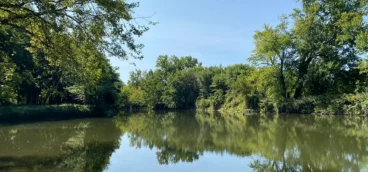
That stream is Dunkard Creek, which snakes eastward for 38 sinuous miles, back-and-forth across the Mason-Dixon Line among the hills of Greene County, Pennsylvania, and Monongalia County, West Virginia, to its confluence with the Monongahela River at Poland Mines, PA.
Dunkard Creek was once acclaimed for its diverse aquatic life, one of the most biologically complete streams remaining in western Pennsylvania. Anglers cast for smallmouth bass, catfish, muskellunge, and sunfish. Hellbenders stalked crayfish among submerged rocks, and 16 kinds of minnow clouded the shallows, while more than a dozen species of freshwater mussels lived their unseen but important lives on Dunkard’s pebbly bottom.
Ecologists praise freshwater mussels as the “livers of our rivers.” Everywhere they thrive, freshwater mussels filter their home stream’s water, 10 gallons per mussel per day, so that Dunkard Creek’s sometimes cloudy flow (Greene and Monongalia counties’ soils are silty clay) ran clear from the siphon-feeding of thousands of living bivalves.
But in September 2009, a perfect storm of pollution and invasive species, still officially unexplained, killed every fish, salamander, and mussel along a 30-mile span of Dunkard Creek. Shoals of pallid bass and three-foot muskies with bleeding gills piled up along the shore. Doomed salamanders tried to crawl out of the water to escape, as a spreading toxin wiped out all 14 kinds of Dunkard’s mussels.
“What a mess!” EPA biologist Lou Reynolds wrote in an email to colleagues after an early survey of the kill. “Up to our knees in rotting fish, mussels, and mudpuppys.”
Federal EPA and the West Virginia Dept. of Environmental Protection determined the direct cause of the kill was an explosive bloom of golden algae (Prymnesium parvum), which emit toxin that destroys the gills of aquatic organisms. But golden algae need salty water to thrive, and had never been documented so far north in the eastern U.S.
Somehow, investigators agreed, golden algae had been introduced to the Dunkard watershed and some event, or series of events, boosted the concentration of salts in the creek, triggering the toxic bloom. Immediately before the bloom, water sampling by the West Virginia Dept. of Natural Resources (DNR) found concentrations of total dissolved solids (TDS), including salts and minerals, many times higher than long-term readings.
Neither federal nor state agencies proved the origin of salty conditions in Dunkard Creek, but numerous sources tainted with compounds known to stimulate golden algae growth were present throughout the basin. Two coal mines near Blacksville, West Virginia discharged mine water into the creek. Permitted treatment of that discharge neutralized mine acid but did not remove salts and other solids. A coal company subsidiary also operated gas wells on the Pennsylvania side that disposed of “produced water,” used to frack coalbed methane formations, by pumping it underground. And in 2010, the Pennsylvania Attorney General charged a contractor hired to haul frack-water with dumping toxic waste into tributaries of Dunkard Creek before the disaster. Shale-gas drillers also pumped millions of gallons from Dunkard Creek into water-trucks for fracking operations, a possible vehicle for golden algae introduction to the watershed.
No entity ever admitted blame. But Consol Energy, the coal operator, paid $5.5 million in a settlement with West Virginia. After the Pennsylvania Fish and Boat Commission sued Consol for environmental damage and lost recreation, a subsequent owner of some of its facilities, Murray Energy, settled with that agency for $2.5 million.
The Pennsylvania Fish and Boat Commission is best known for stocking hatchery-raised trout in lakes and streams for recreational fishing, but state law also entrusts the commission with enforcing water pollution regulations, and conservation of aquatic life, amphibians, and reptiles.
Compelled by mussels’ key role in aquatic ecology, the commission resolved to return mussels to Dunkard Creek. It used its settlement funds to convert an aging fish hatchery at Union City, Erie County, into one of the country’s few laboratories for propagating freshwater mussels. The conversion took years, and innovative engineering. By 2020, the Union City Aquatic Conservation Center was ready to grow its first generation of mussels, and in October 2022, Fish and Boat biologists and volunteers stocked 500 lab-raised mussels into Dunkard Creek, the first to exist there since the “total kill” of 2009.
“This is new conservation work being done here,” said Scott Ray, the Fish and Boat Commission’s species recovery biologist at Union City. “We’re working on restoring a whole ecosystem instead of just game fish, and mussels are a vital part of that system.”
Mussel propagation is a painstaking process, demanding time, money, and intimate knowledge of their complex reproductive habits, but the return of some fish to Dunkard Creek boosted the biologists’ hopes for mussel restoration.
“Fish will come back relatively soon but, without help, mussels are a generational thing,” said West Virginia DNR fisheries biologist Frank Jernejcic at the time of the kill.
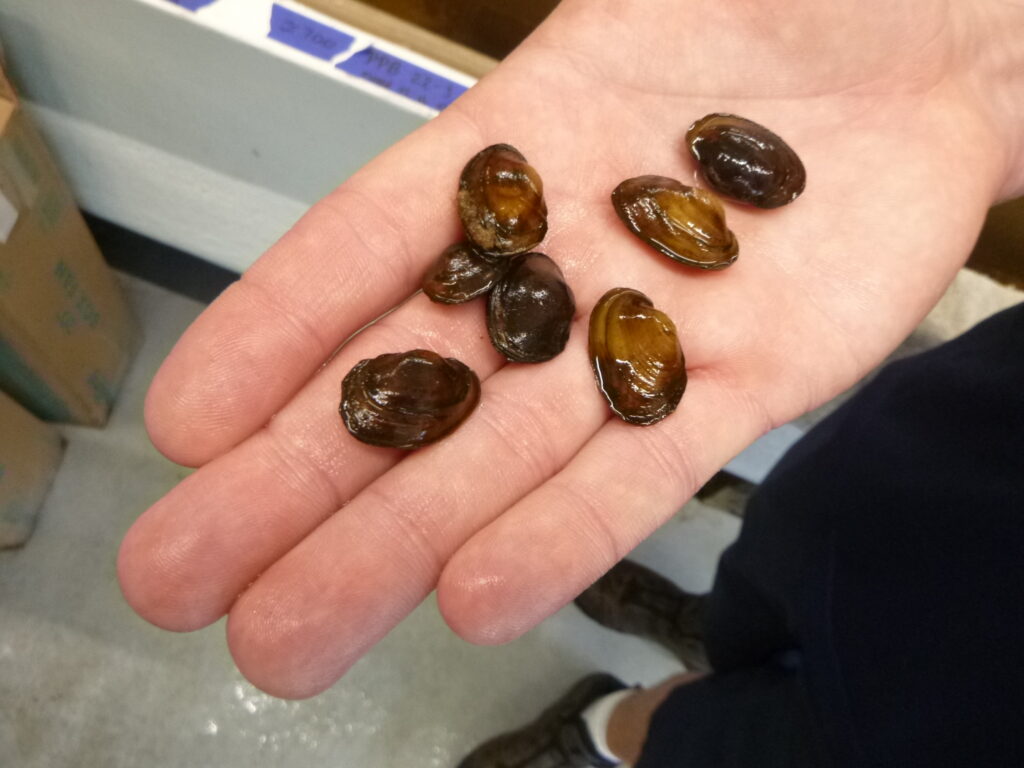
Fish play a vital, if unintentional, role in spreading freshwater mussels throughout a stream basin. Each of the mussel inhabiting Dunkard Creek had evolved an elaborate ruse to enlist fish in their species’ proliferation.
Listening to Scott Ray describe the mussel-fish relationship sounds like a nature documentary filmed in some exotic part of the world, but it happens right here, in healthy streams of western Pennsylvania.
“All these mussels have devised a way to trick fish, sometimes a specific kind of fish, into transporting their larvae to other parts of the stream,” Ray said.
Female mussels have specialized tissues that can be extended outside the shell where the tissue is visible to fish. That tissue functions as a lure — a fishing lure. Some lures resemble crayfish, others mimic small fish. Some mussels even “cast” their lure outside on a short line of membrane, where it flutters and darts in current like a fly-angler’s streamer fly.
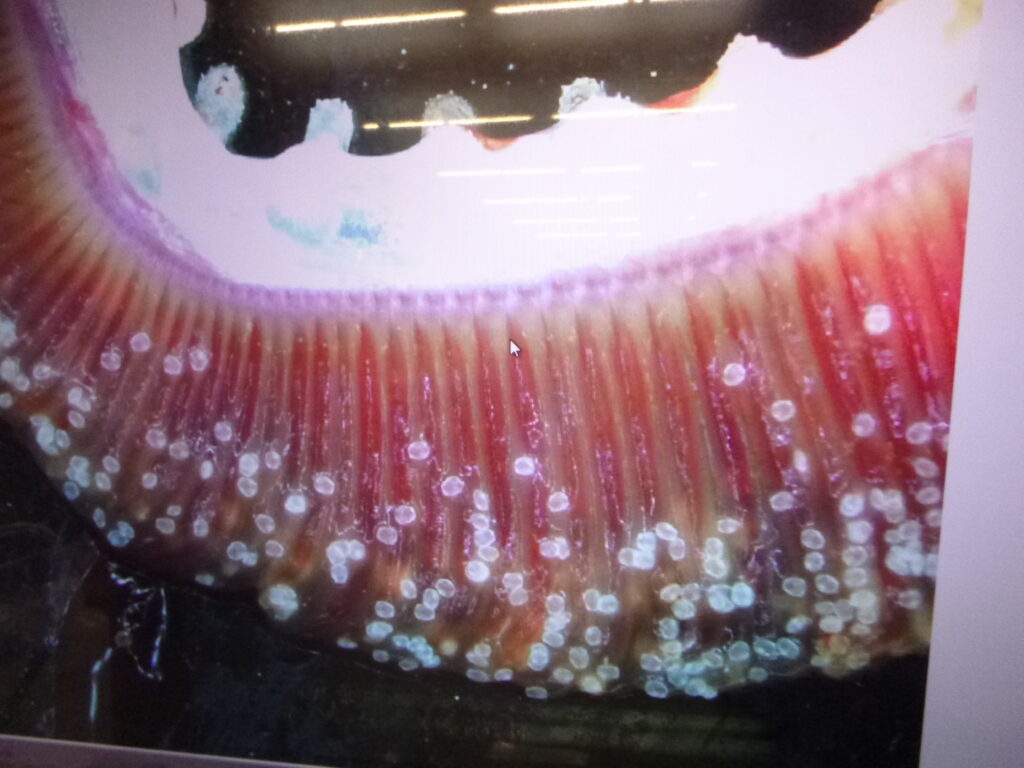
When a fish bites the “lure,” the mussel ejects a cloud of tiny larval mussels — called glochidia — into the fish’s mouth. The glochidia attach themselves to the red filaments inside the gills, where they pose no harm to their temporary host. The so-inoculated fish then swims elsewhere, often upstream to spawn, where the glochidia release their grip and drop to the bottom to pioneer in a new location.
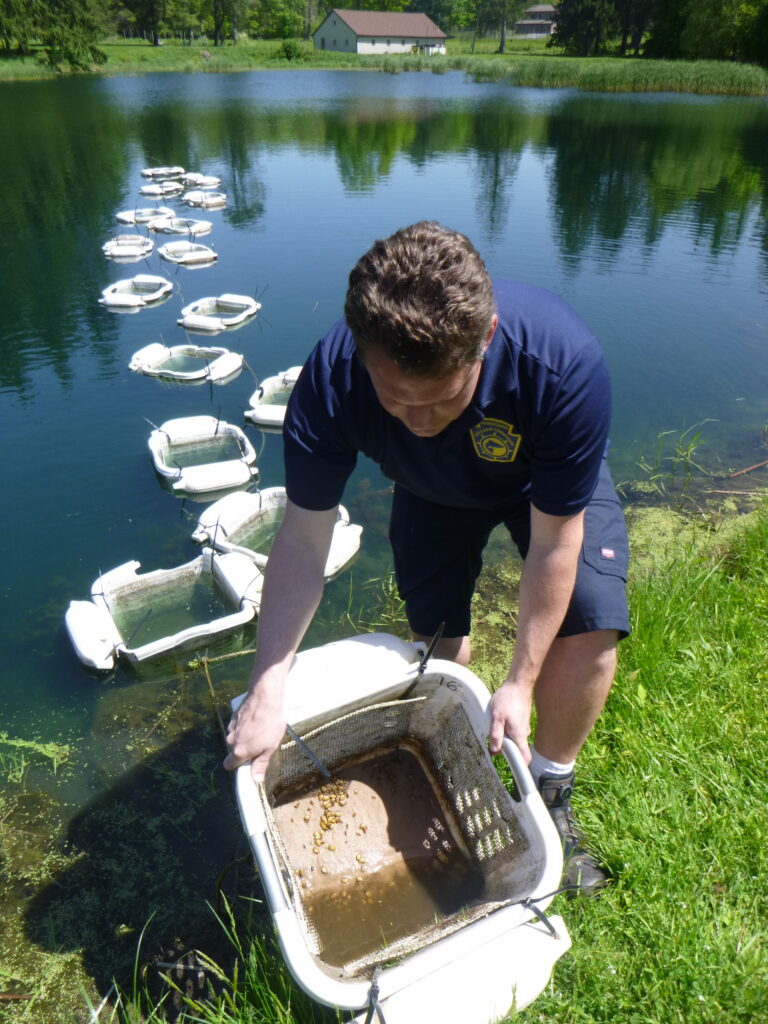
Without these elegant relationships with host fish, mussel larvae, which are at the mercy of current, could never move any direction except downstream.
One Dunkard mussel, the pistolgrip, employed a specialized ploy to scam, exclusively, a flathead catfish. Flatheads scavenge decaying flesh of dead fish, turtles, or other carrion. To exploit this, the pistolgrip presents a pale blob-like lure that resembles rotting flesh, while some of the pistolgrip’s glochidia die and decay before ejection, spewing putrid scent into the water, irresistible to flatheads. When a catfish bites the blob, the pistolgrip mussel ejects living larva into its mouth.
Should mussels’ strange affairs with fish fail to anchor their stoney lives in the public imagination, their names might. Somewhere in history, people gave freshwater mussels colorfully descriptive names. Heelsplitter, pocketbook, pistolgrip, wartyback, pigtoe, fatmucket, and kidneyshell are some of the mussel species that filtered Dunkard Creek’s flow.
Before they can raise young mussels, biologists and volunteers must first collect mature specimens from remaining populations in other western Pennsylvania streams, notably French Creek and the Shenango River.
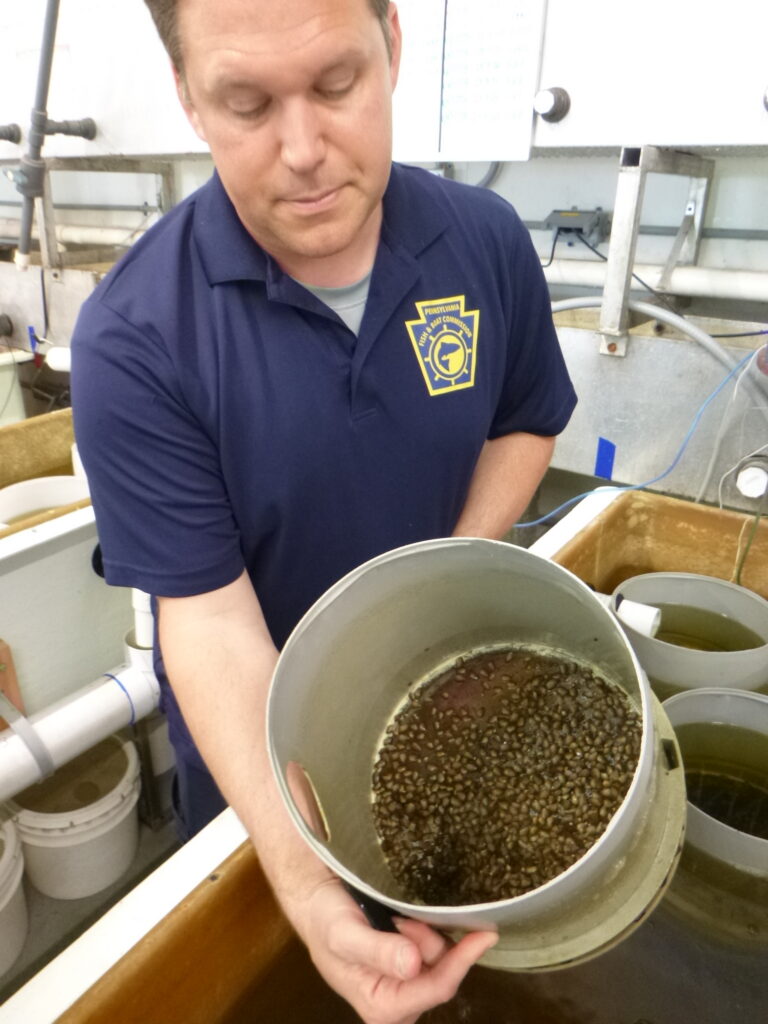
“The biggest challenge is that those mussels need a host fish to start the cycle,” Ray said. “We need enough hosts here to accommodate a huge number of glochidia because they are so tiny and their mortality is high. But if we can pump up the numbers game, we can still produce viable mussels for planting in Dunkard Creek.”
Flathead catfish, bluegills, darters, and smallmouth bass swim in aquaria inside the lab, destined to be hosts for mussel larvae.
After they drop from the fish, most mussel larvae require two years in special “Heath trays” in the lab before reaching a size when they can be stocked, one-by-one, by biologists and volunteers.
“Some species, like the pocketbook, take a third summer when we move them outside the lab into our pond. There we raise them to one-inch diameter before stocking,” Ray said.
In 2024, the Richard King Mellon Foundation awarded the Fish and Boat Commission an $86,000 grant that will expand the Union City Conservation Center’s capacity to raise mussels for re-stocking.
“The initial settlement funds went only so far in setting up this facility,” Ray said. “The grant from Mellon will improve our pond-rearing system which is key to parts of the life cycle. We can also enlarge our array of Heath trays that handle very small larvae. We were limited before, but now we’ll be able to boost our production by tens of thousands of mussels.”
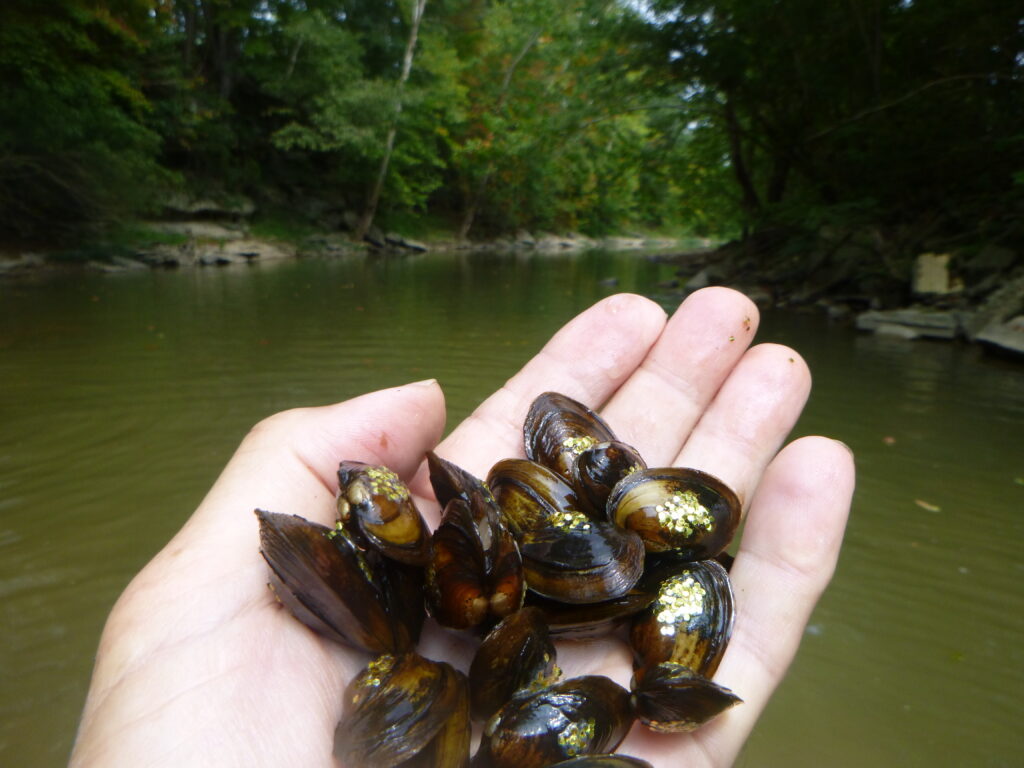
As the mussels grow and their release date nears, Ray’s team anoints each with a dab of glitter-paint so they can be identified later to gauge survival.
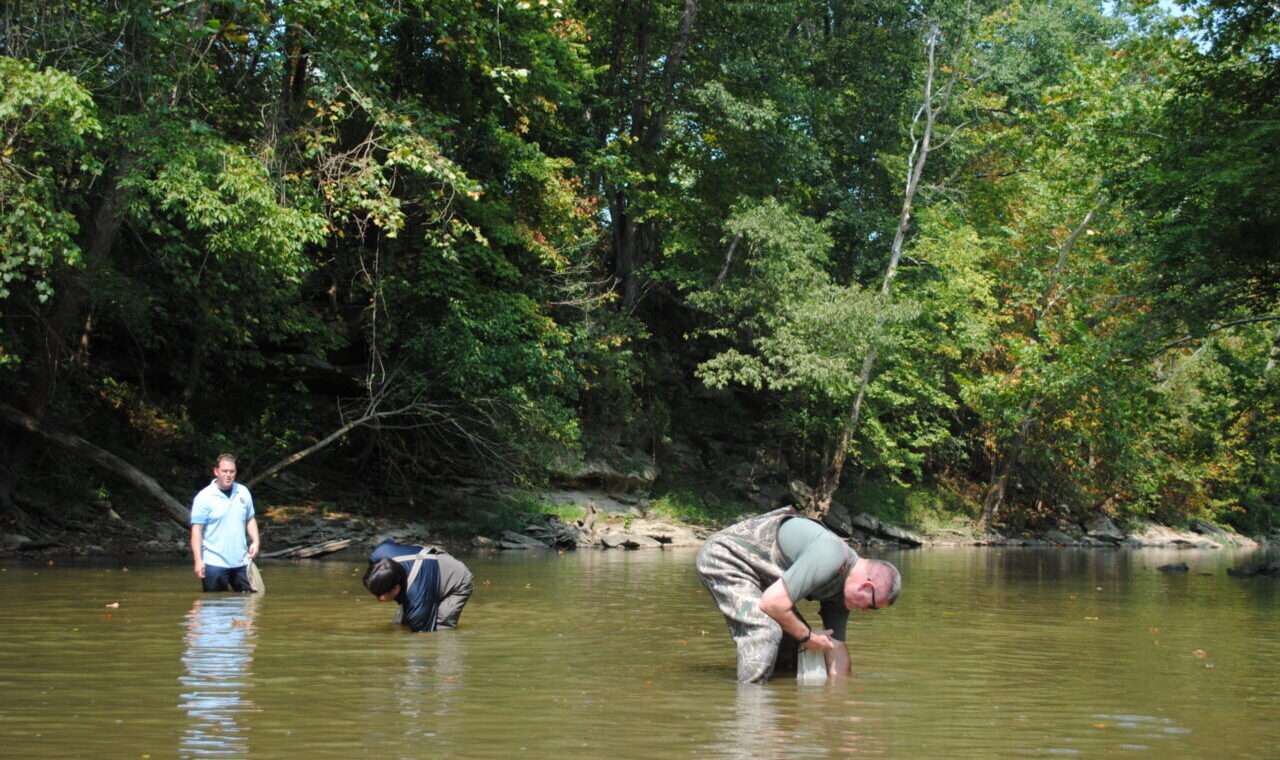
Last September, Ray, his lab team, and a dozen volunteers met along a secluded stretch of Dunkard Creek near Mt. Morris, Greene County. Ray opened his van’s hatchback to reveal two coolers. He reached in, lifted net bags bulging with hundreds of fatmucket mussels, their glitter-paint flashing, and handed a bag to each volunteer.
“Space yourselves out and wade upstream through this pool,” Ray instructed. “Press them into the bottom where there’s a mix of sand and rubble. Be sure to plant them ‘short side’ down.”
That last command refers to an anatomical difference between mussels and clams. Viewed from above, a clam’s shell is rounded and symmetrical, while mussel shells are “oblong,” with one “half” more bluntly tapered. Planting a mussel with its “short side” in the bottom enables it to extend its “foot” and move about.
Passersby would have wondered about that ragged line of mussel-planters, bent over with faces skimming the creek’s surface, peering at the bottom, stopping every few shuffled steps to reach in net bags, then submerging an arm to its pit.
After planting the fatmuckets, the group moved upstream where Ray gave each helper another bag of larger pocketbook mussels, to be stocked the same way.
“After learning about this effort, I wanted to get personally involved in the stream’s restoration,” said volunteer Grey Berrier, retired U.S. Army colonel from Pulaski, Lawrence County.
The all-volunteer Pennsylvania Governor’s Youth Council on Hunting, Fishing, and Conservation has made re-introducing mussels to Dunkard Creek one of its projects.
“It’s meant a lot to participate in work these scientists are doing to re-establish freshwater mussels,” said Sage Storm, a Youth Council member from Stahlstown, Westmoreland County, now studying biology at State University of New York. “Stocking mussels makes my coursework real.”
Since 2022, Ray, his colleagues and volunteers have planted 20,426 lab-raised mussels of various native species back into Dunkard Creek.
“We’ve come back and surveyed. We know our stocked mussels are surviving,” Ray said. “Next year we’ll dig up substrate in known plots, filter it, and look for larval mussels. If we find them, we’ll know the mussels we raised are reproducing, and that Dunkard Creek’s ecosystem is in recovery.”
No other toxic algal bloom has occurred on Dunkard Creek since the kill of 2009. But that could be little more than luck. Congress, legislatures, federal or state agencies have made no substantive changes to more effectively manage pollutants which likely stimulated Dunkard Creek’s devastation.
With symbiotic assistance from their fish partners, lab-raised “livers of rivers” are doing their part to make Dunkard Creek clean again. Time will tell if residents, leaders, and industries of the upper Monongahela watershed reciprocate that work with commitment to the ecological health of our region, and the health of everyone who lives downstream along the Mon.

Ben Moyer writes about nature, outdoors and conservation issues from his home in western Pennsylvania’s Laurel Highlands.