The Springhouse
I love outbuildings: springhouses, woodsheds, barns, cottages, tractor sheds. I’d have more if I could — a tool shed, a sugar house, a summer kitchen, a cider house. We have a small wooden building we call a goat shed because once we housed goats there. When the children were young, I wanted to convert a corn crib into a playhouse. (Sadly, I never got around to it.) On a trip to Vermont, we saw an outbuilding filled with old maps. A map house! If my husband had his way, he’d have one of those and a stone folly at the top of the hill.
Most outbuildings were simple structures — form ever following function, to paraphrase architect Louis Sullivan — used for practical purposes: to make maple syrup, press apples, cook during the hot months, or split wood. In his book, FARM: The Vernacular Tradition of Working Buildings, David Larkin explained the origin of early American outbuildings. When Europeans first came to America, settlers had to learn new ways of farming far away from the communal villages to which they’d become accustomed. Our landscape was vast and neighbors were distant, so farmers had to be even more self-sufficient. “The farms they built reflect this,” Larkin wrote. “In addition to a farmhouse and a barn, many outbuildings were built to accommodate the different activities of the isolated farmer.”
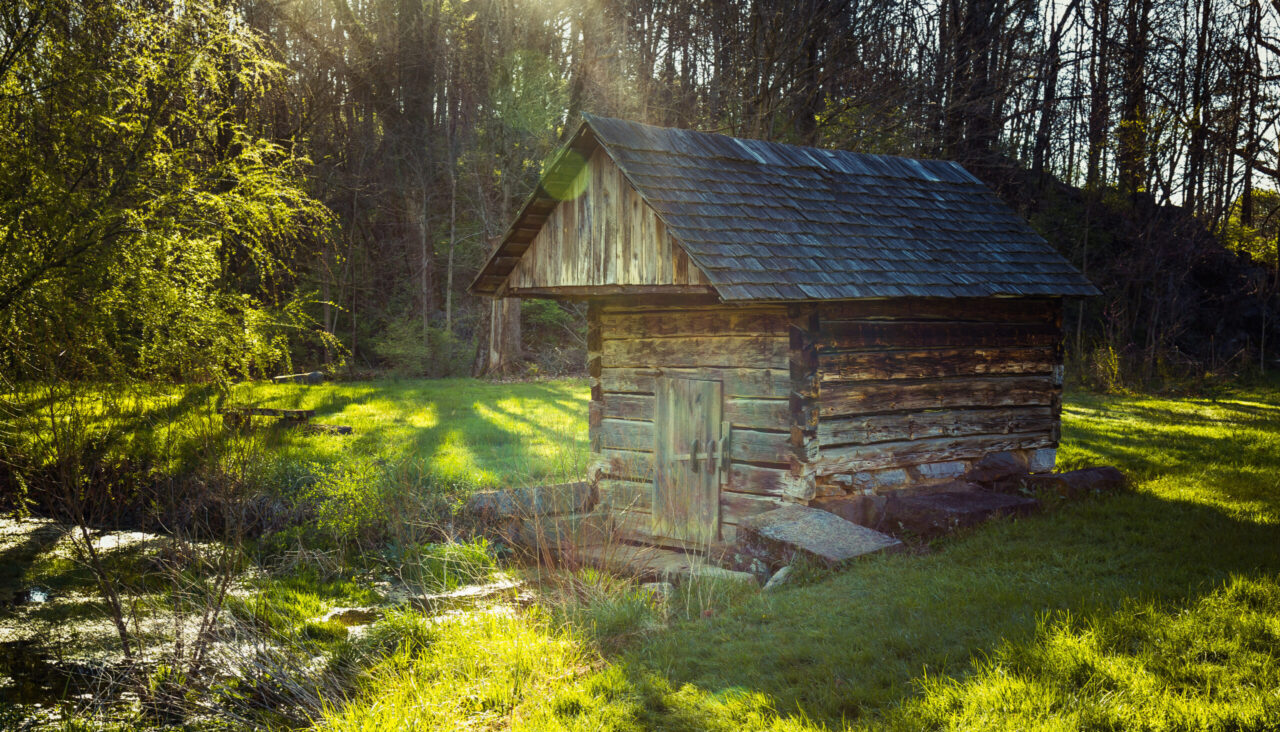
One of the first tasks of early settlers was to find water — for themselves and their livestock. That usually meant a natural spring; hence, the springhouse, a building so important that it was likely the first building constructed on a farm and indicated the location of the house and barn. We have a springhouse on this farm, a simple cement building with clapboard at the gable, likely rebuilt since the mid-19th century. It has a door and two windows and is nestled into the base of a hill, as many were. The building is painted white with green trim, matching the rest of the farmstead, and it is one story, but some springhouses had second stories to be used as living quarters or for other tasks, such as making butter. Ours is not beautiful, though many were, especially those made of stone or wood with cedar-shake roofs.
We have no moss on the roof, but according to Eric Sloane in An Age of Barns, moss was encouraged because it helped to keep such buildings cool. Springhouses were also surrounded by trees, often willows, which offered protection from the sun. We had a spectacular maple next to the springhouse, likely standing when the springhouse was built, which we just lost. Now, there’s an oak — stately, but younger — that shades the structure. I’ve also found glass and pottery shards around the springhouse, so it might have been a spot where settlers threw their garbage.
Springhouses were built directly on top of a spring or next to it. Ours is next to the spring, which is tucked inside a moss-covered stone enclosure. A wooden door with old iron hinges keeps the animals and debris out. Once we had a ladle there to sip the spring’s pure, cool water — a gourd hanging near the spring was customary for dipping — but that has disappeared. I will fix that.
Our drinking water comes from the farm’s springs — the best water I’ve ever tasted. When we bought this farm 38 years ago, we found, tacked to a basement wall, a handwritten note from the previous owner explaining the two ways that the water entered the house: one from the springhouse, the other from a spring located underneath the dining room. It’s all rather mysterious, a convoluted scheme I barely understand and one of the difficulties of living in an old log house. Still, the springs have never let us down, but I do worry about them running dry as summer droughts occur more frequently.
Springhouses were nature’s way to keep food cool, a forerunner to the icebox and the refrigerator. Water was piped from the spring into a trough inside the springhouse where earthenware crocks of milk, cheese, butter, cider, and other foodstuffs were placed directly into the water. There may also have been shelves and hooks to hang other food items that needed cooling.
Spring water never freezes. That’s because the water is deep, the flow constant, and it is warmed by the heat of the earth, rocks, and minerals. “Spring water maintains a temperature of around 53 degrees,” said Theresa Gay Rohall, executive director of the Ligonier Valley Historical Society and the Compass Inn Museum. On December 15 of last year, I tested her theory. The outside temperature was 7 degrees, with a below-zero wind chill. I opened the springhouse door and saw a leaf or two and some spiderwebs, but otherwise clear, clean water. I dipped a thermometer into the spring: 50 degrees.
In Foxfire, volume 4, the series of books that began in 1966 about Appalachian life, there is a section about springhouses. Harry Brown in Georgia said he preferred a springhouse because it didn’t take on the smell of fish as a refrigerator might. But Aunt Arie Carpenter in North Carolina said going to the springhouse required too many unnecessary steps to fetch her milk and butter, and forced her outside in the rain. “I wouldn’t trade one Frigidaire for a thousand springhouses,” she said.
Myths and superstitions surround springhouses. Amos Long, Jr. wrote in The Pennsylvania German Family Farm that:– “To have healthy feet, one must bathe them in the water from a spring every evening.”– “Dip the hands and feet of the newborn infant into spring water and it will never suffer frost hands or feet.”– “When an infant is born, the first thing it is fed should be water fetched from the spring in a thimble. Then it will not be constipated.”– “If there is no bullfrog in the springhouse, the water isn’t good.” (I have seen no bullfrog in the springhouse…)
Long has chapters on every type of outbuilding common to Pennsylvania Germans, including the ice house, the pigpen, the carriage house, the smokehouse, the privy, and some I’d never heard of: the malthouse, the sheepfold, the limekiln, and the dryhouse.
Such buildings may be simple and functional, but to me they are more than that; they are aesthetically pleasing, an improvement to any rural landscape. But as we’ve grown accustomed to life’s modern conveniences — not walking outside in the rain to fetch our milk, for example — springhouses have lost their usefulness. They are falling into disrepair and disappearing from our environment, a way of life not coming back.
Still, I’ll look for springhouses on my travels and take pleasure in their beauty. In doing so, I will remember a way of life more difficult perhaps, but one more tied to the earth.

Daryln Brewer Hoffstot's new book of essays, "This Patch of Earth: Observations on a Rural Life," will be published in July by Stackpole Books.