Look at Your Fish: David McCullough’s History Matters

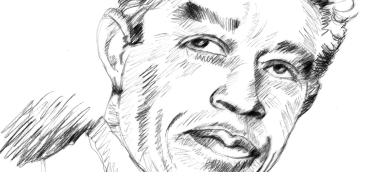
Historian and biographer David McCullough, winner of two Pulitzer Prizes, two National Book Awards, and the Presidential Medal of Freedom, said that his strength as a writer was his love of storytelling. Over his brilliant career, he wrote about remarkable events — the building of the Brooklyn Bridge and Panama Canal — and remarkable people — John Adams, Theodore Roosevelt, and Harry Truman. But, oddly enough, in 1992, when he sat down for The Paris Review interview, he opened with a fish story.
When interviewers asked him about the motto tacked up behind his desk, McCullough told them, “It says, ‘Look at your fish.’” He went on to tell them the story of 19th-century Harvard naturalist Louis Agassiz, who tested every new student by taking a smelly dead fish out of a jar, placing it in a pan, and asking the student to “look at your fish.” When the student said he didn’t see much, Agassiz would repeat “look at your fish” until the student finally began to see some of its characteristics. Agassiz was pleased, but asked the student once again to “look at your fish.”
McCullough told his interviewers he loved that fish story and had used it often when teaching classes on writing because seeing the true nature and character of one’s subject is “so important to a writer’s work.” It’s as important “for the historian as it is for the poet or the painter, it seems to me.” He then reminded his interviewers of Charles Dickens’ admonition to the writers of his generation: “Make me see.”
The Paris Review interview, David McCullough’s favorite, is one of 20 speeches, essays, tributes, and interviews that appear in History Matters, edited, after McCullough’s death in 2022, by his daughter, Dorie McCullough Lawson, and his long-time research assistant and friend, Michael Hill. While some of the pieces had been published before “for small audiences,” many were “previously unpublished.”
The pieces selected for History Matters let readers see in miniature what David McCullough achieved on a grand scale. In the “Figures in the Landscape,” section, there are wonderfully insightful essays and speeches on accomplished figures, ranging from the great late-19th-century painter Thomas Eakins and Harriet Beecher Stowe, author of Uncle Tom’s Cabin, to George Washington, regarded by McCullough as the greatest individual in American history, to a flawed Harry Truman, admired by McCullough for his “profound sense of history.”
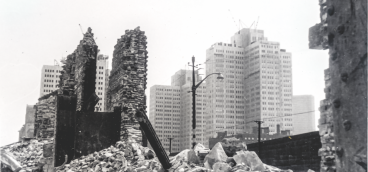
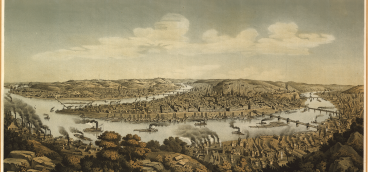
While most of the pieces in History Matters invite readers to look at McCullough’s historical landscape of great Americans, they also afford the opportunity to look at McCullough’s own life. In The Paris Review interview, when asked “What was it like growing up in Pittsburgh?” he replied that he was “very fortunate to have been raised there,” a view that echoed Anne Dillard’s — “It was a great town to grow up in” — in her An American Childhood, published in 1987.
Like Dillard, McCullough grew up in a privileged East End neighborhood, where he went to the best schools and was only a streetcar ride away from the Carnegie Museums, Pittsburgh’s cultural center, with its library and concert hall all under one roof. He remembered, as a “12-year-old kid,” entering a museum that had no dividers and conveyed a sense of openness. He walked through the library into the museum’s big hall, with its plaster model of the Parthenon, as dinosaurs waited for him around the corner, and, if he survived the encounter, there were the paintings of great masters, just past the dinosaurs and up a flight of stairs.
While McCullough lived a good distance from Pittsburgh’s steel mills, he remembered seeing the evening sky glowing from the mills, and in the morning seeing the outside of his bedroom window sill covered with soot. He told his Paris Review interviewers that if you were a kid riding Pittsburgh streetcars in 1945, “you heard three or four languages being spoken. You smelled the garlic. You saw the foreign newspapers.”
Besides McCullough’s historical landscape and his Pittsburgh childhood, readers of History Matters can see McCullough at work. He wrote all of his histories and biographies in an 8-by-12 feet shack just a stone’s throw away from the renovated farmhouse on Martha’s Vineyard where he lived with his beloved wife, Rosalee. He’d spend most mornings and afternoons writing and rewriting on his second-hand Royal Standard upright typewriter that he purchased in 1965. He loved that typewriter so much that he wrote an essay about it.
In 2012, he told those attending a conference on writing at Dartmouth College that “I love what I do. I love every day of it.” But, he warned his audience, comprising mostly aspiring writers, that “writing is hard work, make no mistake, but that’s what makes it so captivating.”
Near the end of his Dartmouth lecture, he offered some practical advice: They wouldn’t truly become writers until they learned to read their own writing critically and learned to “rewrite, rewrite, and rewrite.” As for writing about history, the job was to bring the past to life. He told them to remember that no one lives in the past, that their characters were living in the present, “much like we do. History is human.”
McCullough closed his Dartmouth lecture by urging his audience to read good writing, whether past or present, fiction or non-fiction: “Read everything good you can get your hands on.”
Ten years earlier, at a lecture he gave for the 2002 Library Congress Festival of Books, McCullough recalled the books that meant the most to him. The first book he took out of the public library in Pittsburgh was A Tree Grows in Brooklyn and the first book he bought was Richard Henry Dana’s Two Years Before the Mast, and that he still has it: “It’s one of my most treasured possessions.”
The list of books that McCullough gave to those attending his Festival of Books lecture included a number of works by Pulitzer Prize- and National Book-winning novelists, historians, and biographers, including Willa Cather, who spent her early writing career in Pittsburgh. For his most important book, however, he went back to the 17th century and John Bunyan’s The Pilgrim’s Progress. He regarded Bunyan’s allegory as “absolutely essential” reading because of its lesson for our times of overcoming our fears and acting with moral courage.
A lighter, but no less essential favorite? “Dear, old Bartlett’s Familiar Quotations.” He liked to sit down with it in the evening, randomly picking a century or two, and marveling at the richness of the writing and the language that William Shakespeare or John Milton passed along to us.
McCullough’s final words to his Library of Congress audience reminded them that “we live at a time and in a land where there is an abundance of choices,” and that includes books. “All those different voices. All those points of view.”

Richard “Pete” Peterson is the co-author, with his son, Stephen, of “The Slide: Leyland, Bonds, and the Star-Crossed Pittsburgh Pirates” and “The Turnpike Rivalry: The Pittsburgh Steelers and the Cleveland Browns.”