Glasco’s Biography Examines August Wilson’s Pittsburgh Origins and Voice
In 1918–19 in Zurich, Switzerland, English painter Frank Budgen found himself often drinking wine while enjoying long talks about writing with James Joyce, author of the controversial novel Ulysses. It was during one of those discussions that the self-exiled Irish writer shared his vision on getting the detailed setting of that masterpiece right: “I want to give a picture of Dublin so complete that if the city suddenly disappeared from the earth, it could be reconstructed out of my book.”
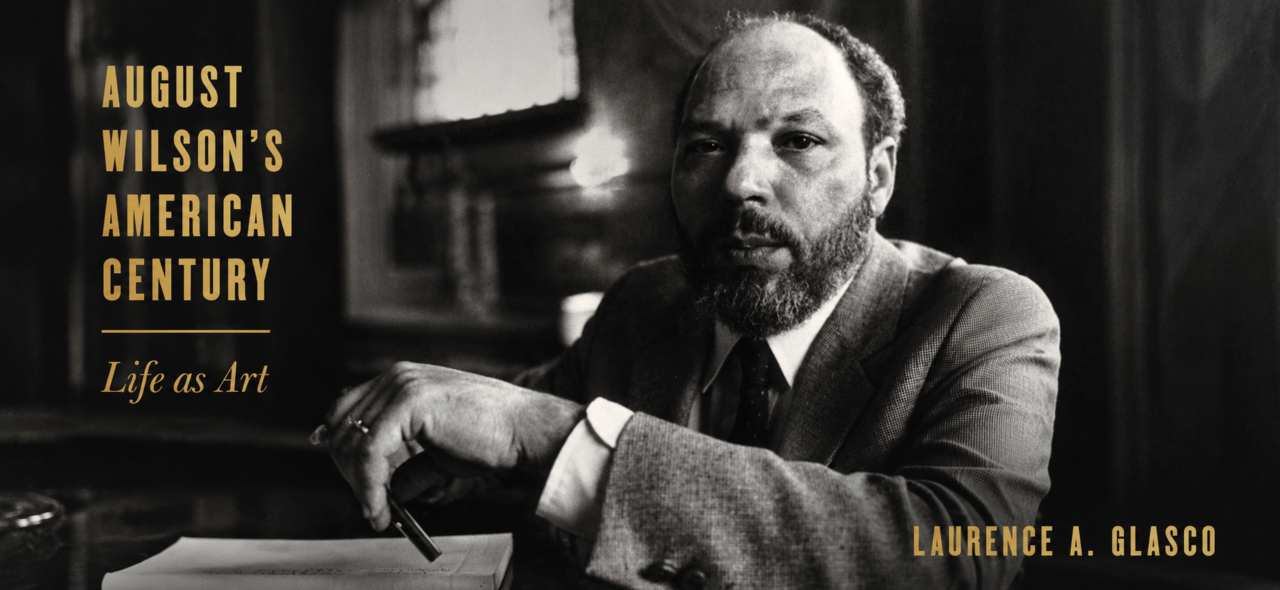
The same might be said of August Wilson’s portrayal of his native Pittsburgh, and, more important, the Hill District neighborhood where he grew up, shaping it into the focal point of his 10-play “Pittsburgh Cycle.” It’s also a testament to how place shapes a writer’s consciousness, as emeritus Pitt history professor Laurence Glasco states in August Wilson’s American Century: Life as Art: “Among theatregoers and many others, the Hill District has challenged Harlem as the metaphorical site of the urban Black experience.”
Wilson’s keen sense of place, in which setting becomes a character, brings to mind William Faulkner’s fictional Yoknapatawpha County, Mississippi, or Gabriel Garcia Marquez’s Macondo. But as with Joyce, it would take the distance of a move (in Wilson’s case to St. Paul, Minnesota) for him to “write what I know best.”
For many a Pittsburgher, the basic facts of Wilson’s upbringing are well known. Born to a white father (Fred Kittel) and black mother (Daisy Wilson) in 1945, “Freddy” Kittel would go by the pen name “August Wilson” from 1965 until his premature death from liver cancer in 2005. A high school dropout who’d go on to receive honorary doctorates, he spent most of his formative years immersed in reading at the Carnegie Library. It’s there (and in diners that allowed him to smoke and get free coffee refills) where Wilson, according to his friend, Franki Williams, learned to eavesdrop and mimic those rhythms in writing. She came to realize “how much he was interested in the way people talk.”
Jitney was the first Wilson play to make its mark, premiering in 1982 at the Allegheny Repertory Theatre, and it made good use of a youth spent in places like the jitney station on Wylie Avenue, finding rhythm in the banter of the drivers and others who frequented the spot.
Glasco’s emphasis on Wilson’s early years are most insightful and informative, making good use of interviews and archives throughout this well-researched book. But perhaps what’s more interesting is how Glasco teases out the threads of influence that Wilson weaved into his iconic plays. One is Wilson’s childhood neighbor, the former prizefighter Charley Burley (Archie Moore once called him “the greatest fighter ever”), who became both father figure and template for the iconic lead, Troy Maxson, in Fences. A garbage collector (same as Maxson), Burley was a “warrior” who “fights hard but does not hold a grudge or become consumed with bitterness who gets off the mat and stays in the ring throwing punches.”
August Wilson’s American Century allows readers to consider how Pittsburgh and the 20th century played roles in Wilson’s work. More important, it shows how Wilson acquired “traits that defined who he was and who he would become… outsider, warrior, race man, and poet.”

Fred Shaw is a Visiting Lecturer in Writing at the University of Pittsburgh.