Elegy for an Irish American Catholic Family
My mother died in late November at the age of 95. She was the last surviving member of her Irish American Catholic family. Her passing closed the century-long story of a Pittsburgh archetype, once more familiar, now a faded shade of green.
Her parents emigrated from rural County Kerry, separately and single, shortly before Ireland’s 1919-1921 rebellion against British rule. Siblings and cousins preceded them to industrialized Pittsburgh, then the nation’s sixth largest Irish hub. He became a streetcar motorman, she a household domestic. They were married at Holy Rosary Catholic Church in Homewood two weeks before St. Patrick’s Day, 1924.
That same year the U.S. Congress passed strict immigration quotas in a backlash against post-World War I immigration. An ascendant Ku Klux Klan spread violence and intolerance beyond the South, including Western Pennsylvania. The hooded order railed against Catholic schools and politicians.
The immigrant couple welcomed a daughter in 1925. They bought a house on Johnston Avenue in Hazelwood, behind St. Stephen Catholic Church, half a block from bustling Second Avenue. Five more daughters arrived over the next seven years, my mother the fifth of the six sisters.
The couple paid off their mortgage in the middle of the Great Depression with his union-backed wages and rental income from third-floor tenants. But tragedy interrupted the family’s success.
The 47-year-old motorman died of a heart attack in December 1941, between the Pearl Harbor attack and Christmas Day. He had just stopped the streetcar in front of St. Mary of Mercy Catholic Church in downtown Pittsburgh. A hastily summoned priest administered last rites aboard the trolley.
The six sisters were aged nine to 16. Their father was waked in the living room; his funeral held at the church that shadowed the back yard. “We thought the world was coming to an end,” my mother used to recall.
The widow and six sisters supported each other through World War II and all that followed. They were helped by the new Social Security program their father had enrolled in shortly before his death. But private sector jobs, family thrift, and deep faith played a larger role in their survival.
During the 1950s three of the sisters married men without Irish heritage but within the Catholic faith. My mother walked down the aisle at St. Stephen. These three women gave birth to a total of 12 children by the end of the 1960s. Two of the sisters entered the Sisters of Charity of Seton Hill and became Catholic school teachers. The sixth sister also remained unmarried, worked as an executive assistant, and lived with their aging mother.
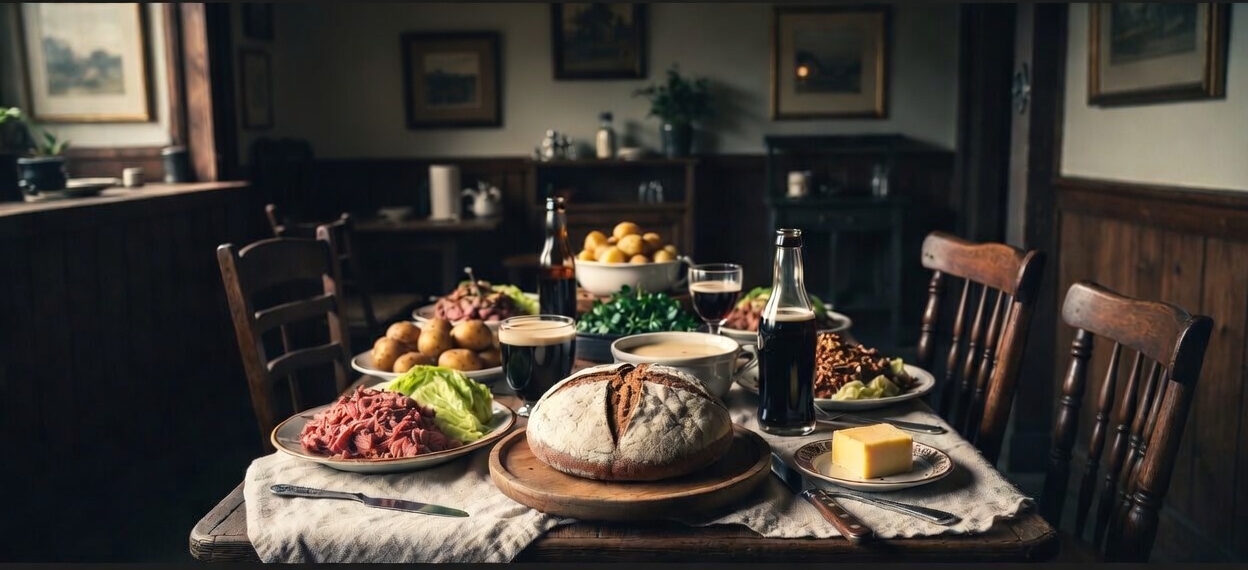
Spouses, children, and immigrant relations crowded a makeshift extended dinner table at Christmas dinners in Hazelwood. Everyone cheered when grandma presented the turkey with the help of her daughters. At St. Patrick’s Day my mother baked Irish soda bread, which we hurried to slather with butter while still warm from the oven. The married sisters hosted summer cookouts in suburban backyards. There were baptisms, first communions, confirmations, graduations, and weddings. The six sisters posed together for Kodak Instamatic photos long before smart phones.
One of the nuns traveled to Rome for the canonization of Elizabeth Ann Seton, foundress of her order and the first American-born saint. My mother and one of her sisters made a different type of pilgrimage, taking separate trips to Ireland. They slept in the thatched-roof cottage where their father was born in the late nineteenth century, still owned by a cousin. The Irish relations whispered about the Troubles in the North of Ireland and worried about lagging modernization when they visited in the 1970s and 1980s.
Nothing could stop the shuttering of the J & L Steel mill and other economic and social deterioration along once-robust Second Avenue in Hazelwood. Many of Pittsburgh’s Roman Catholic parishes consolidated or closed due to scandals and shifting demographics. “Catholic Ireland” secularized as it modernized. But the believers held the ancient faith in their hearts.
We mourned the death of the matriarch at age 92, “herself” having never lost that lilting Kerry brogue. The six sisters weathered surgeries and other emergencies. The three married sisters all became widows, just like their mother. Two of my aunts buried three of my cousins. Most of the other children, me included, moved away from Pittsburgh.
The first sister died in 2004, four others over the next 18 years. My mother was moved to a South Hills memory care residence two weeks before the COVID pandemic. She was confused by the window visits of her husband and adult children. It was heartbreaking for those of us standing outside the glass. She did not grasp the death of her husband after 62 years of marriage, did not attend his COVID-restricted funeral.
My mother forgot the names and events of her long life. She disengaged from viewing old photos. But she continued to pray aloud the “Hail Mary,” probably the first thing she ever learned from her Irish parents. She maintained a sweet and loving disposition, without the fear or rage that afflicts some seniors with memory loss. Learning to accept and love her as she was, not as she once was, became a great lesson for her visitors.
Occasionally, my mother wondered: “When am I going back to Hazelwood?”
Now, I believe, she is in a better place; reunited with her husband, her parents, and her sisters. I will remember them all at Mass on St. Patrick’s Day, and as I hurry to slather butter on my wife’s Irish soda bread while it’s still warm from the oven.

Pittsburgh native Mark Holan is a freelance writer and editorial director of a national industry association in Washington, D.C. He blogs about Irish history and contemporary issues at markholan.org.