The Tools Left Behind
Frozen forever in their black-and-white time, the two men gaze at me from separate photos atop a dresser. In one, my late paternal grandfather, Ray, “RC,” squats in the bright Florida sunshine while holding a tray of fish. A caption written on the photo’s border is in my grandmother’s (his wife Catherine’s) neat cursive: Snapper fillets. Dated December 1953, a shirtless RC is on vacation from his job at a Pittsburgh steel plant, appearing tanned and fit as he holds the wide tray on which about 20 red snappers are neatly stacked in several rows. Taken in the late afternoon, the photo captures the long shadow of an unknown photographer, maybe my grandmother, behind and alongside Ray’s own shadow. Ten years out from retirement, RC appears already at ease in a world far from Pittsburgh, a world that he and my grandmother would come to know well in later years after purchasing a home near the Intracoastal Waterway in Pompano Beach.
The second photo, taken in the 1930s, is an informal portrait of my late dad, Jack, posed by the photographer in a seated position on a lawn. Jack, or “JC,” dressed in an open-neck shirt, shorts, and a loosely knotted tie, is looking directly into the camera’s lens. Soon to grow into a lanky youth who loved baseball, JC would go on to attend college before settling into a career in business. The two of them — father and son — their interests overlapping only at the edges, embodied two distinct ways of navigating their worlds, with RC’s robust physicality being his trademark. Dad toed a more thoughtful, introspective line, though still hewing close to his Everyman roots. Despite their differences, they had at least one notable thing in common: their middle initial “C.” Bestowed upon them as first-born sons at birth, their Anglo-Saxon middle name “Croft” means field or arable land; “crofter,” a noun, means tenant farmer. But though their family tree may have been firmly rooted in the soil, neither man ever farmed, and only RC honored his agrarian heritage by tending a small backyard vegetable plot.
Beyond the odd humorous detail or one-liner, their fuller selves are impressionistic in nature, dots of illumination rather than sharply focused features, and as the years flow by it has become harder to know who they really were, if it can be known, beyond what remains. Reassembling clear images of them from my fragmented memories is as daunting as trying to piece together a shattered mirror, and with the passage of time it becomes all the more challenging as those memories become fragile and, inevitably, malleable. Slipping downward from view, they eventually disappear altogether. That said, it takes just a shard or two to trigger a partial assembly of their reflection, and at such moments I see RC’s weathered hands and his neatly trimmed nails, or recall the sound of his voice: “Son of a brick!” Come to life, I see my cantankerous, shot-and-a-beer granddad in his prime, pitching horseshoes at a family picnic.
While memories of my dad are triggered in much the same way, when they come, it’s like watching grainy documentary footage. Fully attentive to the details of those moments, I see him pull into our driveway in his company car and get out, briefcase in hand. Tall, with a slim build, he enters the house and, with his long fingers, removes his hat — one of the few men I’ve known who could pull off wearing a fedora. Resting near his photo atop the dresser is a penknife he’d occasionally slip out of a pocket to cut a string or skin an apple. Beyond that, much is anecdotal, but what can be said with certainty is this: Based on the lives they lived, the two Crofts were knowledgeable, solid men who could be counted on to do the right thing when times were tough. Perhaps just as important and impressive, they had the ability to fix things when they broke.
Which brings me to the tools.
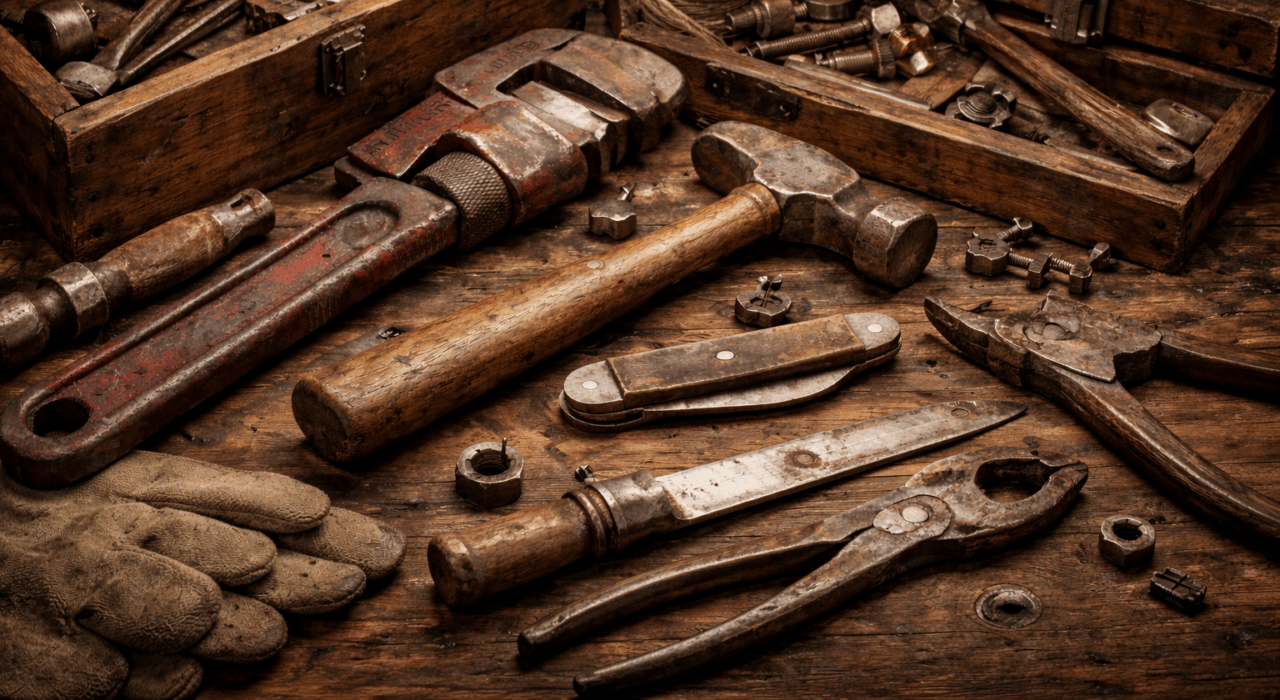
Rarely quick and never easy, at least from my experience, restoring anything mechanical to a working state requires more than a bit of thought and skill, and that restoration necessarily requires tools. Sadly, while only a trickle of the Crofts’ combined hands-on knowledge was passed down to me, I find myself, ironically at this stage of life, to be a man of many tools; a tool-rich man of many seasons. Just recently, while looking for the right tool to remove a stuck coupling nut from a trap under the sink, I came upon a large pipe wrench in a decades-old wooden chest that was made by and belonged to RC. Passed down to me and now relegated to the category of “heirlooms,” RC’s tools and my dad’s, all lightly used in recent decades, have found repose in the chest in my basement. Upon opening the lid and inhaling a musty scent, I saw what I needed and could almost see my grandfather nodding approval and saying, “That’ll do ’er.” Weighing several pounds and with an 18-inch steel handle, the pipe wrench was the only one with jaws wide enough to tackle the coupling. As I felt its heft, I wondered what bigger projects it had undertaken in my grandfather’s capable hands.
Much of RC’s how-to knowledge was passed to my dad, an old-school do-it-yourselfer, and among the tools in the chest is a hammer with a painted handle that he fashioned in a high school metal or wood shop. As a man of many talents, JC’s tool savvy remains on view in my home in the form of a half-circle end table that sits beside my favorite chair, while in my garage Dad’s neatly labeled cigar boxes — Antonio and Cleopatras, Roi-Tans, Dutch Masters — containing various fasteners, are stacked inside a weather-beaten wooden cabinet. Opening its door and inhaling its olfactory amalgam triggers memories of my dad working on some repair at home, his tongue quietly maneuvering outside his mouth, helping him concentrate. Always present in the background while he worked, mainly during the summer months, is the static-filled radio broadcast of a Pirates baseball game: “A little dinger, Dool!”
Other tools in the cabinet are waiting to be brought out into the light, and with them their muted histories. One such item is stashed inside a small wooden box that was carved by my wife’s late grandfather — a railroad man — to store a wood-boring auger from his era. Hollowed out in the shape of the auger from a single block of wood, it protects the tool, which still shines like new and must have been important in his work. Much “fashioning” went on back then, much “jury-rigging” too, both of which require a certain foundation of skills foreign to me, and I’m occasionally humbled by the fact that, aside from some light painting or replacing a light switch, much of what they knew has somehow failed to take up residence in my marrow. Though the men are gone now, in my imagination the two Crofts are sipping beers and looking over my shoulder, shaking their heads, as I struggle to repair something beyond my level of expertise. I realize only now, at this late date, that I should have asked more questions.
After Catherine passed away at 86 in Florida, RC lived for a time with my dad’s older sister Ruth and her husband Jim, outside Miami. When Ruth passed away, RC came north to live with my dad for several years before frailty made it impossible for Dad to care for him. RC moved, reluctantly, to a local nursing home where staff continued to see that he received his special “medicine,” a daily shot chased by a non-alcoholic beer. Two years later, when RC passed away at 95, my dad and I drove out to the nursing home early on an overcast morning to gather his belongings. It was a somber journey for us, made more so by events of that black day, April 19, 1995, the details of which we were unaware of until we entered the facility where televisions were tuned to news of the Oklahoma City bombing. In RC’s tidy room the television’s screen was black, silent. On the chair where he had been sitting just a few days before there was only his clothing, an electric razor, a few photos, and a toothbrush; no tools certainly. RC’s cremated remains were laid to rest in a family plot near Pittsburgh, where he was ultimately reunited with Catherine. She, who had always hated the Florida heat and had enjoyed the change of seasons in Pittsburgh, would have approved.
Exactly 10 years later, in May 2005, Dad, suffering from a degenerative nerve disorder, died and was laid to rest alongside his dad and mom. It felt like the passing of an era, and in the years to follow I reflected on whether I had taken full advantage of their knowledge and experience. Maybe it goes without saying, but people in the past, in what they’ve left behind — be it their words or the tools they used — have something important to teach us. For me, that realization has come slowly, along with my deeper appreciation of the Crofts and the gifts they left behind: their tools. As we know, there is a last day for everything, though the same cannot be said for tools. No matter how old or worn, they have no last days. Along with the muted memories of their work and those who labored with them, the tools remain waiting to be picked up by different hands, put to use, and to create new memories at some future time and place. In their dark storage they remain ready to resume their work, ready to live again.

Jeff Dooley, former Investigations Manager for the Carnegie Hero Fund Commission, retired in 2022.