Pittsburgh Opera’s “Time To Act” Asks What If Sophocles Wrote “The Breakfast Club”?
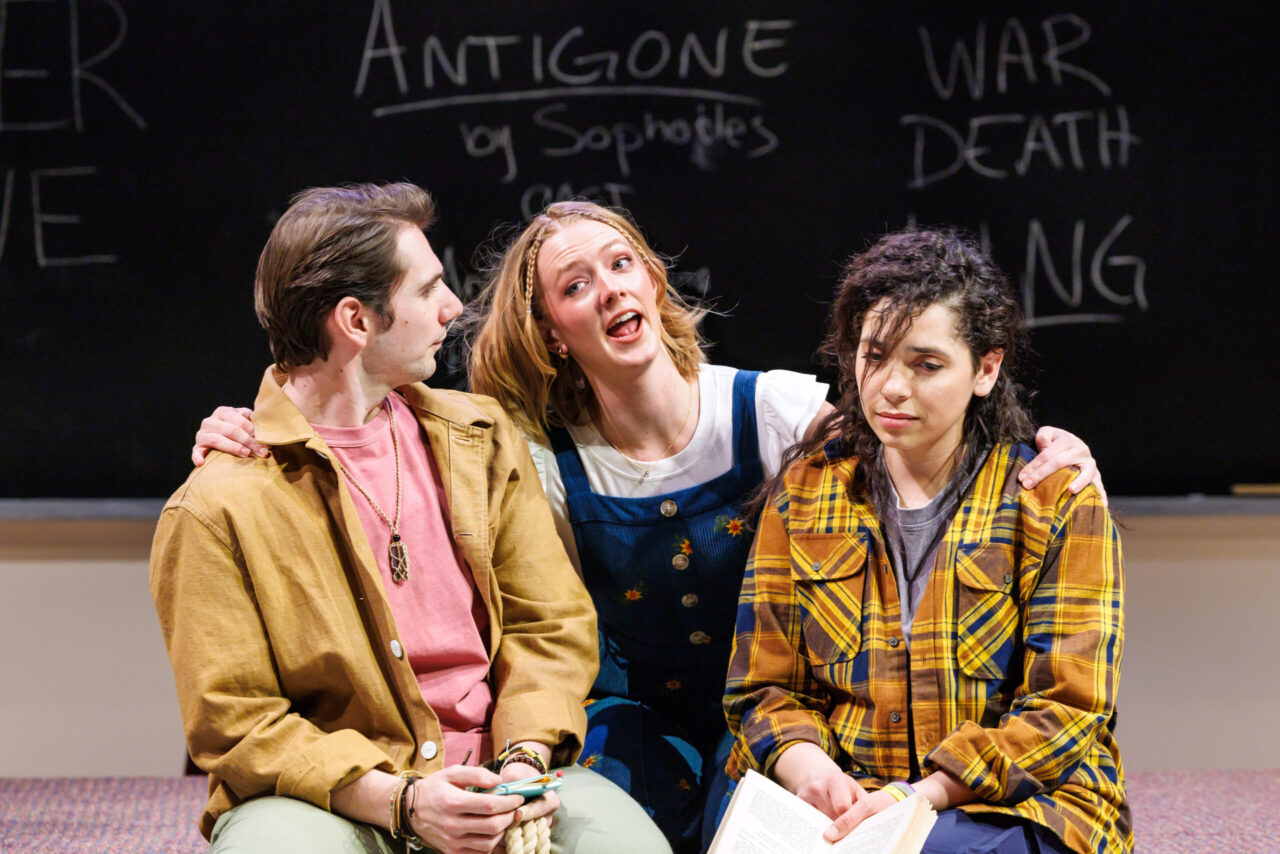
We may not know much about how Ancient Greek drama was performed, but we do know that it was fundamentally a musical, and more pointedly, a choral event. Furthermore, according to scholar Peter Wilson, it was the “sixteenth-century Florentine pioneers of opera who conceived of their new cultural project as basically a regeneration of Greek tragedy for a new age.” Thus, Pittsburgh Opera’s world premiere of “Time to Act” is not really the modernization of an ancient Sophoclean tragedy, as much as it is a restoration of the story of “Antigone” to its primeval, sung roots. Ironically, operas such as this may be the closest we can actually come to experiencing Greek theater as it was originally conceived.
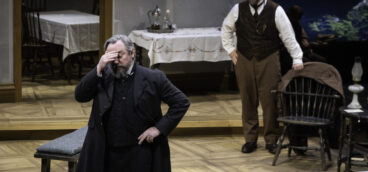
Librettist and director Crystal Manich transposes the setting to a contemporaneous high school, wherein a group of students are rehearsing a production of Sophocles’ “Antigone,” originally written in the 5th century BCE. Scenic designer Lindsay Fuori (who also designed the costumes) puts us in a classic school auditorium, and the first thing we hear is the pared down Pittsburgh Opera Orchestra, conducted by Michael Sakir, playing a jazzy drum and saxophone duet with a gritty, almost staccato vibe, joined by the kind of instruments you would find in a high school band room: piano, percussion, reeds and strings. It’s barebones, not lush, which is appropriate to a tragic setting. Composer Laura Kaminsky’s score accentuates the discordant mood of the students, giving us permission to enter their emotional realm in the way that Alfred Hitchcock’s scores (especially those composed by Bernard Herrmann) put audiences into the maelstrom of his characters’ minds.
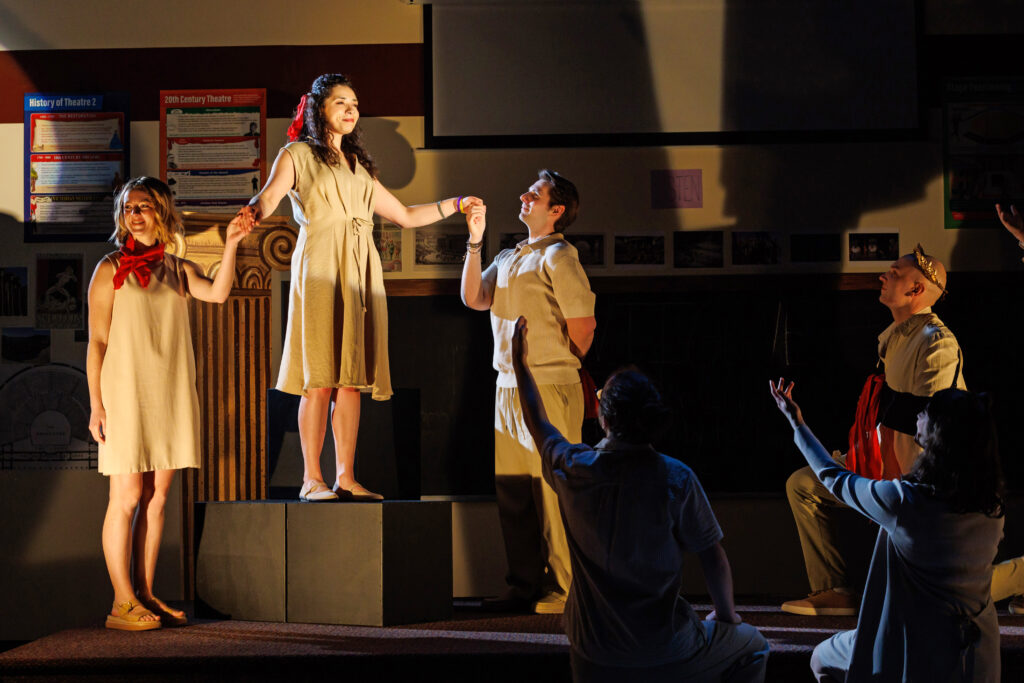
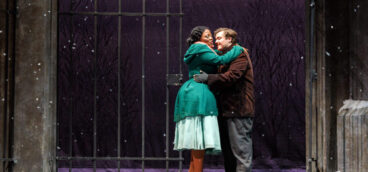
In the middle of the rehearsal process a new girl enters the school, Alona (mezzo Timothi Williams), who is clearly experiencing PTSD, which throws off the psychic balance of the cast. As the words of Sophocles’ play (mostly sung, and sometimes spoken) start to resonate with the group, we begin to sense the inchoate feeling that what is not right with Alona is connected to what is not right with the characters in the play . . . and may be what is not right with America. This miasmic foreboding grows in intensity until we discover Alona’s secret, which involves an experience with gun violence from her past. Impressively, none of this is self-evident or predictable. Like a good film noir, we walk with the students in their quest to uncover the truth about Alona, and how her tragic past merges with the tragedy of the play they’re rehearsing.
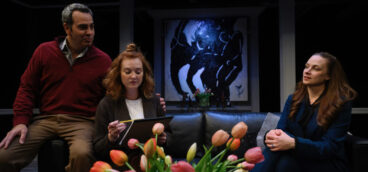
The five main characters represent archetypes similar to those in the film “The Breakfast Club,” as we have a teacher (baritone Yazid Gray), a jock (baritone Erik Nordstrom), a basket case – Alona, the sweet girl (soprano Shannon Crowley), and the nice guy (tenor Logan Wagner). Also, as in Greek drama, there are seven or eight other characters with minor roles, representing the chorus.
It should be noted that the cast comprises young artists who not only look, but sound the part. They should be given credit for having to sing, speak, and act throughout a challenging score which is devoid of sweeping orchestrations and melodic lyricism: this is edgy material and they handle it like veterans with many seasons of stage experience.
So here we have a play within the play, which is wrapped within an opera, which is really about the state of the society we live in.
Mr. Nordstrom, as the jock, has the longest developmental arc, and his rich baritone encompasses a wide array of vocalizations, including scat singing. Also impressive is Ms. Crowley, whose soprano expressions infuse the room with sonic luminosity while the others are quarreling,
There are many tragic works upon which Ms. Manich could have based this drama, but “Antigone” is an enlightened choice. The character of Antigone is one of the strongest, if not bravest, female roles in theatrical history: she stands up to everyone for what she feels is right, even if it means sacrificing her own life. Antigone exemplifies the fearless interiority inherent in the dramas of Sophocles, engendering a recognition of human psychology that is not really encountered again until Shakespeare.
I won’t spoil the plot, which deserves to unfold organically, but one of the key questions this production asks is, can a book stop a gun? This is a pregnant conundrum, as books are growing increasingly rare in our society, and guns are increasingly ubiquitous. We used to seek out books for answers to ethical, cultural, and political questions, but now we use guns for many of these purposes. The students – who represent so many students today encumbered by the stress of active-shooter drills their schools practice – see guns as intrinsic to their pedagogical experience, the way books used to be.
The trauma that has resulted from this paradigm shift, as Alona’s experience illustrates, is often the unseen, or perhaps unacknowledged elephant in schoolrooms today. Aristotle commented on the cathartic power of tragedy 2,500 years ago, and we can glean from “Time to Act” that nothing has changed to this day. The Ancient Greeks placed shrines dedicated to Asclepius, the god of medicine and healing, next to their amphitheaters – like salubrious loudspeakers — as they believed in the curative powers of music and song.
My only criticism is that the lyrics become a little preachy at the end – such is the vogue of art in almost any form today – and yes, we get the double entendre of the title, it doesn’t have to be hammered so hard. But these are minor issues in an otherwise strong, innovative endeavor. See this production, and don’t forget to bring your kids. You’ll get to introduce them to opera in a form simultaneously ancient and modern. And you can learn from each other. How often do we get to explore the abyss and joy of human experience in such a synergistic and compelling manner?
TIME TO ACT continues through March 8th, Bitz Opera Factory, Strip District. For further information: www.pittsburghopera.org or 412-456-6666.

Stuart Sheppard is an award-winning critic, essayist, novelist, and poet who writes “The Hamlet Machine” column for Pittsburgh Quarterly. Follow him: @HamletsMachine.