No News is Bad News
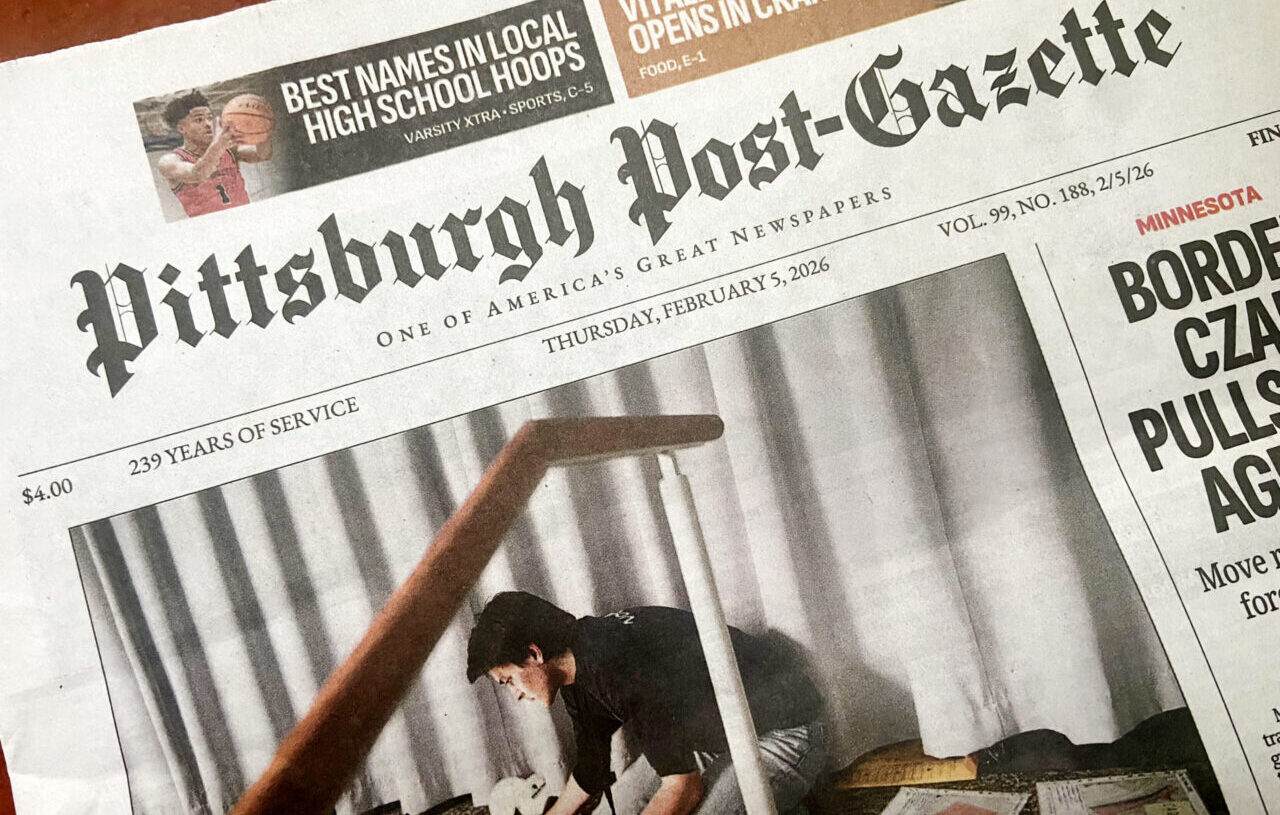
Within a day of the Jan. 7 news that the Pittsburgh Post-Gazette will close on May 3, I began receiving emails suggesting I create a group to save the paper or start a replacement. Why? Because I worked at The Pittsburgh Press and Post-Gazette for 20 years as an investigative reporter and business editor, and I’ve run Pittsburgh Quarterly for the last 20 years. I didn’t and don’t relish the role of “saving” the paper. I’m already working more than ever, partly on the magazine but mainly on Pittsburgh Tomorrow, the nonprofit I started to turn around this region’s population losses. And that project — to reinvigorate the economy and civic spirit — is gaining steam.
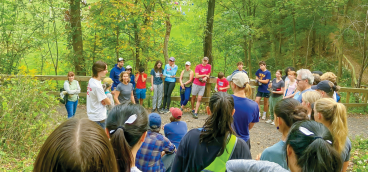
But I did take two first steps. I researched the facts. And I quickly convened and moderated a Pittsburgh Tomorrow panel on Jan. 29 at the Heinz History Center. A crowd of 300 braved that frigid night to hear the panel that included: Jim Busis, Pittsburgh Jewish Chronicle publisher; Andrew Conte, head of Point Park’s Center for Media Innovation; Rod Doss, New Pittsburgh Courier editor and publisher; Luis Fabregas, Trib Total Media executive editor; City Cast’s Megan Harris; Terry O’Reilly, head of WESA and Pittsburgh Community Broadcasting; Evan Rosenberg, Pittsburgh Business Times publisher; and Public Source editor Halle Stockton.
Rumblings abound about who’s jockeying to fill the coming void. Former mayoral aide and former Penguins executive Kevin Acklin quickly announced he’d form a group to buy the PG, but he has likely removed himself from serious consideration by publicly criticizing the Block family, which owns the paper. PG union workers say they might start a paper. Nonprofit journalists have met with local philanthropic foundation leaders. And Trib Total Media will launch a Saturday Pittsburgh edition on May 9, returning to the Pittsburgh city market it largely left after the death of its former owner, Richard Mellon Scaife. Finally, rumors that “a billionaire” might buy the PG were stoked in early February when David Hoffman, whose family bought the Pittsburgh Penguins in December, announced his interest in the PG.
THE BLOCK FAMILY
Over the past 35 years, I’ve gotten to know the Block family. I don’t see them socially, and I haven’t seen most of them in decades. But when I left the paper 20 years ago to start this magazine, I offered the Blocks a small ownership percentage if I could use PG writers, which I did on about four occasions over 20 years. Since then, none of the Blocks has been involved in anything regarding this magazine. Still, I respect each of the family members in the various branches — different as they are — and as the sun sets on their ownership, I’d like to reflect on their tenure.
The Blocks have owned the Post-Gazette for 99 years, since Paul Block and his close friend and business associate Wiliam Randolph Hearst created the merged paper, which traces its lineage to 1786 and the Pittsburgh Gazette, the first paper west of the Allegheny Mountains. The good times involved high margins for decades and a noblesse oblige typified by something the late Bill Block Sr. told me at dinner one night. He said that when he sensed a recession might be coming — and they could often tell early because the paper was the center of the city’s advertising — he didn’t shrink the paper’s size or reduce staff because he didn’t want to set an example that might cause or accelerate a regional recession. It was a remarkable and decidedly uneconomical example of civic responsibility and leadership.
The family continued that sense of obligation and responsibility long after the good economic times stopped — especially for the past 20 years, when they employed well over 100 journalists, even though their losses mounted, ultimately topping $350 million (most of us have no conception of how much money that is) — in order to provide Pittsburgh with one of the country’s best regional newspapers.
So, in their own way and for a long time, the Blocks have been major Pittsburgh philanthropists. Yet over the past 20 years, they’ve received tepid support, at best, from the business community and outright hostility from many quarters. Some of the latter was due to their change from reliably toeing the liberal line under Bill Block Sr. to a conservative populism under John Robinson Block, who believes the nation’s heartland has been largely neglected and undermined by the coastal elites. John has been vilified for his political views (which mirrored those of half of the country). And though he’s not the outwardly affable fellow his uncle Bill was, it was largely John’s commitment to Pittsburgh and journalism that kept the paper publishing these last 20 difficult years. And during that time, its news coverage has been generally excellent and right down the middle, winning a Pulitzer in 2018 for its “immersive, compassionate” coverage of the 2018 Tree of Life shooting.
Adding to the “anti-Block” chorus was a strike that began in 2022. The unions understandably wanted their economics to improve. It’s also understandable that the Blocks felt that keeping the paper going and continuing to pay people while suffering massive losses was the best they could do. In Pittsburgh, though, the prevailing narrative was that the Blocks were monsters and the strikers were martyrs. And though the strike ultimately included a small minority of the staff — just 26 journalists — former Pittsburgh Mayor Ed Gainey hid behind it to avoid the paper’s tough questions. And many businesses withheld advertising for fear of being perceived in Pittsburgh as anti-union.
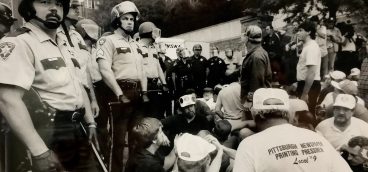
The increasingly bitter strike dragged on for three years. The paper kept publishing because, I’ve been told (not by the Blocks), the owners believed a path to profitability existed. But when the U.S. Supreme Court refused to hear their appeal, forcing the PG to take back the striking workers under 12-year-old contract conditions, that path to profitability ended. The May closing was announced the same day. The union won a classic Pyrrhic victory. Soon they’ll likely lose their jobs and Pittsburgh will lose its historic paper. It’s a story that’s played out here repeatedly over the past 50 years, including the Pittsburgh Press, which closed after a 1992 strike.
I’m not suggesting the Blocks need a pity party. John and his identical twin Allan literally grew up as little boys in the business. They’re smart and tough, and they know the bruising media business at least as well as anyone in town. All that said, I believe that they and their cousins — Bill Sr.’s family — care deeply about the Post-Gazette, Pittsburgh and their legacy. I think they’d like to see a viable, daily product continue here under responsible community ownership. And the Post-Gazette’s assets clearly have value, whether it’s the name, the journalists, the archives, the subscriber list, and/or the intellectual property. Determining that value, however, and making a deal for it won’t be easy or quick, not the least because the Blocks are a family with many members.
THE FOUNDATIONS
Until 20 years ago, when Warren Buffet threw his money in with Seattle’s Bill Gates, Pittsburgh had the nation’s highest philanthropic wealth per capita. Pittsburgh still has anomalously massive philanthropic wealth — $15 billion to $20 billion. And since the PG announcement, news stories and columns from across the country have trumpeted nonprofit models in which foundations support or own newspapers. In Philadelphia, after several failed ownerships and bankruptcies, philanthropist Gerry Lenfest put in more than $100 million to buy the Philadelphia Inquirer, now the country’s biggest paper owned by a nonprofit. Many have suggested that Pittsburgh follow suit.
Let’s not forget, though, that Pittsburgh’s foundations became journalistic activists long before most cities. In 2011, two local foundations believed they could create better journalism than what existed here. It’s worth recalling that, in 2011, the Blocks and conservative billionaire Dick Scaife had been battling for 20 years with massive spending on both sides. In that already intensely competitive environment, the foundations purchased and closed jazz station WDUQ and created nonprofit station WESA to have more National Public Radio programming and a competing radio news organization.
Simultaneously, those foundations believed Pittsburgh lacked investigative reporting, despite what the dailies were doing and spending. They created and funded another new nonprofit, Public Source, to do that. Public Source’s leaders tried but never succeeded at investigative reporting, which is extremely challenging and nuanced. And now, small teams at WESA and Public Source work hard to do daily news and feature reporting, battling for subscribers and donors and keeping their heads above water with continuing foundation support.
Part of the role of foundations is to pioneer and fund new approaches, which they’ve done here in many areas including journalism. But a few questions are in order. Are local foundations happy with their journalistic investments? Do they now wish they had stayed out of the fray 15 years ago or had, instead, supported the Post-Gazette, by far the biggest employer of regional journalists? Did they effectively distort the news market here by creating and subsidizing nonprofit competition that ultimately weakened the private news organizations? Those questions likely will never be answered publicly, in part because foundations tend to be beyond the purview of the journalists they fund.
SOLUTIONS FOR THE FUTURE
Despite the number of local news outlets — topping 40 in a recent count — if you ask Pittsburghers of any age where they get their local news, the answer is usually the Post-Gazette. Our Jan. 29 panelists generally agreed. Most also described a varied news scene and said that there will not be a “news desert” after the Post-Gazette ceases.
My view is that Pittsburgh is a major city, and it needs a large and robust daily news company. We will not be adequately served by a constellation/cacophony of disparate, tiny outlets, none of which has the staff or audience to cover the region and give it a central intellectual gathering place. A newspaper, in whatever form, provides a city with information, consensus and identity, which we need now more than ever.
The most pointed question I asked the Jan. 29 panel was directed to Luis Fabregas, editor of Trib Total Media, which includes the Tribune-Review. I wrote it out:
“Luis, I assume that when people ask, ‘What will we do without a daily paper,’ your reaction is ‘What about us?’ I have a two-part question. First, how many journalists do you have? Second, my main question has to do with your funding. For many years there was a pitched battle between the Blocks and your former owner, Dick Scaife — the Blocks lost $350 million, and reports say Scaife lost twice that amount. After his death, the Trib curtailed many of its Pittsburgh activities. My question is, how much money did Scaife’s estate leave to the paper? I realize it’s likely a private matter, but I ask because, right now, many in this region are seeking pockets that are deep enough to fill the PG void. And if you guys have a big enough pool of funds, you may be the White Knight that solves this whole problem. If you don’t, then we may need other options. So, that’s the context. Do you have the money, will and ambition to become Pittsburgh’s paper of record?”
I don’t blame Fabregas for not answering with the specific amount of money, but he gave an excellent answer, that the Trib does have the will and ambition. They currently have about 80 journalists, and they are making plans to move into the coming void. I initially included a figure in this story about how much money was left from Scaife’s will to support Trib Total Media. Company representatives, however, said the figure was inaccurate. They declined to specify the actual amount, so we don’t know how much money there is.
Given what the Trib already has, and in the absence of a benign billionaire stepping in (which could happen), I believe there’s an obvious conclusion: The Trib is the leading candidate to run Pittsburgh’s future newspaper.
I say this as someone who viewed the Trib as “the enemy” for the 10 years I was at the PG. Back then, we viewed Scaife’s prohibitions about his political opponents ever having their photo on the Trib’s front page as proof that they could never win. But things change. And after Scaife’s death, the Trib is a different paper. It has trained and still employs many excellent journalists — three were on our Jan. 29 panel: Conte, Harris, and Fabregas. They know the market. They have a business structure. They have a strong editorial team.
But the Trib team needs to show this region that it’s serious about filling the void. It needs to come up with a plan and earn this community’s support. If its leaders are smart, they’ll welcome partnerships and realize that they, too, will need to change and improve.
But if they can come up with such a plan — and in short order — and if they can persuade this region’s leadership that they’re up to it, then we should rally around them.
If that happens, local foundations should consider finding a way to help the Trib hire and fund a group of the best and most promising Post-Gazette journalists, however many that might be. Businesses should advertise, and readers should subscribe. Just as the smaller Post-Gazette swallowed the larger Pittsburgh Press in 1992, a “Trib-Gazette” could become this region’s new paper of record. It could grow into the role that all of us here need: a bastion of strong and independent journalism that gathers the news with a grave sense of responsibility and with the awareness that our community has many points of view.
A NEWSPAPER’S ROLE
In the lobby of the now-empty but always-ugly old Pittsburgh Press building at 34 Blvd. of the Allies, there was a bust of E.W. Scripps, the newspaper’s founder. As a 23-year-old, I befriended the lobby security guard and he used to let me have some fun with that bust by employing an old Clarence Darrow trick. As his courtroom opponent was making closing arguments, Darrow would light a cigar, into which he had inserted a long, straightened-out paper clip. As he puffed away, jurors were transfixed by the fact that the ash on Darrow’s cigar reached several inches long without falling, clinging to the unseen paper clip. I used to place a cigarette in the mouth of that old Scripps bust, and visitors were amazed at the three-inch ash as it burned down.
That was my second favorite memory of that bust. My favorite is the bronze words engraved under Scripps’ name. They read: “Give Light and the People Will Find Their Own Way.” I, for one, took them seriously.
We mourn the PG’s imminent loss, but the history of Pittsburgh newspapers is a list of old names, most of which have faded out of memory, including: The Gazette, Sun, Times, Dispatch, Post, Telegraph, Advertiser, Courier, Tribune, Sun-Times, Press, and many more, with the next maybe being the Post-Gazette.
Whatever the name, the key is having a traditionally trained, non-biased news organization led by seasoned professionals who understand the essential role that journalism plays. And that means not having the hubris of thinking you know the truth before you do your reporting and then telling people what to think.
I don’t personally think a for-profit paper is impossible. I’ve run a profitable magazine for 20 years. Yes, it’s small and not really comparable, but I believe it’s doable here. And I actually don’t believe we need or even want an enormous pot of money to waste — to have an angel from heaven bestow $100 million or more onto an effort that allows its beneficiary to operate as it always has, losing money and following a dated template.
I think we need something different. Whether it’s the Trib or a billionaire or a group that has not yet coalesced, what we need is a news outfit that’s scrappy and hard-working; that adapts to changing readership and adopts new technology; that is nimble enough to respond to the demands and needs of the market; and that has the gravity, humility and sense of fair play to understand Scripps’ old motto and to lead this great city into the future.

A journalistic innovator, Heuck has been writing about Pittsburgh for 40 years, as an investigative reporter and business editor at The Pittsburgh Press and Post-Gazette and as the founder of Pittsburgh Quarterly. His newspaper projects ranged from living on the streets disguised as a homeless man to penning the only comprehensive profile in the latter years of polio pioneer Dr. Jonas Salk to creating a statistical means of judging regional progress that has led to similar projects across the country. Heuck's work has won numerous national, state and local writing awards. His work has been cited in the landmark media law case "Food Lion vs. ABC news." He is also the founder and CEO of Pittsburgh Tomorrow, a nonprofit whose mission is to reverse population decline by reinvigorating the region's civic spirit and economy.