Barebones Says No to Nothing in “Our Dear Drug Lord”
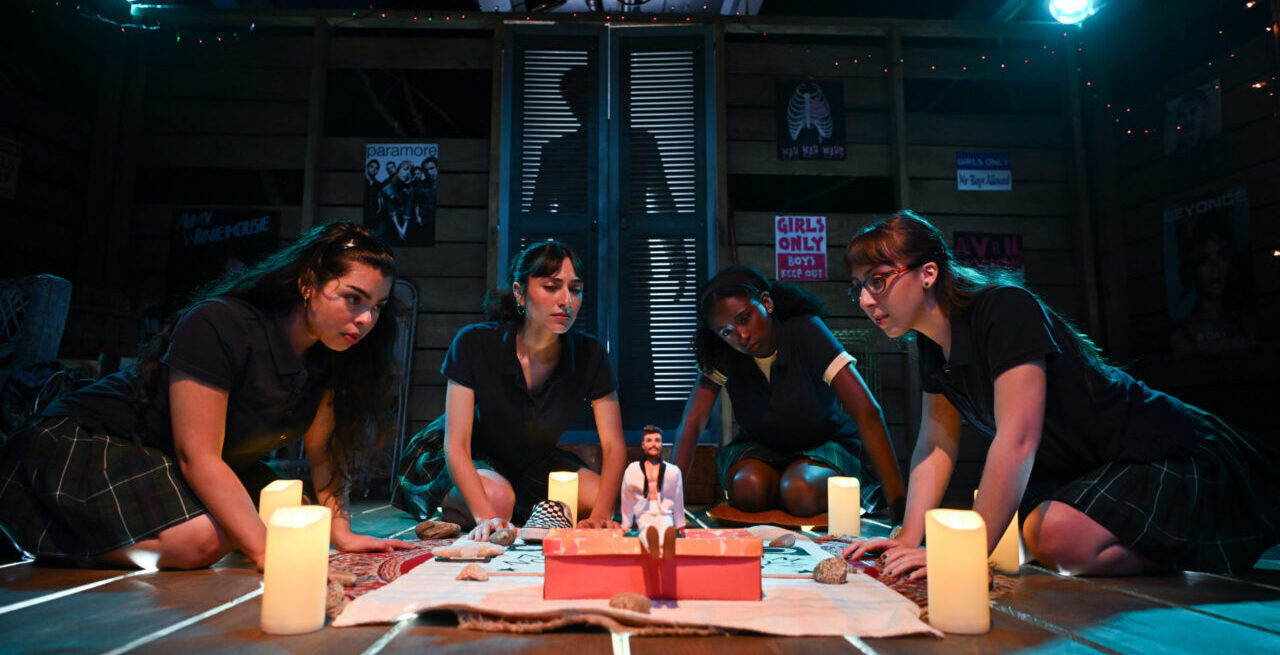
I once asked Barebones artistic director Patrick Jordan about something risky he did in a play, and he responded, without hesitation, “I’ll say no to nothing.” This ethos is certainly the basis for the company’s new production, “Our Dear Drug Lord,” (2019) in which four high school girls try to conjure the ghost of the Colombian drug trafficker and narcoterrorist Pablo Escobar, who became an international cultural phenom from the 1970s until his death in a bloody police shootout in 1993.
This would make an intriguing story, but it’s the moments that vivify live theater, and there are some shocking – and even violent – moments that lift this show above the usual story-based plays to which you may be accustomed. Before I go any further, I should warn readers that the rest of this review will contain spoilers, so stop here if you intend to see this production (which I strongly think you should), and please come back later to finish it, as foreknowledge of the action will definitely attenuate your experience.
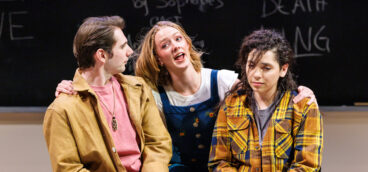
Tree houses, as escapist constructions, can do strange things to the people who visit them, and playwright Alexis Scheer utilizes this conceit in creating a believable foundation for some horrific acts committed by four prep school girls, ages 15 to 18, who are bored with their lives and need an outlet for their hyper-charged imaginations. Their leader, Pipe (Gianna Gutierrez), is dealing with the post-traumatic impact of the death of her little sister, and the gang she collects all suffer such hidden psychic damage, whether they realize it or not.
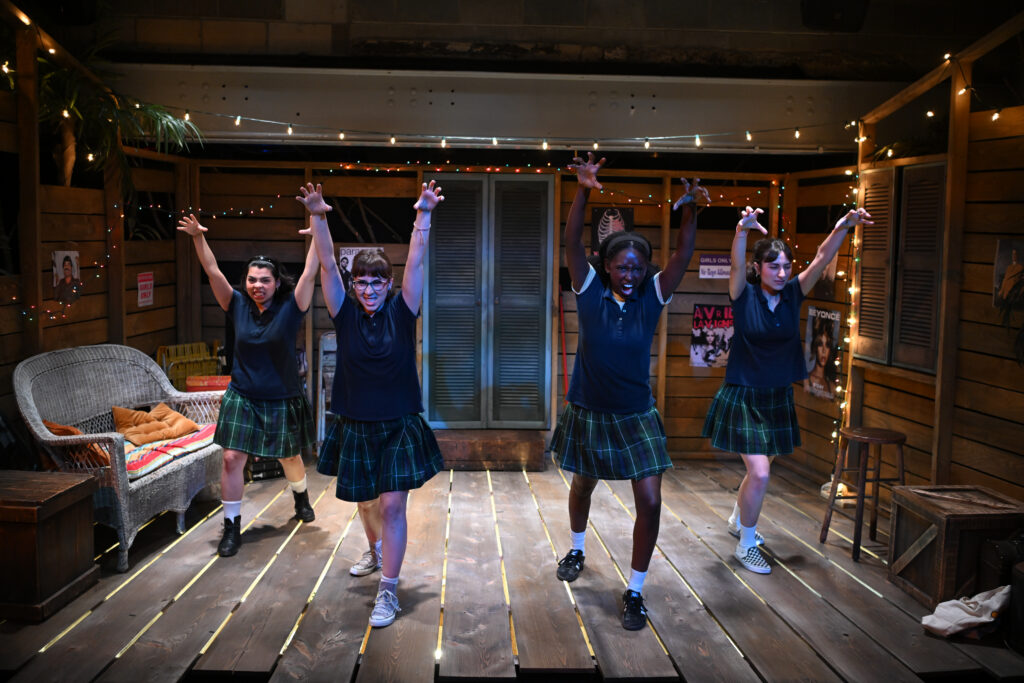
Zoom (Lila Grace English) is the oddball of the group; she’s Jewish, while the others are either Latina or black. Playwright Scheer emphasizes identity constantly in her dialogue and even more so in her casting notes. Perhaps she doesn’t want to be accused of presenting “privileged” or “elitist” characters, even though, ironically, they’re all wearing private school uniforms, and the maid lets the kids in as the parents are seldom home. As a virgin, Zoom has pregnancy fantasies, which the other girls mock but eventually take seriously, with satanic repercussions.
Squeeze (Ava Benson) evinces a morbid haughtiness; she has no compunction urging the strangulation of a cat because its presence in the tree house makes her sneeze. And finally, there’s Kit (Aurora Martinez), the newcomer to the “club” – they refer to themselves as the Dead Leaders Club – who isn’t intimidated by the bizarre rituals of her new friends. In fact, she nonchalantly volunteers to murder the cat, and does, with the ease of someone snapping the crown off a head of broccoli.
We meet them after the very appropriate intro song: “Cherry Bomb” by the Runaways – Barebones always nails the music – as they enter by an ingenious trap door designed by the masterful Tony Ferrieri. Ferrieri’s set is more than a tree house; it’s a waystation to a kind of warped consciousness, and this visceral instantiation is a major part of the show’s success (more on the construction below). By building it to scale we feel we are watching something we shouldn’t be – as if we’re voyeuristically peeking through a window – whereas on a bigger stage the set would have to be inflated to account for the additional space, thereby becoming fecklessly allegorical.
There are posters on the wall of singers such as Avril Lavigne, Beyonce, and Amy Winehouse, indicating that the play is set circa 2008, as well as those of dictators like Hitler, Stalin, and Saddam Hussein. These are juxtaposed with one of Lady Diana, and cute signs that say, “No Boys Allowed.” It’s a creepy vibe – the kind of room a young Hannibal Lecter would have been comfortable growing up in.
Director Daina Michelle Griffith doesn’t try to overmanage the utter weirdness of this mise-en-scène; rather, she allows the characters to behave like silly teenage girls, which makes their actions all the more diabolical. The highest compliment I can give to any director is that their work doesn’t carry the stink of “direction,” and Ms. Griffith’s style of blocking and pacing is fragrantly organic, as is her brilliant handling of the overlapping dialogue, which may be playwright Scheer’s outstanding strength.
There are two characters entering late in the show who deserve recognition, which again, with my apologies, takes us further down the spoiler hole, but so be it. Utilizing Aristotle’s premise that, in drama, “An impossible thing that is believable is preferable to an unbelievable thing that is possible,” the girls do manage to conjure the white-suited ghost of Escobar, played by the mesmerizing Leandro Cano, who combines the authoritative insouciance of the late Raul Julia with the dangerous magnetism of Benicio del Toro. Mr. Cano’s entrance is the high point of the evening as he appears first in silhouette and then steps onstage like flesh poured into shadow. He’s one of those rare thespians who doesn’t become the role; the role becomes him. If you saw him as Chief Bromden in Barebones’ “One Flew Over the Cuckoo’s Nest” ten years ago, then you saw one of the most sublime performances ever to transpire in a Pittsburgh theater. This part, while relatively brief in stage-time, and mostly spoken in Spanish, is no less powerful.
Also moving is Aviana Carrillo as the little sister of Pipe, who passes from the netherworld into the clubhouse as a nebulous apparition. Can this manifestation of the girls’ hysteria be real, or is it a projection? You’ll find no answers here.
The tech side of the show is impressive as it always is at Barebones: in a space this intimate, any such flaws would be glaring. Especially noteworthy are the lighting effects of the innovative Andrew David Ostrowski, the sound designs of the subtle Andrew Michel, the constructions of carpenter Paul Ford (you’ll notice that Barebones’ sets never “shudder”), and the wardrobe stylings of artistic director Jordan, who has evolved over the years into a respectable costume designer. The white suit of Escobar, which mirrors the white suit of the Ken-doll version of him (over which the girls have been conjuring their spells), is the luminous detail that makes this fantasy sing.
A new generation of female playwrights – such as Ms. Scheer and Megan Tyler who wrote “Crocodile Fever,” which Barebones performed in 2024 – are recognizing that the most badass characters, going back to Greek tragedy, are women (for example, Antigone, Medea, and Clytemnestra). And they’re not afraid to evoke this sensibility in their contemporaneous works, no matter how challenging it may appear to conventional mores. I applaud this. As I hope you will too, when, not for nothing, you see this production.
OUR DEAR DRUG LORD continues through June 28th at the Barebones Black Box Theatre, 1211 Braddock Ave., Braddock: www.barebonesproductions.com

Stuart Sheppard is an award-winning critic, essayist, novelist, and poet who writes “The Hamlet Machine” column for Pittsburgh Quarterly. Follow him: @HamletsMachine.