A Pittsburgh Legacy
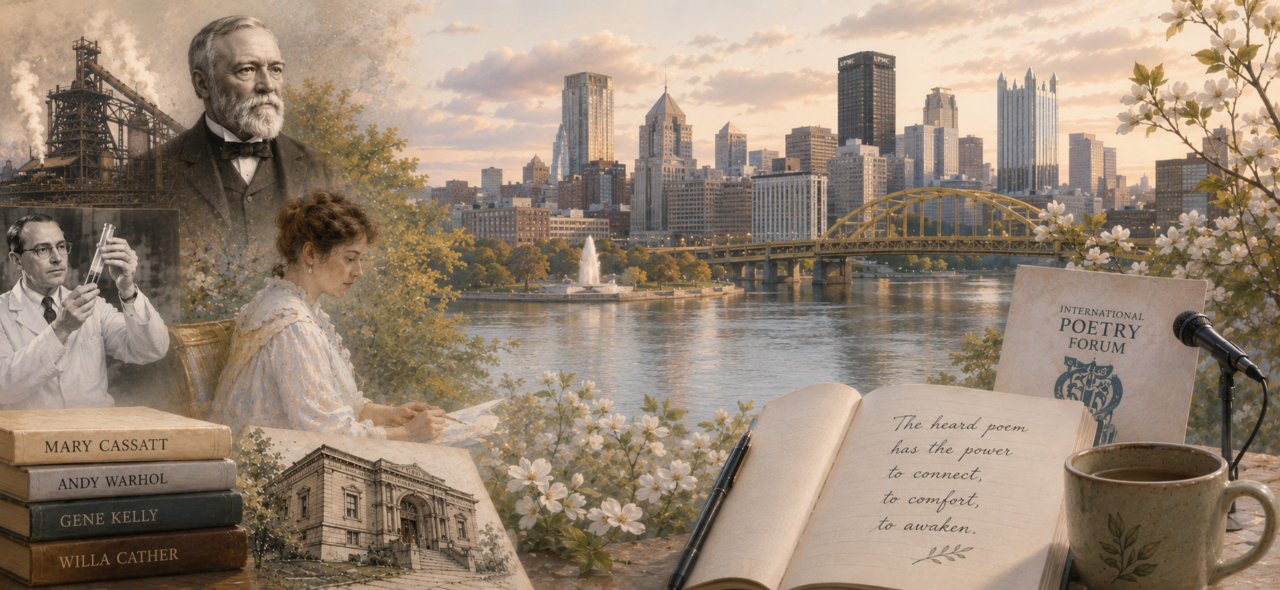
Pittsburgh is known for many things, but some of its most significant legacies are largely unknown or underplayed. Among the most famous are as the steel capital of the U.S., with the city’s contribution to the allied victory in World War II best described by Winston Churchill as the war that was won by steel. Equally significant was Dr. Jonas Salk’s development of the polio vaccine. And Andrew Carnegie’s construction of 1,700 public libraries across the world…
The legacies of the arts in Pittsburgh are less known. Most Pittsburghers know of Andy Warhol and Gene Kelly. But what about Mary Cassatt, who was born in Allegheny (now the North Side), lived most of her life in Paris, and is regarded by many as being on a par with Degas? Or Virgil Cantini, George S. Kaufman, or Willa Cather? The list of Pittsburgh’s “long lost” artistic leaders could fill a page, but I would argue that it is that artistic fabric, as much as steel, that gives Pittsburgh a legacy that, while slightly under the surface, makes it a compelling place to live.
As the director of the International Poetry Forum, I was compelled to close the Forum in 2009 after 43 years because of funding difficulties. But 43 years of audience support for poetry programs proved that an indigenous audience did exist here for “poetry hearings.” Thousands of Pittsburghers attended more than 400 poetry programs by poets, actors and singers, including young poets of promise, Nobel, Pulitzer and National Book awardees, Academy Award-winning actors Gregory Peck, Eva Marie Saint, José Ferrer, Judith Anderson, and Anthony Hopkins, and singers ranging from Victoria de los Ángeles to Judy Collins, together with programs by cultural and political leaders Princess Grace of Monaco, Queen Noor of Jordan, and Senator Eugene McCarthy.
It created a legacy I was not fully aware of until I encountered a woman in a supermarket shortly after the International Poetry Forum was relaunched in 2023. (This reopening happened by chance after I met Jake Grefenstette and asked him to be the new director. He was a Notre Dame alumnus with graduate degrees from Chicago, Peking and Cambridge universities, and was uniquely qualified for the role.) The woman in the supermarket approached me and said quite sincerely that she was glad to see the International Poetry Forum revived because she was a “member of the poetry community.”
The phrase stayed with me. She saw herself as one of many who had attended, and would continue to attend, public “poetry hearings” where she could listen to poems recited as an expected part of public speech. After all, if it was the destiny of poems to be heard, that opportunity had been made possible by the Forum. The heard poem historically had preceded the printed poem by centuries, and in a society like ours today, in which most people are television viewers, fast talkers or just listeners-in-passing, “poetry hearings” remind us that we still have the opportunity to listen to felt speech.
The “poetry community” that my fellow shopper referred to assured me that it still exists. This was confirmed by audiences who attended the first five presentations of the relaunched Forum in 2024 and 2025. All of them were sellouts. One — Emily Wilson’s recital of passages from her translations of Homer’s Iliad and Odyssey — drew more than 1,000 people.
I learned recently from a friend that a former student of his, who was himself a poet, had decided to move back to Pittsburgh because it was a city where poetry had a prominent place in public life. There were “poetry hearings” under various auspices. Books of poems were published by university and private presses, and the Pittsburgh Post-Gazette, before it eliminated its usual weekday editions, published a poem every Saturday on its editorial page for more than 10 years. This prompted poet Jim Daniels to say, “More people read my poem in one day than read all my books put together.”

Samuel Hazo is the author of poetry, fiction, essays, various works of translation and four plays. Governor Robert Casey named him Pennsylvania’s first State Poet 1993. He served until 2003. From his first book, through the National Book Award finalist “Once for the Last Bandit,” to his newest poems, he explores themes of mortality and love, passion and art, courage and grace. samuelhazoauthor.com