Kinetic’s “The Murder of Roger Ackroyd” Has All the Clues
We could just as well discuss the historical influence of Agatha Christie’s 1926 novel “The Murder of Roger Ackroyd,” as we could its mechanistic genius as a whodunnit. The British Crime Writer’s Association voted it the best crime novel ever, and it’s been cited by famous writers over the past century for its innovative style; in fact, the work is often referred to as her greatest masterpiece. For that matter, we could delve into the archetypes of the 12 characters – which have been imitated countless times – or the innovative vision of the current director, but I’d like to initially focus on what may be the most important element – the ostensible 13th character: the stage.
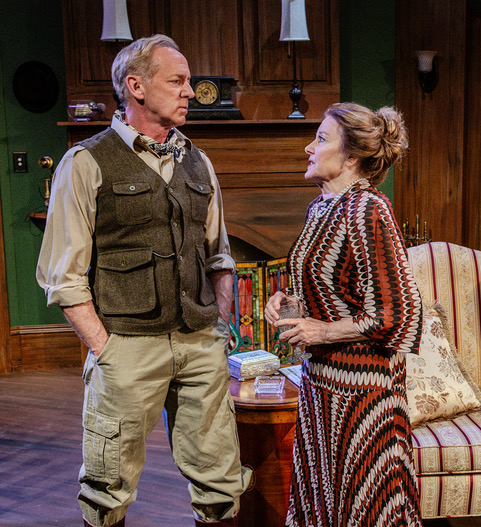
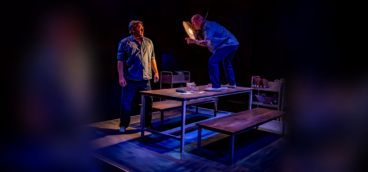
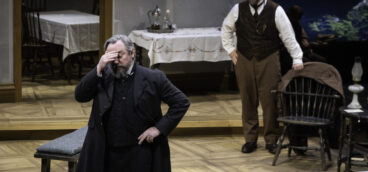
The Carnegie Stage – where this 2023 adaptation of the novel, by Mark Shanahan, is set – is the unique lovechild of a black-box and a proscenium-style performance space. Kinetic Theatre Company’s director Andrew Paul has figured out how to utilize this squat, long, and narrow area to maximum effect. The set is lush and richly adorned with wood paneling, elegantly upholstered furniture, and the kind of appointments any aristocratic late Georgian-period home would be happy to contain. But what makes it so effective is how the dwellings of two characters, that of country doctor James Sheppard (no relation to this writer), and Mr. Roger Ackroyd – the wealthy owner of the estate who is murdered – meld so seamlessly into each other, yet keep their psychic distance, allowing us to believe, when the characters pass from one location to the other, they are actually miles apart: much like a cinematic dissolve from one tableau to the next.
This is brought off by the masterful synergy between scenic designer Johnmichael Bohach, and lighting designer Andrew Ostrowski, who make time and space blend or separate with transfigurative illumination. Especially arresting is the way Mr. Ostrowski places much of the ambient lighting on set, such as the gallery lamps above the paintings, rather than solely relying on traditional mounted ceiling lights.
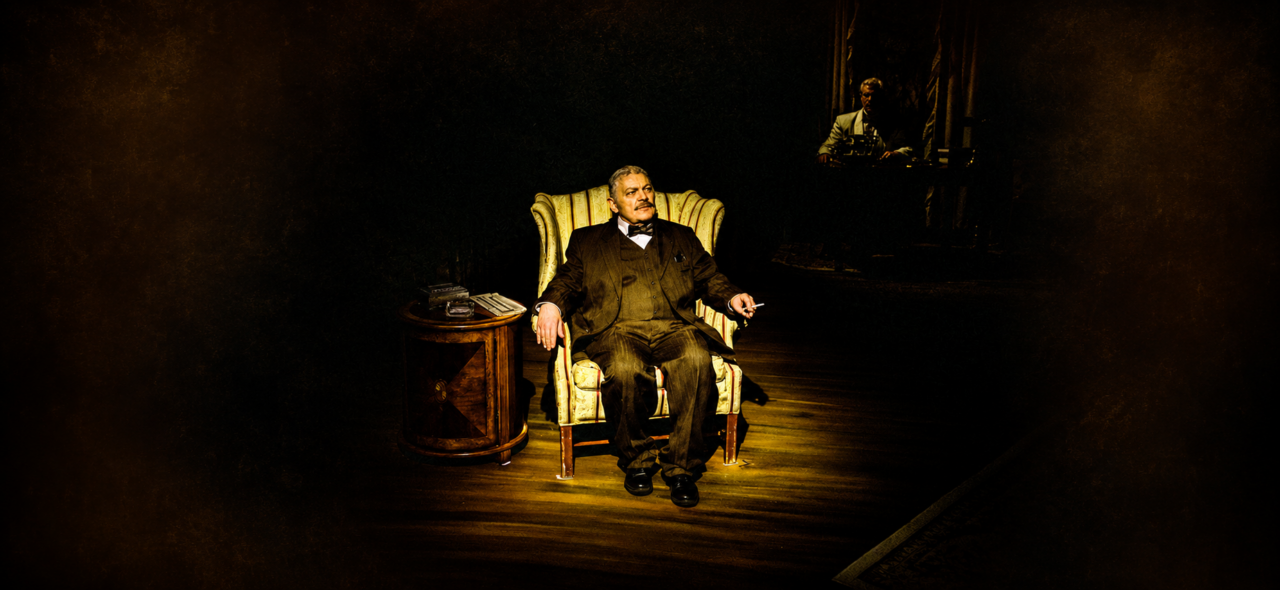
Everyone in the ensemble cast is a suspect, with the exception, perhaps – and note I am not giving anything away here that would spoil your evening – of the inimitable retired Belgian detective Hercule Poirot, played with circumscribed irascibility by Sam Tsoutsouvas. Thankfully, Mr. Tsoutsouvas’ accent is consistent and not hammy, as so often is the case with this character in popular films (kudos to dialect coach Lisa Ann Goldsmith). He teams up with Dr. Sheppard – a kind of benign Watson in the manner of the Sherlock Holmes stories – who acts as the narrator of the drama, and in whose home some of the action takes place.
As Roger Ackroyd (played with authority by Darren Eliker) is murdered early in the play, it is up to Poirot, Sheppard, and most importantly, us, to figure out who did it, and we are presented with clues both elegantly, and to Poirot’s annoyance, sometimes clumsily. You’ll probably have flashbacks, as I did, to many books, dramas, and films you’ve experienced over the years with similar tropes – as divergent as Robert Altman’s 2001 film “Gosford Park,” and the 1970s TV series, “Columbo” – Ms. Christie’s work is that canonical.
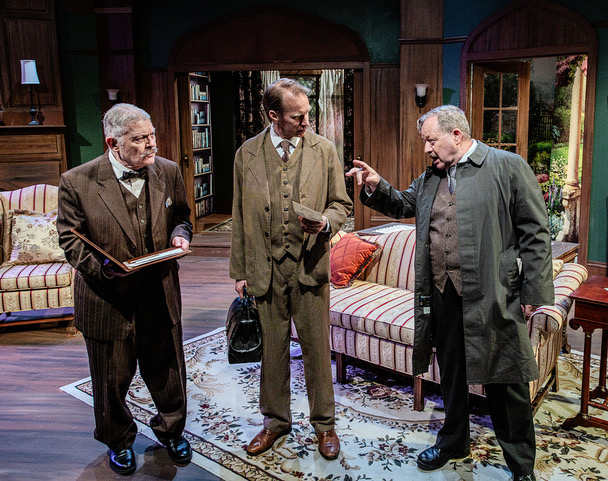
As Dr. Sheppard, Christopher Kelly has the heaviest burden in carrying the show: he must act in his role, as well as step out of it to narrate the happenings. However, being the “sidekick,” he doesn’t let his character fall into bumbling cliché, as Nigel Bruce sometimes did as Watson in the 1940s Sherlock Holmes films. There is an interiority that threatens to surface which makes his persona intriguing.
His gossipy sister Caroline (Shelia McKenna) imbues her character with a delicious fascination regarding detection (if she lived a half-century later, she’d be watching “Murder, She Wrote” every day) and detectives: she’s sweet on Poirot. If I had any disappointment with the show, it would be that her role wasn’t bigger.
Also swallowing more than just her role is Ackroyd’s boozy sister-in-law Gertrude (Helena Ruoti) who enters rooms in a sloppy whirlwind of highballs and garish jewelry, like the drunk aunt who says all the wrong things at dinner parties.
James FitzGerald – an actor so gifted at immersing himself in pre-WWII roles that I think he wears a Norfolk jacket in real life – plays the aggravated but circumspect butler, Parker. The indefatigable David Whalen once again reinvents himself as the macho Major Hector Blunt (the prototype for Colonel Mustard in the boardgame and subsequent film, “Clue”), who stomps around in boots and hunting garb as if he’s on safari, but really is hiding other passions that may or may not indicate a killer’s motive.
And perhaps as the most quintessential character of all, Simon Bradbury’s foppish Inspector Raglan offers comic relief every time he enters the scene and tries to assert his faulty intelligence. This inevitably rankles the meticulous Poirot and muddies the pool of clues swirling everywhere.
I will admit, I could not solve the crime, and it makes me want to watch the show again to see which details I missed. I’d like to complement the inventive Agatha Christie on her utilization of leading-edge technology in the unfolding of the story. Again, I don’t want to give anything away, but she’s brilliant in how she makes a seemingly inconsequential element crucial to the solution of the case.
See this drama and you’ll have experienced the mother of all crime thrillers. And if you guess who the murderer is, treat yourself to a stiff brandy in front of the fire and toast your own genius. Or better yet, pull that dusty boardgame of “Clue” out of the closet and challenge your kids to play. It might be the most fun they’ll have off their phones for a long time.
THE MURDER OF ROGER ACKROYD continues through August 30th at Carnegie Stage, 25 West Main Street, Carnegie. www.kinetictheatre.org or (888) 718-4253.

Stuart Sheppard is an award-winning critic, essayist, novelist, and poet who writes “The Hamlet Machine” column for Pittsburgh Quarterly. Follow him: @HamletsMachine.