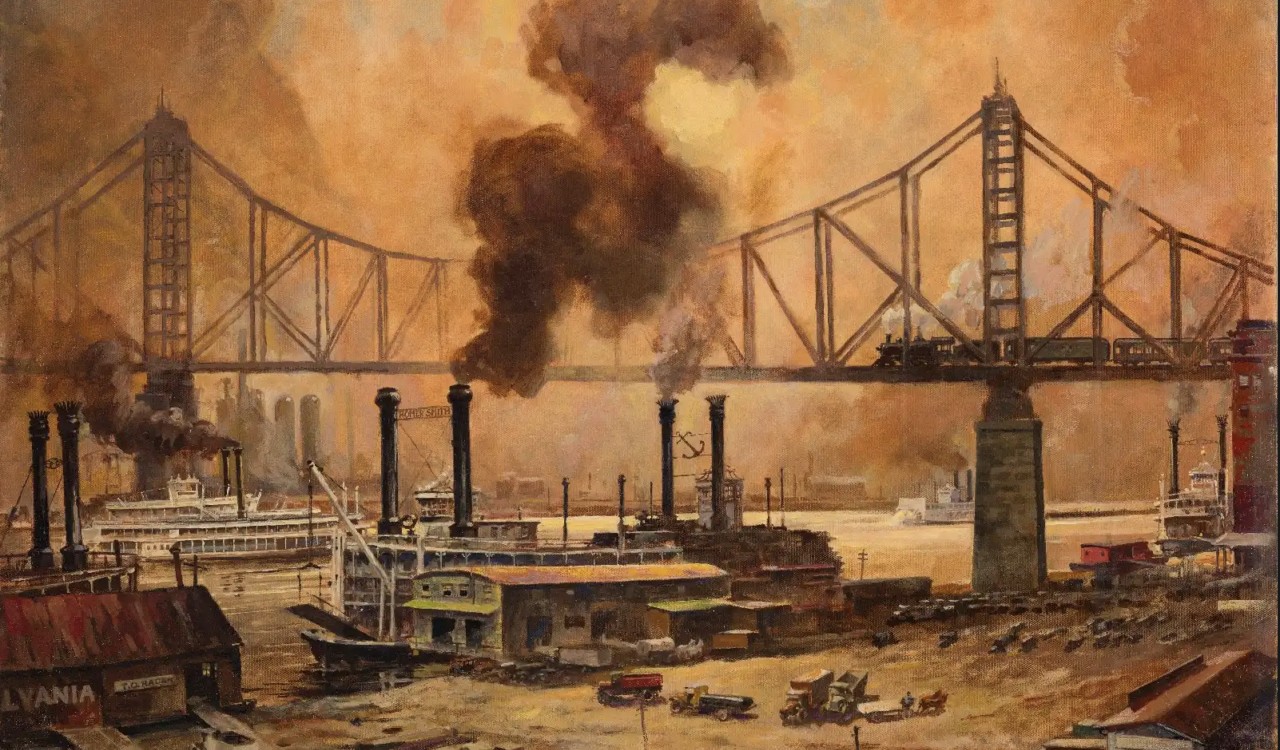
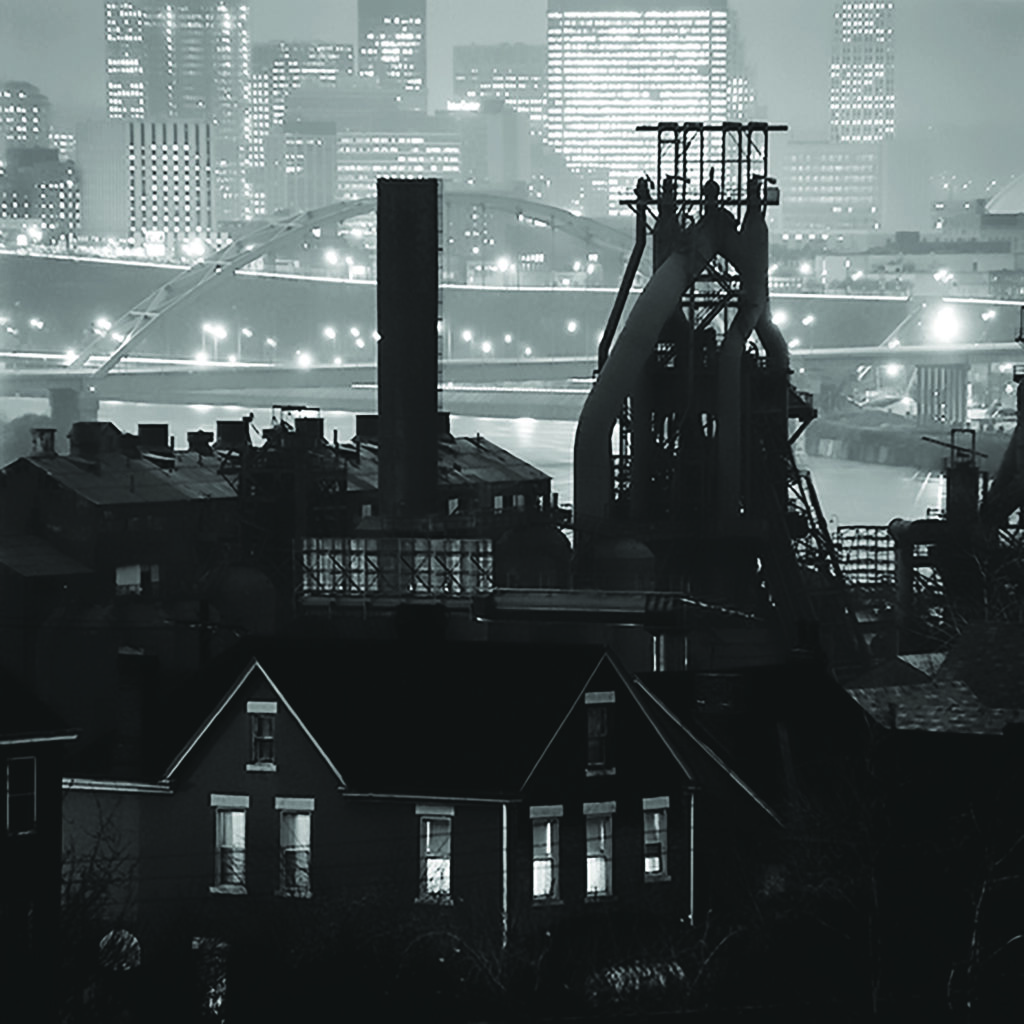
Throughout western Pennsylvania’s big steel era, artists captured a compelling visual record of the industry’s rise and fall: grit and glory, power and peril, beauty and brutality. At its height, the region’s three rivers reflected the brightness of fire and molten metal, and thick smoke filled the air. This was a place where muscle met machine, where immigrants and locals alike shaped not only steel, but also a vision of modern America.
To honor this legacy and commemorate the United States’ semiquincentennial, The Westmoreland Museum of American Art has curated Steel Valley Visions: An American Legacy, which includes paintings, sculptures and photographs, and an immersive experience of the region’s landscape, industry, and culture with large-scale animation and sound. The Westmoreland is the region’s only museum dedicated solely to American art, including a wide array of industrial landscapes depicting the Big Steel Era.
To fully appreciate America’s industrialization, it helps to look back to the French and Indian War (1754–1763), and the earliest works in the museum’s collection. Steel Valley Visions opens with The Wounding of General Braddock: Battle of the Monongahela 9 July 1755, an epic painting by contemporary regional artist Robert Griffing, depicting the battle’s climax: the fallen Braddock is surrounded by officers and aides, including a young George Washington.
More than 120 years later, Andrew Carnegie built his first steel mill, the Edgar Thomson Works, where the Battle of the Monongahela occurred. Carnegie, born in Dunfermline, Scotland, was aware of the land’s history: two officers from the battle, Sir Peter Halkett and his son James, were from a prominent Dunfermline family, and their heroic deaths were recorded on the walls of Dunfermline Abbey. Carnegie sent a bayonet, a relic from the battle, back to his hometown.
Another local industrialist, Thomas Lynch, built a mansion in Greensburg and commissioned a stained-glass window from Louis Comfort Tiffany depicting his Irish homeland. This extraordinary, colorful piece stands in stark contrast to other works in Steel Valley Visions. For example, Riva Helfond’s 1937 black-and-white lithograph, Miner and Wife, shows a weary, dignified, coal miner and his wife gazing directly at the viewer, their patch town and coal tipple in the distance.
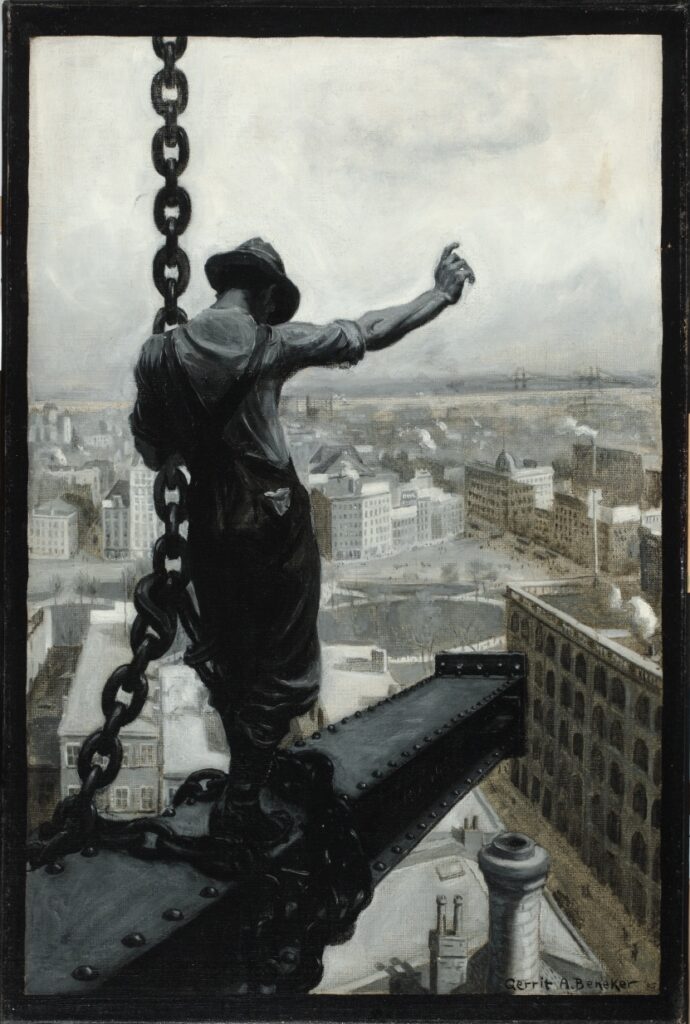
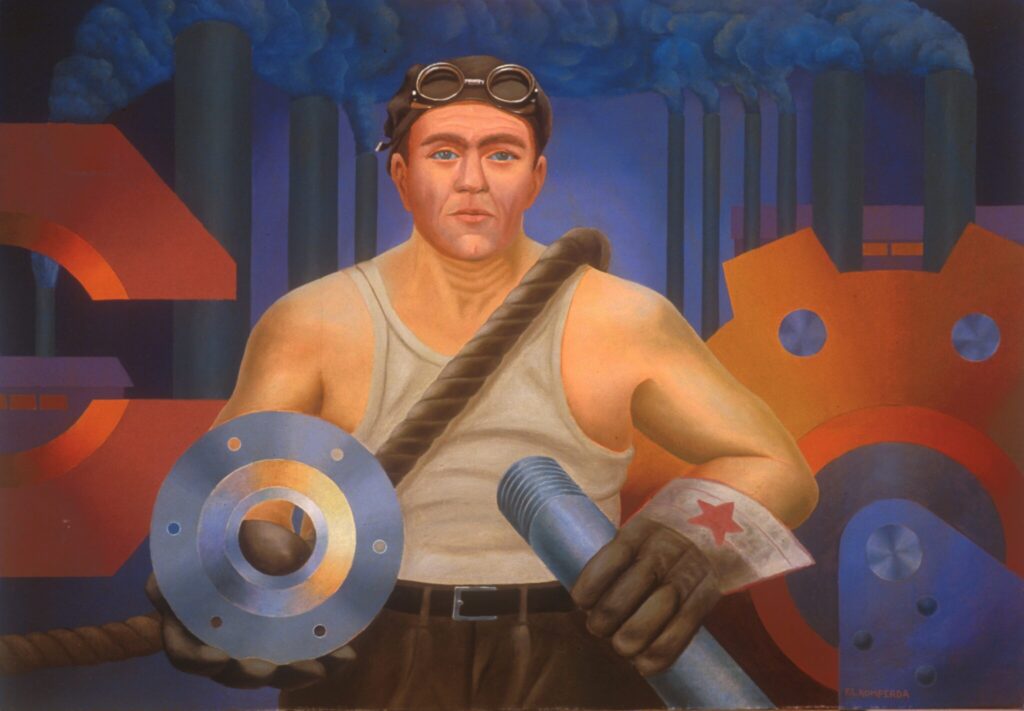
Artists also depicted the conditions of southern and eastern European immigrants and black migrants who worked in the mills and mines and raised families in the shadows of these towering industries. F. Frinka’s 1914 charcoal work on paper, Open Hearth, shows a shirtless steelworker shielding himself from a mill’s searing heat. In Steel Town, Pennsylvania, Elizabeth Olds portrays the proximity of steelworkers’ neighborhoods to the mills and the challenges residents faced, such as hanging clean clothes to dry in sooty air.
Martin B. Leisser’s Union Station Riot depicts the Great Railroad Strike of 1877 — the first national walkout — and was used by Harper’s Weekly to illustrate a story about the strike in Pittsburgh’s Strip District. Nearly 60 years later, Thomas Hart Benton’s dramatic 1933 lithograph, Strike (Mine Strike), shows a fallen protestor lying beneath his fellow miners as armed figures pursue them.
At its height, during World War II, Pittsburgh’s steel industry produced nearly half of America’s steel. After the war, the industry entered a slow decline due to global competition, automation, stricter environmental regulations, and shifting economic priorities. By the 1970s, mills and mines began to close and disappear.
Despite the decline, the Steel Valley’s spirit of hard work and innovation continues to inspire artists today. Steel Valley Visions concludes on a hopeful, contemporary note. Stephen Towns uses archival photographs of black coal miners in West Virginia to create a mixed media work, The Pioneer. Marie Watt (Seneca, Turtle Clan) uses a steel I-beam in Skywalker Greets Sunrise, VI, to honor the Mohawk “skywalkers” who, for over 100 years, built iconic skyscrapers, bridges, and other infrastructure in New York City.
Working with Italian multimedia firm OLO Creative Farm, The Westmoreland created an immersive experience with large-scale digital projections, animated details, sound effects, and music — transporting visitors into the artworks: glowing furnaces illuminate the gallery, silhouettes of mills rise along shimmering rivers, glimpses of the mines and the people who worked in them appear larger than life. Rivers of Steel provided authentic recordings from the steel industry — the rhythm of machinery, clang of metal, and roar of furnaces alongside train whistles and steamboats moving along the rivers.
A powerful part of the exhibit is that visitors are invited to contribute their own “Steel Valley Connections” to an interactive display of stories. So far, more than 1,000 have responded.
Unlike commercial immersive shows such as the Van Gogh experience, where projections replace the original art, The Westmoreland’s original paintings and photographs are displayed nearby, allowing the installation to serve as a gateway that deepens appreciation of the works in the exhibition. Steel Valley Visions is the museum’s second immersive installation. In the past two and a half years, attendance has doubled.
Erica Nuckles is director of Learning, Engagement and Partnership and Silvia Filippini-Fantoni is director and CEO of the Westmoreland Museum of American Art. The Steel Valley Visions immersive experience is on view through November 8, 2026. The traditional exhibition, Steel Valley Visions: An American Legacy, is on view through January 18, 2027.