Steel City Sparks
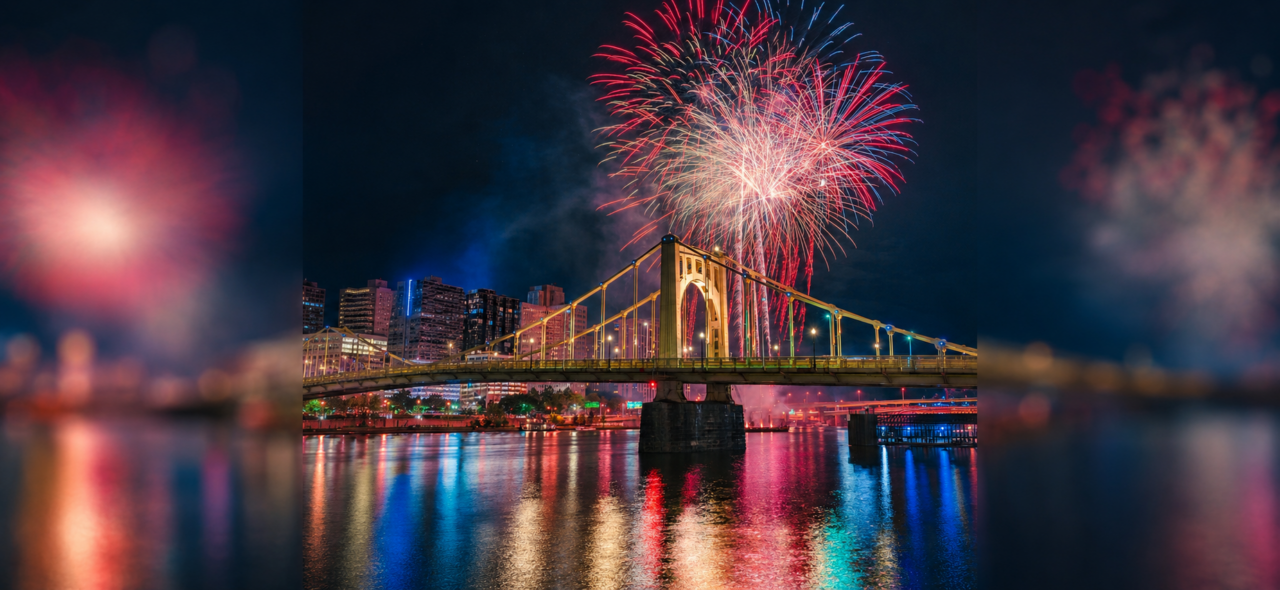
Every July Fourth, as the last light fades behind the hills that cup this city on three sides, something old and immigrant-born rises above the rivers. The barges are already in position a mile below the Point, loaded and wired and waiting. At 9:35 p.m., the first shell breaks open above the Ohio, and for the next 20 or 30 minutes, Pittsburgh remembers, as it does every year, that the sky is not just a backdrop. In this city, it is a canvas.
The fireworks that light it up are not imported. They are local, in the deepest sense of that word. Western Pennsylvania is home to three professional pyrotechnics companies: Zambelli Fireworks, Pyrotecnico, and Starfire Corporation — each built by Italian immigrant families, each still family-owned, each capable of producing shows on any stage in the world. Their combined history stretches back to 1886, to a single tin-mill worker from Italy who arrived in a small city 40 miles north of Pittsburgh and changed the region forever.
WHERE IT BEGAN
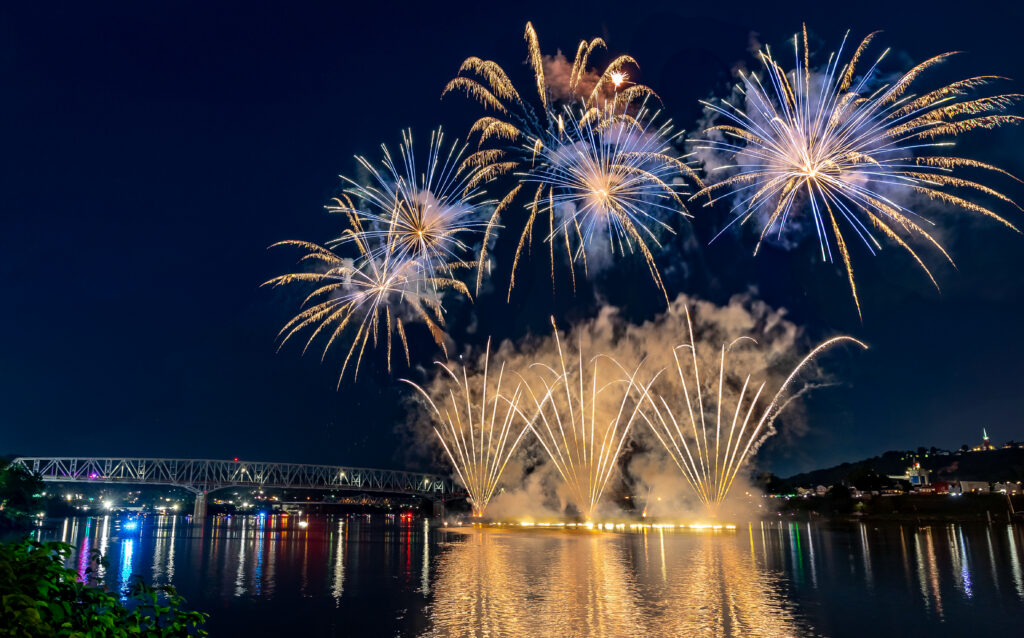
The story does not begin in Pittsburgh. It begins in New Castle, the county seat of Lawrence County, 43 miles northwest, along the Shenango River. In 2006, the U.S. Patent and Trademark Office formally recognized New Castle as the “Fireworks Capital of America” — a distinction it had been claiming since 1990, when the city first declared itself the center of the nation’s pyrotechnics industry. At its peak, Lawrence County accounted for roughly a quarter of all professional fireworks manufactured in the United States.
Between 1890 and 1921, an estimated 100,000 Italian immigrants settled in western Pennsylvania in search of what they called pane e Lavoro — bread and work. New Castle drew many of them, offering jobs in its mills and a community that quickly anchored itself around St. Vitus Catholic Church on the South Side. Most of those men came to work in steel and tin. But a small number arrived carrying something else: the craft of pyrotechnics, passed down through families in the villages of southern Italy, where fireworks were as essential to religious festivals and saints’ days as the liturgy itself.
The first was Leopold Fazzoni. He arrived in 1886, worked in a tin mill until he had enough money saved, then launched the Fazzoni Brothers Fireworks Company, New Castle’s first pyrotechnics operation. The surnames of the men who came to work with him — Rozzi, Conti, Vitale, Zambelli — eventually would account for most of the professional fireworks produced in America.
THE ZAMBELLIS: THE FIRST FAMILY
Antonio Zambelli arrived in New Castle in 1893, 16 years old, carrying — according to family lore — a small black book filled with his family’s fireworks recipes. He had emigrated from Teano, a village north of Naples in the Campania region, and he went to work almost immediately at two jobs: as a laborer at the New Castle Works of Carnegie Steel by day, and as a hand-craftsman for the Fazzoni Brothers by night and on weekends. He married a fellow Italian immigrant named Maria Tuscano in 1907. By the 1940s, when Leopold Fazzoni died, Antonio and his eldest son Joseph acquired the company.
It was George Zambelli Sr. — Antonio’s son, born in New Castle in 1924 and a 1946 graduate of Duquesne University — who transformed a local operation into a national enterprise. George Sr. had an instinct for spectacle and a businessman’s eye. In 1960, he rebranded and incorporated the company as Zambelli Fireworks Manufacturing Company and introduced the innovation that would define the modern professional fireworks show: choreographing pyrotechnic displays to live musical scores. As his son George Jr. later told CNN Money, “My dad took the business to another level. He created a designer brand of fireworks and choreographed the displays to musical scores or live music. That’s when the business exploded, you could say.”
Zambelli’s first major national commission came in 1961, when the company provided pyrotechnics for the inauguration of President John F. Kennedy — the first in an unbroken run of presidential shows that has continued across every administration since. The company calls itself “The First Family of Fireworks.” They have produced shows for the Statue of Liberty centennial, New Year’s Eve at Times Square, and annually for Thunder Over Louisville, the largest fireworks display in America. The Guinness Book of World Records has credited Zambelli with shooting fireworks from the highest altitude, off the top of the U.S. Steel Tower in Pittsburgh.
On the night of October 4, 2008, Zambelli mounted what remains one of the most ambitious pyrotechnic displays ever staged in the United States: fireworks launched simultaneously from 17 locations across Pittsburgh to mark the city’s 250th anniversary. “This display is truly the fireworks extravaganza that my father had dreamed of for Pittsburgh,” George Jr. said afterward.
THE VITALES: PYROTECNICO
The second New Castle dynasty traces its origins even further back. Constantino Vitale started making fireworks in the Italian village of Pietramelara near Naples in 1889. He immigrated to the United States in 1922, arriving through Ellis Island and settling in New Castle. That year, he incorporated the Vitale Fireworks Manufacturing Company, and it quickly became one of America’s premier fireworks manufacturers.
The Vitale facilities in New Castle were repurposed briefly during World War II to manufacture explosives for the U.S. Navy. In 1994, the company rebranded as Pyrotecnico, a name that better reflected how far the operation had grown. By then, Pyrotecnico was working with lasers, synchronized computer-fired electronic sequences, close-proximity pyrotechnics, and large-scale special effects for concerts and film productions.
Today, Pyrotecnico produces more than 3,000 Fourth of July shows alone, across the eastern half of the country. Its client list has expanded to include Super Bowl halftime shows, Formula 1 races, Coachella, and major concert tours. The company is in its fifth generation of Vitale family leadership, run by Stephen and Rocco Vitale, Constantino’s great-grandchildren.
STARFIRE: LIGHTING PITTSBURGH’S SKY
The third of western Pennsylvania’s pyrotechnic trio did not come from New Castle. Starfire Corporation was founded in 1983 and is based in St. Benedict in Cambria County, roughly an hour and a half east of Pittsburgh. Vince Terrizzi Sr. discovered his passion for fireworks in the mid-1950s, learning the trade under Old-World masters. The Terrizzis also are of Italian descent, and the craft arrived through the same channels of immigrant tradition and handed-down knowledge.
Starfire has been producing Pittsburgh’s annual Independence Day fireworks show for several years, holding a contract with the city that runs through this year. They operate under the name of the EQT Flashes of Freedom — the show that WPXI-TV has broadcast live every July Fourth since 1990. The fireworks launch from a series of barges in the Ohio River, about a mile below the Point, and are visible from Point State Park, the North Shore, Mount Washington, and much of the surrounding hillsides. On a clear night, the shells are audible four miles away.
THE CRAFT THAT STAYED
Pittsburgh uses fireworks to mark the moments that matter most. The next milestone is America’s Semiquincentennial. The tradition that produces it runs deep — older than the city’s 2008 record, older than Zambelli’s presidential debut in 1961, older than George Zambelli Sr.’s musical choreography, all the way back to a tin-mill worker from the village of Teano who got off a boat in 1893 with a recipe book in his pocket and a trade in his hands.
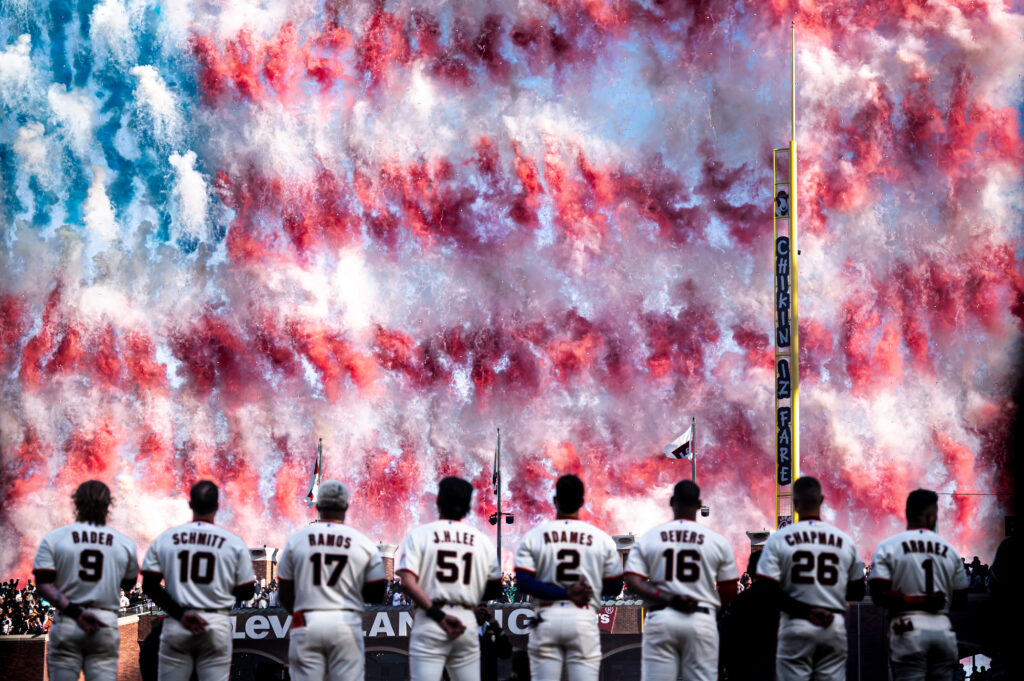
There is a particular kind of civic pride that does not announce itself loudly. The Zambellis have lit up PNC Park after Pirates games for decades. Pyrotecnico has produced major events at venues across the city and the region. Starfire has been the company that ends Pittsburgh’s Fourth of July every year since the Three Rivers Regatta era. These are not visiting companies; they are neighbors.
At 9:35 p.m. on July Fourth, when the first shell goes up over the Ohio and the crowd at the Point tilts its head back, that continuity is what you are really watching. The rivers have been here longer than the city. The hills longer than the rivers. And somewhere in the lineage of every fireworks display over those hills, there is a 16-year-old kid from a village near Naples, standing in a mill town in western Pennsylvania, carrying the family recipes waiting for the right moment to light everything up.

Samuel Peters is an African-American writer whose work explores culture, history and regional life.