Pittsburgh Ballet’s “A Midsummer Night’s Dream” Reaches for the Sublime
We are often surprised by the little things we find when someone passes away, things we were perhaps not aware of, or things that were saved because they carried an importance we didn’t realize. In the case of my mother, who passed not long ago, I found, in her closet, the ballet shoes she wore as a young woman studying dance in the years before I was born. They were still in their original Capezio box with its unmistakable “midcentury” graphic design, like something you might see on the shelf in an Audrey Hepburn film such as “Breakfast at Tiffanys.” They were well-worn, with the telltale hammered look that dancers’ shoes get. She obviously put in her practice time.
That she kept them floating on the top of things in her closet is remarkable, when you think about how many shoes are washed away in a lifetime: hundreds of pairs I would imagine over 92 years.
But really it shouldn’t be surprising. My mother wasn’t a professional dancer, just someone who loved dance, and loved it not merely as a type of entertainment, but for its epistemology. She always stressed the importance of form she learned in ballet: not just in dance, but in art, in literature, and in life. She would say, “Look how that woman is holding herself,” and would note the line of the body, the way the leg would extend, how the toes would point. I began to notice these aspects not just in dancers, but in statues, paintings, and even in poems. Form was the way I learned to see the world, and the significance of this for me continues to this day, and no doubt influenced me to become a writer and, I daresay, a critic.
I was reminded of this as I had the opportunity to spend a day at Pittsburgh Ballet Theatre last week and witness the tremendous investment in form this company of young dancers is making — not just as an occupation, but as a way of life — which left me deeply impressed. I think we all have some vague notion of how hard professional dancers work, but to see their ethic in practice is truly enthralling.
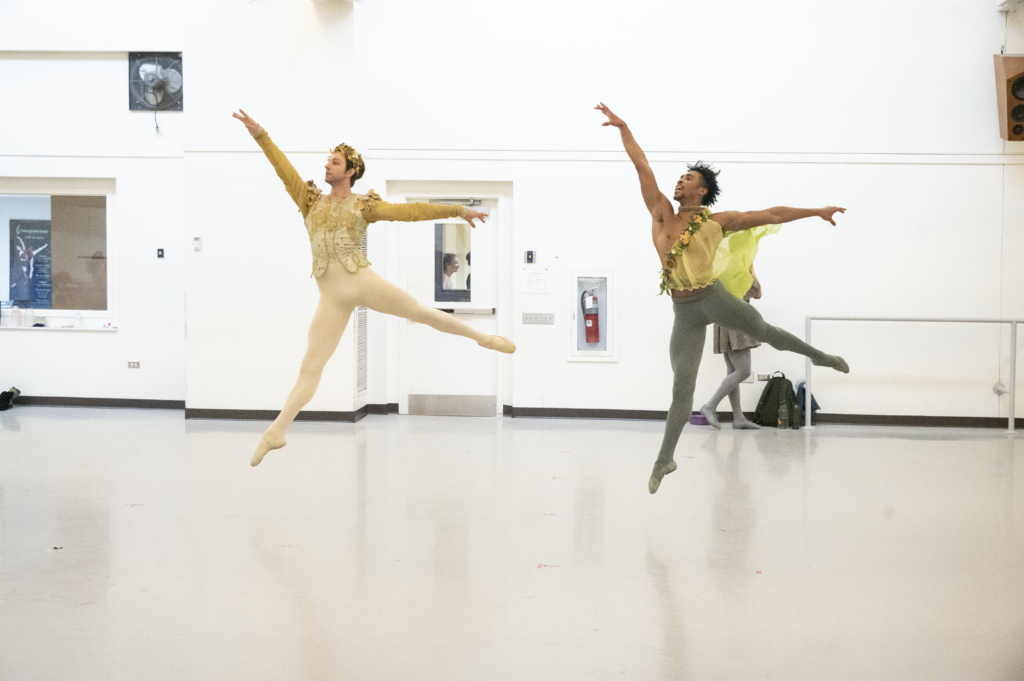
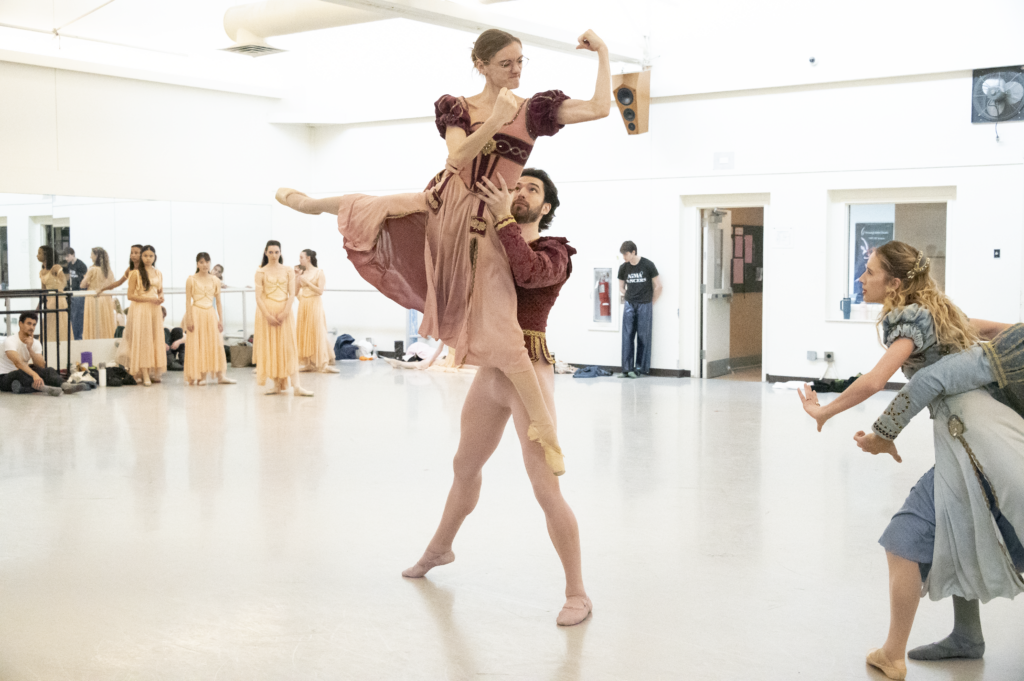
That morning, the company was performing a dress rehearsal of their new show opening this weekend, “A Midsummer Night’s Dream,” which I must say, even without the embellishments of a set, lighting, or formal stage, was scintillating. If you’ve never been to a ballet, or have only seen “The Nutcracker,” then make this show your introduction to what you’ve been missing. It’s funny and whimsical, with dazzling execution and a galloping pace that keeps getting more engaging over the taut 90-minute runtime. Furthermore, if you love this play by Shakespeare, you’ll see it in an entirely new perspective, with the bard’s poetry transmuted into movement. Ballet dancers are master storytellers who don’t use words: they become language itself.
And they are also, in PBT, excellent actors. I’ve commented on this in prior reviews, but seeing the company perform up close had an overwhelming impact, similar to that of the great silent film stars such as Chaplin, who really understood how to communicate solely through the visual. In fact, one of the few live notes stager Dawn Scannell gave to the dancers during the rehearsal was a reminder to “Look at each other!” which they certainly absorbed.
Afterwards, I asked artistic director Adam McKinney about this ancillary skill, and if the dancers were trained in the art of acting. He said that they’re not, as “The intention of the choreographer is theatricality, which requires acting. Embedded within classical ballet technique is theater — the placement of the body to communicate emotion and human experience.”
I think this is an insightful point, and one that needs to be properly recognized, as ballet dancers live in two realms: they are world-class athletes, and they are world-class artists. Furthermore, they have to be flawless, and are, according to principal dancer, Lucius Kirst, “Expected to perform a show perfectly every time.” This is a tremendous responsibility, especially when you compare ballet dancers with professional athletes, who can and do routinely make mistakes, like fumbling a ball, striking out, or tripping during a play. Athletes are happy to “win ugly,” but dancers cannot. And, for example, while a professional football game only has about 11 minutes of actual action — with individual plays only running for a few seconds — in a ballet, a pas de deux may last 12 minutes without rest. On top of an ensemble scene (or divertissement) that may run an additional 20 minutes straight. Plus, they’re doing this in makeup and costumes that have to be meticulously maintained. All in time with the music, amidst a cacophony of other performers leaping through the same frenetic, interwoven space.
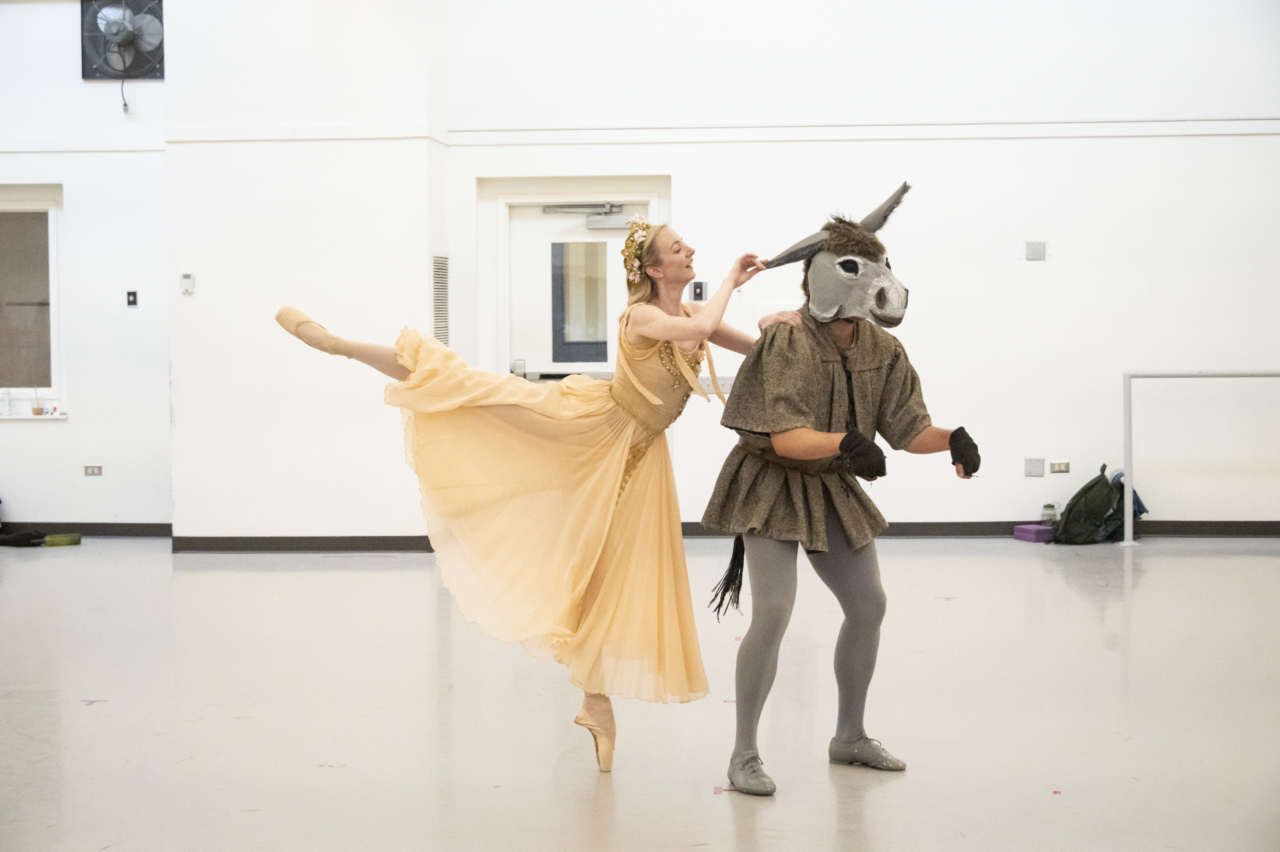
One of the things I most enjoy is how performers interpret particular characters. In the version I saw (dancers commonly switch roles during a show’s run), there were many standouts, including Emry Amoky as the mischievous Puck, who stirs the other characters like a giant swizzle stick of rambunctious energy, and Matthew Griffin as the wobbly Bottom — sporting a Donkey mask and tail — like the drunken guy dancing at a wedding reception who won’t leave the dance floor. Hannah Carter, as Titania, is smitten with Bottom from the effect of Puck’s love potion, and floats as if her body is filled with helium, like a soul that wants to escape its tether to the earth. Also, Grace Rookstool is compelling as the nerdy, spectacle-wearing Helena, exuding a comedic physicality which Lucille Ball would love.
The dancers I met, as busy as they were, turned out to be welcoming, gracious, and extremely eloquent, sharing their insights on a profession that many had been practicing for two decades, which, in a studio full of twenty-somethings might strain credulity, until you learn that most of them, such as Mr. Kirst and Ms. Rookstool, have been dancing since the age of three. Colin McCaslin, another principal dancer, is considered a bit of a newcomer, as he started at 14, but had actually performed in “The Nutcracker” at age six.
I asked them during a break in their rehearsal – they had already completed a two-hour class, plus performed an entire run-through of the show, and that was only half their day – if the technical standards of ballet, and the training process, were changing in any way. Mr. McCaslin said no, “We are still reaching for the unreachable goal,” which is perhaps the best definition of the sublime I’ve ever heard.
It led me to wonder if we’re experiencing a bifurcation of the arts now, with disciplines such as the ballet, opera, and symphony — which require a lifetime of practice and study – growing apart from those which don’t, such as visual art and poetry, which seem (at least in general) to be more superficial and arbitrary in our current milieu. I mention this because I go to a lot of art exhibits and poetry readings and find much more emphasis at those events on kitsch than in achieving the sublime.
Ballet has never had an easy ride in America. It’s not an organic artform here as it is in Europe, for example. Rehearsal director Barbara Bears pointed out that, “In most other countries, art is subsidized, but here, ballet companies have to be creative.” Ms. Scannell the stager added that, “How we grow up in this country is different than in other countries.” They both pointed to the recent and notorious comments by actor Timothee Chalamet as evidence of this conundrum, when he said, “I don’t want to be working in ballet or opera, or things where it’s like, ‘Hey, keep this thing alive.’ Even though it’s like, no one cares about this anymore. … All respect to the ballet and opera people out there.”
The historian Jennifer Homans relates how difficult it’s been for ballet to take root in America. In her book, Apollo’s Angels: A History of Ballet, she nails the problem: “Classical ballet was everything American was against.” In the first half of the 20th century, it was seen as elitist, aristocratic, and Catholic . . . very much at odds with our stern, down-home, Puritan ethic. If not for the Herculean efforts of advocates such as Lincoln Kirstein and the brilliant Russian choreographer George Balanchine, as well as, ironically, the support of the U.S. government (which saw ballet as a diplomatic tool), we might not be fortunate to have the stunning legacy of American ballet which arose after World War II.
I think this legacy is alive in the dancers, teachers, and directors I met during this day. It’s as if each one of these professionals is harboring the concern that if any one of them relaxes their standards just a little, and gives in to the petulant, Chalamet-indolence that is permeating so much of art, poetry, and let’s be honest, Hollywood — where the focus is on commercial entertainment, not “reaching for the unreachable” – then the apotheosis of American ballet could decline.
This would be tragic, but I don’t believe it’s likely, as you will not find a universe of people working as hard to master and further their craft — while pounding their bodies on stages in rehearsals and performances – with as much disdain for the venal compromises of other entertainment genres.
As I learned from my mother, ballet is a generational gift. Almost every dancer I spoke to related that they were taken to a ballet as a young child by their parents and simply fell in love with it. In its struggle, it thrives. But it’s not antagonistic. During the rehearsal I witnessed, the dancers were extremely supportive of each other. And it’s a diverse and balanced discipline, as female and male roles depend on each other, yet neither dominates. In fact, the PBT company of 32 artists is almost evenly divided by gender.
This legacy of intense spectacle, brilliant music, striking costumes, and risk-taking performances is incomparable. I don’t know where else you can find such profound aesthetic engagement today, in any art form. As Mr. Kirst the dancer put it, “We’re trying to be beautiful. Come watch us.” And bring your children to see “A Midsummer Night’s Dream.” It might seem like a little thing in their lives, but who knows, aside from a profoundly enjoyable evening, you may be planting the seeds for the next Baryshnikov or Copeland. And if not that, perhaps an arts critic (heaven forbid!). Or simply, a child who will grow up and joyously spend his or her life reaching for the sublime.
Pittsburgh Ballet Theatre’s “A Midsummer Night’s Dream” (choreography by Ben Stevenson; music by Felix Mendelssohn), runs from May 15-17 at the Benedum Center, downtown. For further information: www.pbt.org

Stuart Sheppard is an award-winning critic, essayist, novelist, and poet who writes “The Hamlet Machine” column for Pittsburgh Quarterly. Follow him: @HamletsMachine.