Dedicated students of Steelers history are likely aware that Pittsburgh was the first NFL team to feature cheerleaders. The Steelerettes, composed of co-eds from what was then Robert Morris Junior College, were active from 1961 to 1969.
But mention the Ingots — the Steelerettes’ male counterparts — to any Pittsburgh fan and the response is invariably a blank expression. With good reason.
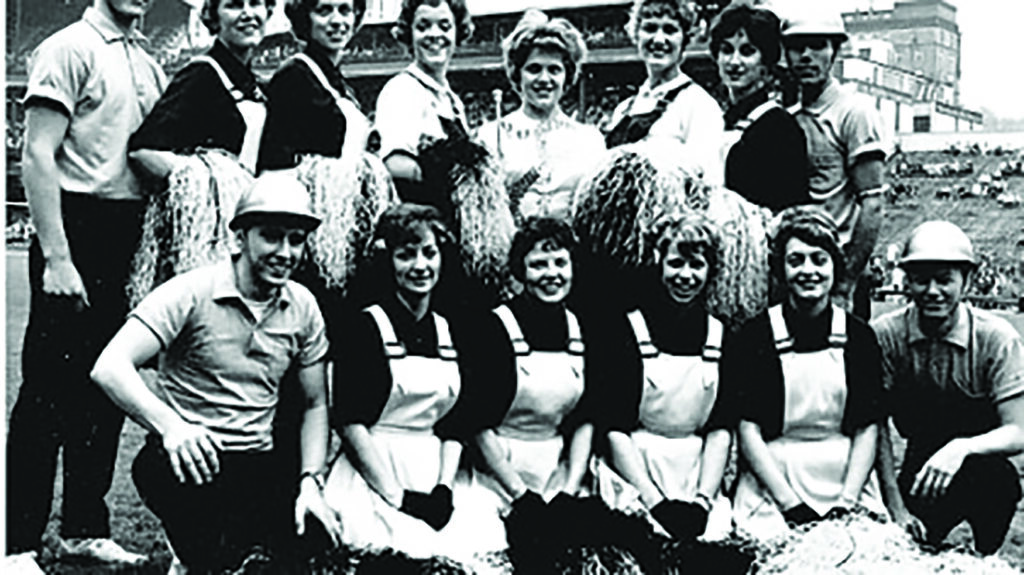
The NFL’s first male cheerleaders, who wore hard hats, white or gold shirts and black slacks, didn’t stick around long enough to make much of an impression. The Ingots debuted during the 1962 season. They didn’t survive to 1963.
If their time on the sidelines was brief, blame a mishap involving an “artillery” piece.
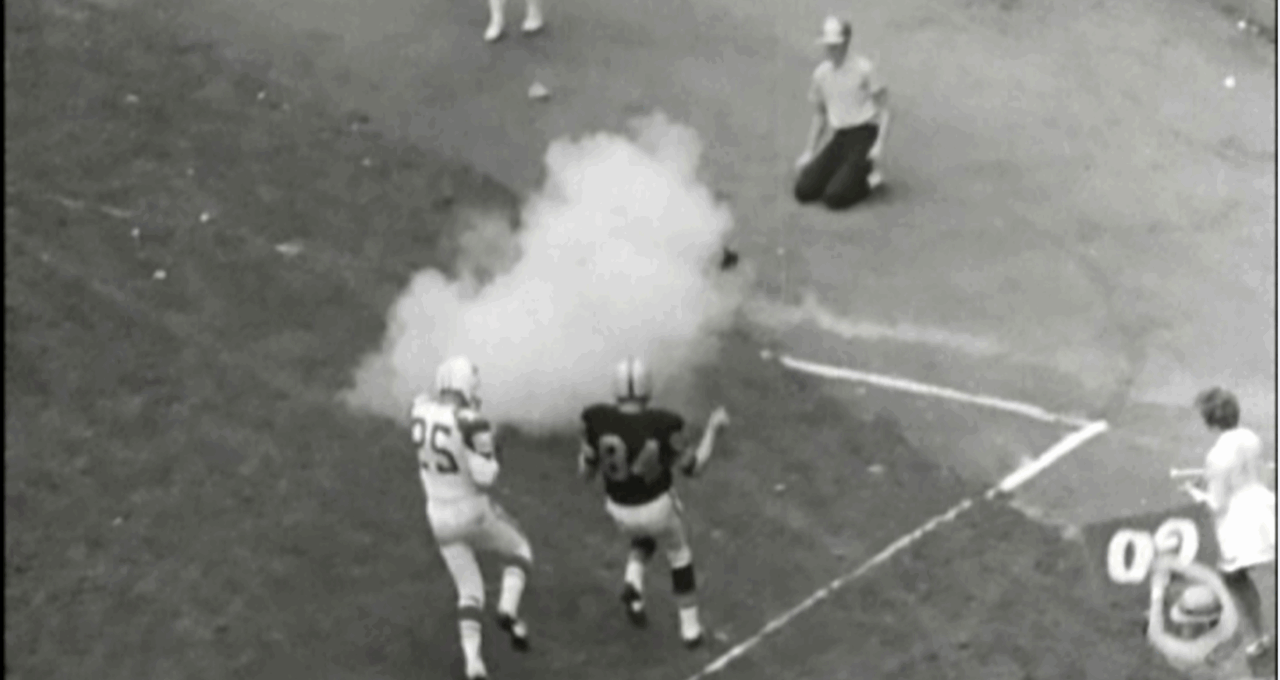
One of the Ingots’ duties was to fire a small cannon, positioned behind the end zone and loaded with blanks, whenever a Steeler scored a touchdown. Wide receiver Buddy Dial did just that against the Dallas Cowboys on Oct. 21, 1962, at Forbes Field. After hauling in a pass from Bobby Layne, the cannon went off just as Dial crossed the goal line. He recoiled before comically vanishing in a cloud of smoke.
“The Steelers’ end zone cannon … almost frightened Buddy Dial out of his cleats,” wrote Pat Livingston in the Pittsburgh Press. “The artillery piece was fired in front of Dial at point blank range. The report startled him so that he whaled the ball up in the air and shouted loudly at the operator of the gun.”
Did the mild-mannered Dial utter an expletive?
“He was quite a gentleman,” recalls Renfrew resident Jean (Craig) Garrett, a Steelerette that season. “But then, he had never been shot at before.”
Both the Steelerettes and the Ingots were the brainchild of Steelers entertainment coordinator Bill Day, whose full-time job was serving as vice president at Robert Morris, then located in Downtown Pittsburgh.
“Back then, the Steelers did not draw well at Forbes Field and only drew well for a few games at Pitt Stadium,” Day recalled in a long-ago interview. “As I saw it, Robert Morris was an institution without a football team and the Steelers were a football team without cheerleaders.”
Day believed a cheerleading troupe could inject some much-needed excitement into the fans’ game-day experience, especially given that the Steelers themselves rarely did: They had posted only two winning records over the previous 12 seasons.
Dan Rooney, then the team’s director of player personnel, gave Day the green light to form a cheerleading squad, and the Steelerettes — as Day christened them — were born. They debuted during a 17-14 preseason loss to Detroit on Aug. 16, 1961.
“A bright side to the game,” noted Al Abrams in the Pittsburgh Post-Gazette, “was the introduction of the ‘Steelerettes,’ eight pretty young ladies from the Robert Morris Business School. … The prancing fillies, decked out in black blouses, gold jumpers and pom poms, made a hit with the small crowd.”
The Steelerettes proved such a popular attraction that a year later Day recruited four students from Robert Morris — Roger Hunt, Ken Kanzleiter, Blair Jury and Tom Boyer — to form a complementary male squad. In a nod to the steelmaking industry, he dubbed them the Ingots. They were tasked with firing the cannon.
“The years have faded a lot of memories, so no one knows whose idea it was to set up a cannon in the end zone,” says 1963 Steelerette Dianne (Feazell) Rossini, a resident of Jacksonville, Florida, who created a website that provides a detailed history of the squad. “It seemed like a good idea at the time — what a great way to punctuate each touchdown and really get the crowd charged. The Ingots would fire the cannon, the band would play the Steeler fight song, and the Steelerettes would go into their victory routine. It was an exciting moment, and the crowd loved it.”
At least until the Dial incident. Garrett still shudders at the memory.
“It was horrifying,” she says. “We were not in the end zone where the Ingots were — we were on the sidelines — but we had a direct view of what was happening. And as Buddy Dial reached the end zone, the cannon went off. You could hear the crowd gasp.”
An eerie silence followed.
“It actually looked like Buddy had been shot,” Day said.
Dial disappeared in a cloud of smoke. Not long after, so did the Ingots. Having made history as the NFL’s first male cheerleaders, they were soon history themselves.
But the Ingots do live on, in a sense. Visitors to the Pro Football Hall of Fame in Canton, Ohio, can view an NFL Films video of the cannon blast that lifted a short-lived cheerleading squad out of obscurity and into the realm of immortality.
Bob Fulton, a freelance writer from Indiana, grew up in the Pittsburgh suburb of Brentwood. His father took him to his first Steelers game in 1961, back when the team played its home games at Forbes Field.

Bob Fulton, who attended many Pirates games at Forbes Field as a youngster and later covered the team as a newspaper reporter, has written two books about the Pirates, the most recent “Burial at Home Plate: An Oddball History of the Pittsburgh Pirates."