Heavyweight Champion John L. Sullivan’s Wild Bouts in McKeesport and Allegheny City
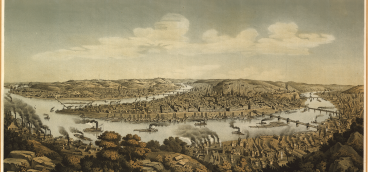
“The air of Pittsburgh has been thicker today than at any time since the discovery and general use of natural gas,” intoned an unnamed editorialist for the Pittsburgh Post on September 19, 1886. “But not as in the old time with smoke however but with pugilism.” On the previous evening, heavyweight boxing champion John L. Sullivan, “The Boston Strong Boy,” had pummeled a fighter from Philadelphia named Frank Herald at the Coliseum in Allegheny City, then a separate municipality from the City of Pittsburgh.
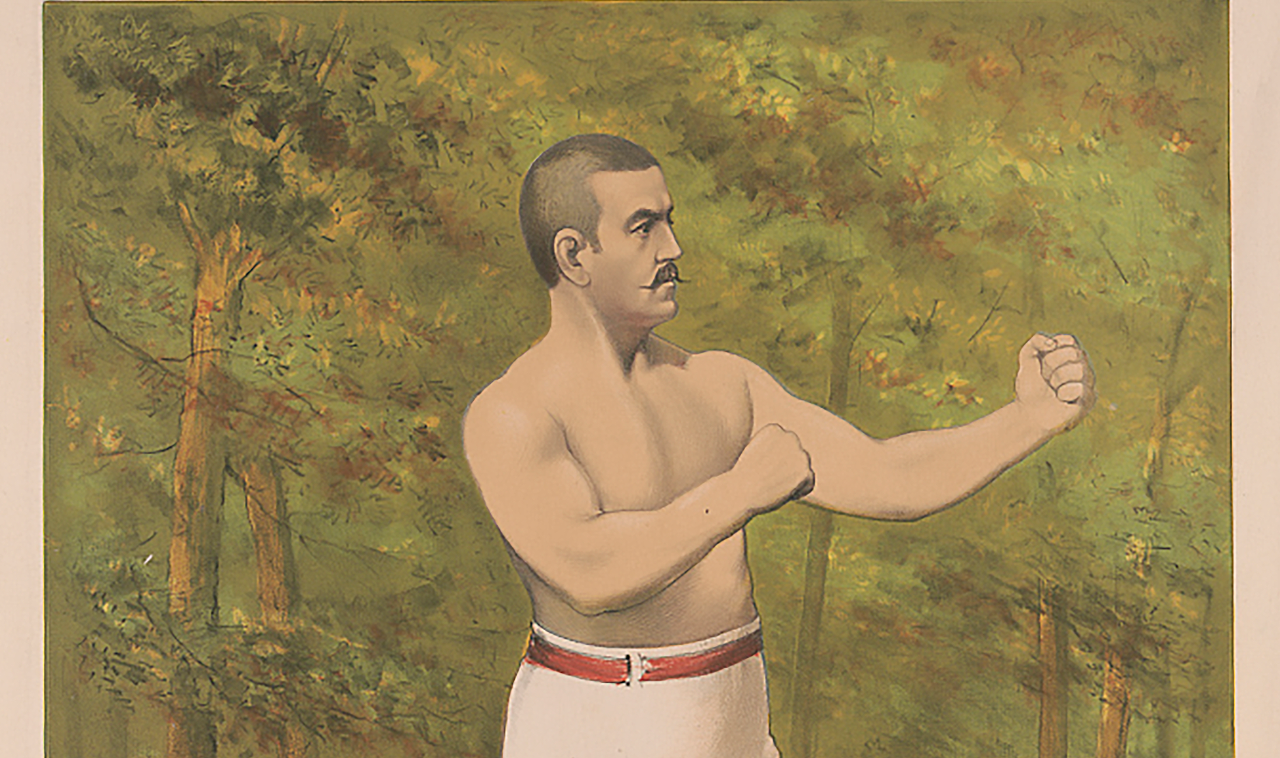
Enthusiasts of “the fancy,” as supporters and detractors of boxing then described it, had filled the city that week to see Sullivan, who had been the champion since 1882. Sullivan was the sport’s first modern champ, holding the title at the time of its transition from bare knuckle brawls to boxing gloves and Marquess of Queensbury rules. He held the championship until 1892 and was almost certainly the country’s most popular athlete and arguably its most famous person. For Irish Americans, he served as a source of collective pride for an immigrant community that was starting to put down roots in their adopted homeland.
Fight fans from all the major east coast cities came by train to Pittsburgh to see the spectacle alongside thousands of local rowdies. Some of the attendees were even of the better sort, according to the Wheeling Daily Register, “solid citizens who all day long had been sitting in banks and mercantile offices in solemn dignity.”
The Sullivan-Herald fight had a wild ending that befit the feral times and place in which it took place. But it wasn’t the first such evening that Sullivan spent in Pittsburgh. Three years earlier, he’d made McKeesport the first stop on a national tour that stretched from Fall 1883 until Spring 1884. Sullivan went from town-to-town challenging local toughs to four-round boxing matches. If Sullivan couldn’t knock his opponent out within four rounds, the challenger would receive $500. In total, Sullivan faced 59 men on the tour and knocked out every one of them. He earned $200,000 (roughly $6.4 million in 2025 dollars) in an eight-month stretch, 50 cent admission fee by 50 cent admission fee.
Sullivan’s knockout tour cemented boxing’s status as one of the country’s leading spectator attractions. He staged fights in big cities, mining camps, and mill towns alike — wherever his manager Al Smith could book a venue. Boxing was banned in many municipalities and in some states altogether. In the wake of Sullivan’s tour, private boxing clubs which held regular “exhibitions” opened in communities across the country to circumvent state and local statutes. Club fighting remained a fixture in American cities great and small well into the 1950s.
The first date on Sullivan’s knockout tour was October 17, 1883, at a saloon in McKeesport, then home of the National Tube Works, which later joined U.S. Steel. McKeesport was just the kind of blue-collar burg where the Boston Strong Boy’s physical prowess would be thoroughly appreciated. Much of the adult male population labored at the Works, and, at the time, the community was heavily Irish.
A local ironworker named James McCoy became the first person to take up Sullivan’s knockout challenge. McCoy weighed just 160 pounds but looked and played the part of a legitimate adversary for the Boston Strong Boy. Nicknamed “Cocky” as well as “Tattoo,” McCoy lived up to both monikers. “Cocky” carried himself with the swagger of a classic 19th century working class dandy — flamboyant in dress and presentation, a grand contrast to the grind of his working life. McCoy was also covered in tattoos. His chest was a menagerie of dragons, snakes, and flowers. Locally, he earned the reputation of a fierce brawler.
Once toe-to-toe with Sullivan, McCoy introduced himself with a punch that had no discernible effect on the champ. Sullivan returned fire with a rapid right and left which dropped “Cocky.” The referee stopped the fight at 20 seconds after McCoy’s friends failed to rouse him from unconsciousness. When he came to, McCoy expressed amazement that anyone could hit so hard as Sullivan. Unhappy customers demanded their 50 cents back given the fight’s short duration. A group of them accosted Sullivan and his entourage as they left the venue while others fished their 50 cents out of the cash box. Nevertheless, the fight proved a major box office draw and presaged a highly lucrative national tour.
More than 40 years later, McCoy got a second shot at fame, though in strikingly grisly circumstances. In 1925, McCoy was 69 years old and working as a night watchman for Carnegie Steel. Ever the dandy, McCoy wore a diamond ring on his left middle finger which had been appraised for $3,000 the previous year (roughly $54,000 in 2025 dollars). One night, he was walking home after a shift at the Duquesne Works when two assailants dragged him into an alley near Kennywood Park. They struggled to remove his diamond ring and resorted to chopping off his finger. Newspaper accounts differ on whether his attackers used a butcher’s knife or a pair of pliers. The assailants took both the ring and the finger. They proceeded to fracture McCoy’s skull as well. The record remains silent on whether McCoy recovered from the attack, or if the assailants were ever captured.
Sullivan made a return visit to McKeesport in 1910. Following his retirement from the ring, the former champion toured the country for years, performing in a stage show based on his life. Bearing little resemblance to his pugilistic self, a 300-pound version of Sullivan would put on a brief boxing exhibition during these performances. In McKeesport, he reenacted the McCoy fight, which suited him well, given its short duration.
By the time of Sullivan’s second and final fight in western Pennsylvania, the champion was at a different place in his career. He had spent more time in bar rooms than gymnasiums in the intervening three years. He’d been arrested on several occasions for drunken mayhem and remained a wanted man in several locales. Sullivan had also put on significant weight, ballooning from 190 pounds to as much as 250 on some occasions. “The Boston Strong Boy” was at the center of several scandals related to his personal life, which were covered extensively in the tabloids of the day.
At the time, many of the country’s leading newspapers refused to cover sports, regarding them as the domain of the lower classes. In the same vein, some papers refused to cover crime, treating such treachery as mere titillation for the uneducated.
Publications like New York’s National Police Gazette gloried in sports and crime stories, finding a massive working-class audience for such coverage. While Sullivan had a long and adversarial relationship with the Gazette, the newspaper’s blow-by-blow coverage of his exploits both in and out of the ring made him a household name.
The Gazette and other such publications cajoled Sullivan to get back into the ring for much of 1886. He hadn’t defended his title since August 1885, when he defeated Pittsburgh’s Dominic McCaffrey at a horse racing track in Cincinnati.
The man most energetically spoiling for a fight with Sullivan was a pugilist named Frank Herald. Newspapers called Herald the “Nicetown Slasher,” a reference to his north Philadelphia neighborhood and the speed with which he delivered blows to his opponents. He had defeated several top ranked fighters on both sides of the Atlantic. Herald’s manager Tom Hughes promulgated the idea that Herald was the number one contender for the heavyweight title and deserved a shot at Sullivan that summer.
Hughes and Al Smith came together and agreed to a September 1886 Sullivan-Herald bout. Initially, the fight was scheduled for early September in Ridgewood Park in Brooklyn but local police refused to grant them a license. Then it was set to take place in mid-September in New Jersey but that too got postponed. Hughes found a taker for the fight in Pittsburgh and boarded Herald on a train for western PA despite no formal arrangement with the Sullivan camp. Several newspapers reported that Sullivan’s camp had used its influence in New York City-area police departments to keep getting the fight postponed. This accusation raised Sullivan’s ire and he soon followed Herald for Pittsburgh.
Originally, Hughes said the fight would take place in Pittsburgh proper, but city officials changed their mind about hosting the event. The fight appeared to be off again until Hughes secured Allegheny City’s Coliseum for the fight. The Coliseum hosted boxing regularly in the late 19th century. During the 1880s and 1890s, this large wooden structure on Federal Street was also known as the Casino Rink, Coliseum Rink, and Grand Central Rink as well. It hosted vaudeville, ice skating, and a range of theatrical performances.
Allegheny City refused to grant the fighters a conventional boxing license. Instead, the city sanctioned a six-round “sparring contest” which would be judged solely on points awarded for tapping one’s opponent. Slugging and knockdowns were prohibited. Bare knuckles would not be allowed. The fighters would have to wear four-ounce gloves (today, gloves are often 16 ounces). The fight would be held in a hastily constructed, 27 square foot ring which was built on the Coliseum’s main stage.
“There will be no police interference providing the law regarding gloves is conformed to,” the Pittsburgh Post asserted. Anyone familiar with boxing in this era knew that such stipulations were rarely if ever followed. They were meant to appease concerned citizens, such as the group of local clergymen that protested the granting of the license to Mayor James Wyman and police chief John Murphy on the morning of the fight. As a cluster of Protestant ministers pleaded in vain to prevent the fight, large crowds met Herald and Sullivan at the train station and paraded with them to the city’s Central Hotel.
Nevertheless, the stipulations meant that Sullivan’s heavyweight title would not be up for grabs that evening since neither the classic London Prize Ring rules or more modern Marquess of Queensbury rules would be guiding the action.
Promoters charged $2 (roughly $64 in 2025 dollars) for standing room, general admission to the fight. Five dollars (roughly $161 in 2025 dollars) earned you a reserved ringside seat. Authorities in Allegheny City insisted on the $2 general admission price to keep out what Murphy described as “objectionable elements.” Several publications noted that if the authorities prevented the fight from taking place at the last minute, a small, private exhibition would be held at an undisclosed location for $15 per head.
Doors opened at 7 p.m. By 8 p.m,, more than 3,000 men had paid their way into the fight. According to Nat Fleischer’s 1951 biography of Sullivan, one unknown woman attended the fight. While they waited for Sullivan-Herald, the crowd enjoyed three preliminary bouts. A conventional boxing undercard was a rarity for a Sullivan fight. Earlier in his career, his opening acts had included competitive shin kicking, cockfighting, Shakespearean monologues, and even the coward Robert Ford reenacting the murder of Jesse James.
While fight fans watched the preliminaries, Hughes and Smith hashed out the details of the contest. Sullivan and Herald sat in a nearby hotel while their managers decided on a referee and the official timekeepers in each fighter’s corner. They agreed to a Pittsburgh-based referee named John Newell while two out-of-town reporters served as timekeepers. Peter Donahue of the New York World kept time in Sullivan’s corner while Eugene Comiskey of the New York Telegram, a longtime Sullivan antagonist, did the same in Herald’s.
Sullivan entered the Coliseum first. The police officers in attendance, all of whom were Irish Americans according to contemporary accounts, raised their hats in honor of the Strong Boy as he walked to the ring.
Sullivan came to the ring in red, white, and blue trunks, a blue robe and blue stockings with black gaiters. The crowd cheered loudly as his cornermen gave him a pre-fight rubdown with fine liniments.
Herald wore nondescript trunks and a plain topcoat to the ring. He received little applause but was not jeered or hissed at by the largely pro-Sullivan crowd. (Booing did not become commonplace at sporting events in America until the 1910s).
By all accounts, Sullivan looked out of shape. Both men stood about 5’11. While Herald weighed between 180 and 185, newspapers reported Sullivan’s weight as anywhere from 205 to 235 pounds, though some stories suggested that his actual weight was likely much greater than what they reported.
The fight began promptly at 10 p.m.
In the first round, Herald tried to stay out of Sullivan’s range. Eventually, Sullivan felled Herald with a blow to the stomach and a follow-up to the face. Herald popped back up and traded blows with Sullivan until the champion grabbed hold of him and started working his body. The referee separated the fighters and called an end to the first round after two-and-a-half minutes. Herald’s corner spent the interim trying to stop “claret,” as the National Police Gazette put it, from leaking out of his nostrils.
Herald danced around the ring to start the second round before lunging toward Sullivan and delivering a volley of punches. Once in Sullivan’s range, the champion landed a pair of blows to Herald’s face, sending him briefly to the floor. When Herald got back onto his feet, Sullivan grabbed a hold of him, punched him in the stomach and barraged his head and neck with punches and forearm blows. Police then intervened to stop Sullivan from killing his opponent. Chief Murphy got between the men and the referee declared Sullivan the winner. The crowd responded with jeers and projectiles. Some attendees decided they ought to enter the ring to give everyone involved a piece of their mind.
A cadre of police officers worked to maintain order with their clubs, trying not only to keep the crowd at bay but also keep the Sullivan and Herald camps from duking it out in the ring. Sullivan went after his nemesis Comiskey, who went for the revolver in his pocket. Police officers disarmed Comiskey before anyone got shot.
Sullivan then asked to address the crowd, which helped restore order. He congratulated Herald for showing “…a great deal of pluck in standing before a man of my talent.” The champion dispelled talk that the fight would be continued at another venue.
He ended his speech with the phrase, “I am yours truly, John L. Sullivan,” to roaring applause. This would become Sullivan’s closing salutation for the rest of his life as a public speaker. After the fight, Allegheny City police escorted the fighters and their camps back to the hotel through a still unpredictable crowd. Sullivan would never again fight in western PA but his pair of Pittsburgh-area bouts figure prominently in the mythology of his life and times.

Clayton Trutor teaches history at Norwich University in Vermont. He is the author of Loserville: “How Professional Sports Remade Atlanta — and How Atlanta Remade Professional Sports”(2022) and the forthcoming “Boston Ball: Jim Calhoun, Rick Pitino, Gary Williams, and College Basketball’s Forgotten Cradle of Coaches” (2023). He’d love to hear from you on Twitter: @ClaytonTrutor.