The Indian Pipe
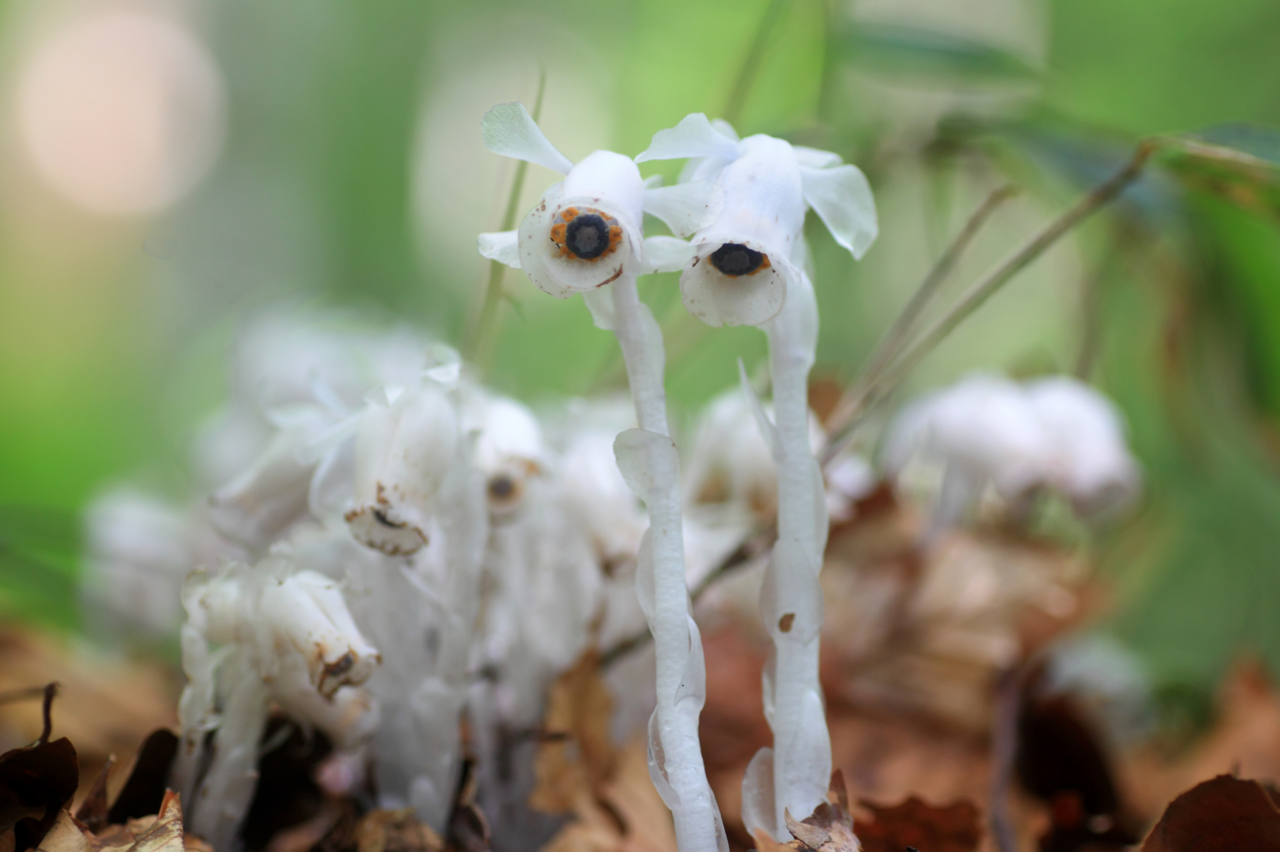
An eerie plant appears in the woods. i bend down and study its translucent white color — ghostly against the vibrant green of mid-summer. The three-inch stems have specks of gray and black, and its tiny leaves resemble scales. Some of the pipe-shaped flowers stand upright, while others droop in a melancholy manner.
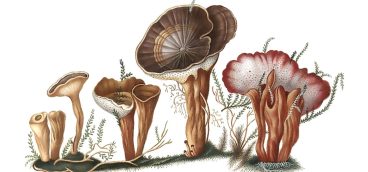
I think it might be a fungus of some sort.
I am wrong. The Indian Pipe (Monotropa uniflora) is a Pennsylvania wildflower. It is also called Ghost Pipe, Corpse Plant and Ice Plant.
I learned that Indian Pipe was a special flower to Emily Dickinson, perhaps her favorite. It was included in her herbarium, and a drawing of it appeared on the front cover of her first book of poems. That drawing was sent to her by Mabel Loomis Todd, a woman Dickinson never met and who didn’t know that Indian Pipe was important to Dickinson. Dickinson wrote to thank the artist: “That without suspecting it you should send me the preferred flower of life, seems almost supernatural, and the sweet glee that I felt at meeting it I could confide to none. I still cherish the clutch with which I bore it from the ground when a wondering Child, an unearthly booty and maturity only enhances mystery, never decreases it.”
Of all the exquisite flowers in the world, Indian Pipe was one of Dickinson’s favorites? What might this tell us about the reclusive poet? Marta McDowell, author of Emily Dikinson’s Gardens, has a theory: “Emily was like Indian Pipes,” she writes. “She relied on family members … for major exchanges with the outside world: necessities, protection and news.”
The Indian Pipe cannot live without the help of others either — specifically, other plants. It has no chlorophyll and cannot photosynthesize so it depends on a milky cap mushroom in the Russulaceae family in order to survive. Through its symbiotic mycorrhizal connection with other plants, the milky cap exchanges nutrients with host trees such as beech, pine and oak, and some of those nutrients are passed back to the Indian Pipe.
Dickinson wrote about the Indian Pipe in a poem “drafted on a fragment of ruled stationery paper in 1879,” according to the Morgan Library.
Tis whiter than an Indian Pipe —
‘Tis dimmer than a Lace —
No stature has it, like a Fog
When you approach the place —
Not any voice imply it here —
Or intimate it there —
A spirit — how doth it accost —
What function hath the Air?
This limitless Hyperbole
Each one of us shall be —
‘Tis Drama — if Hypothesis
It be not Tragedy —
I asked Cristanne Miller to explain the poem to me. Miller is editor of Emily Dickinson’s Poems: As She Preserved Them and co-editor of The Letters of Emily Dickinson. (For the record, Miller said Dickinson loved other flowers also, including violets, roses, jasmine, and even clovers.) The poem, she explained, functions like a riddle:
“What is ‘it’ that is ‘whiter … dimmer,’ hidden, and so on. In the last six lines it appears that this ‘it’ may be a spirit, a ‘Hyperbole’ representing what would probably be the inner life of ‘each one of us.’ We all have our own ‘Drama’ of life — and when we are lucky that drama is not a ‘Tragedy.’”
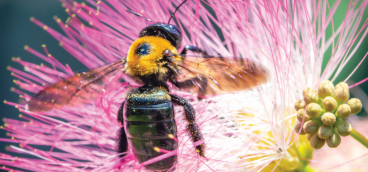
Indian Pipe is being studied right here in Pennsylvania by Eric Burkhart, a professor at the College of Agricultural Sciences at Penn State, and doctoral student Savannah Anez. After seeing Indian Pipe for the first time, people always ask Burkhart: “What kind of mushroom is this?” and for years, scientists believed that Indian Pipes were mushrooms, but now the plant is classified as a parasite. The black and grey and specks, he told me, occur when the plant gets bruised, which can happen if you pick the plant and during pollination, largely done by bumblebees. If you cut it, the white plant will turn completely black within 12-24 hours, he said. The flowers hang down when they first emerge, but as the plant matures, the flowers stand upright. Because the plant doesn’t need sunlight at all, “you often find it in deep moist hemlock stands,” Burkhart said.
Scientists currently surmise that Indian Pipe does not return nutrients either to its mushroom host or the trees, but no one is positive. That’s one area Burkhart and Anez are studying. Using technology called metabolomics, a digital library of molecules, they’re trying to figure out exactly which molecules the plant contains. They’re also studying the plant’s medicinal uses.
Indian Pipe was long thought to be poisonous, though Native Americans have used it as an eye wash and an anti-convulsant. In the last 20 years, the plant also has become popular on the internet as a pain-relieving agent and as relief from psychological trauma, Burkhart said.
In 1889, a single study looked for what are called grayanotoxins in Indian Pipe, which led to the conclusion that the plant was toxic. But the Penn State team did their own study recently, the results of which were published last September in the Journal of Natural Products. “It was the most thorough study ever done on grayanotoxins,” Burkhard said. “We strongly suspect there are no grayanotoxins at this point.”
Burkhart and Anez seek to answer this question: “Do current folk uses, especially for pain management, have any phytochemical explanations?”
I rejoice in what I have growing on this farm, in my own backyard. That it exists here at all, that I was lucky enough to find it, and to discover such interesting facts about the plant — both literary and scientific. I only wish I could know what a famous 19th-century, nature-loving poet might have thought about other people’s fascination with Indian Pipe and the potential medicinal properties of her mysterious “preferred flower of life.”

DARYLN BREWER HOFFSTOT’S book, “A Farm Life: Observations of Fields and Forests” was published recently by Stackpole Books.